
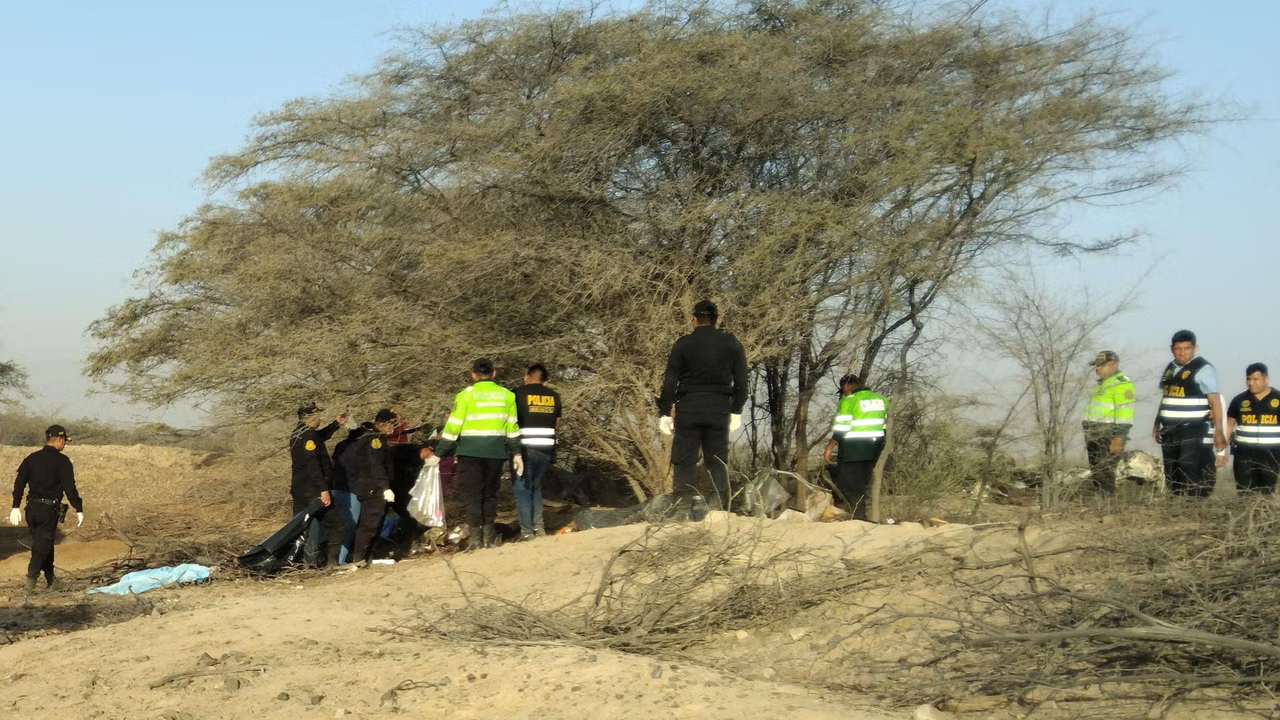
The General Directorate of Civil Aeronautics (DGAC) of Peru has ordered the temporary suspension of operations of the company Aerodiana, as a preventive measure after the accident of a small plane from that company that crashed this Saturday in the province of Nazca and caused the death of 13 people, including tourists from Italy, Spain and Germany.
The measure will remain in force until the investigations are concluded to verify compliance with the provisions, procedures and conditions established in the applicable aeronautical regulations, the Ministry of Transport and Communications (MTC) indicated in a statement. The DGAC is focused on determining whether the operating company complied with current regulations, while the Air Accident Investigation Commission (CIAA) investigates the causes and circumstances of the accident, the Peruvian ministry said.
An emergency call and loss of all contact
The accident occurred around 1:00 p.m. local time (18:00 GMT) on Saturday, approximately two kilometers from the Nazca airfield, after the Aerodiana plane took off around noon from the Pisco airport, in the Ica region, with the aim of flying over the geoglyphs of the Nazca Lines.
In a statement, the Ministry of Transportation and Communications explained that, when the ship, a Cessna Gran Caravan C-208 with capacity for 12 passengers, was flying over the outskirts of the town of Socos, in the district of Pueblo Nuevo, the crew reported an emergency situation to the control tower of the Nazca airfield, after which all radio contact was lost.
Currently, three DGAC Operations and Airworthiness inspectors carry out the corresponding technical and documentary verifications in the area. Likewise, two CIAA investigators have been collecting evidence, interviews, records and other information necessary for the development of the investigation, the statement added.
The CIAA will verify the possibility of locating and recovering the storage card installed on the aircraft, which is a device that could contain records related to its operation and position.
On the other hand, the Ministry of Transportation specified that the Pisco airport, from where the small plane with the tourists took off to fly over the geoglyphs of the Nazca Lines, continues to operate due to its status as an alternate air terminal to the Jorge Chávez airport, which serves Lima and Callao.
The Peruvian Corporation of Airports and Commercial Aviation (CORPAC) reported that the ground-air communications systems at the Nazca aerodrome remained operational during the development of the event, with no interruptions in aeronautical frequencies.
Mechanical problems, a hypothesis of the accident
Likewise, it was confirmed that there are recordings of communications linked to the accident, recorded through CORPAC’s remote system, which are available to be delivered to the competent authorities, in accordance with established procedures.
The Minister of Foreign Trade and Tourism, Rogers Valencia, told reporters from the scene of the accident that “there was a call from the ship to indicate that it had mechanical problems,” which is now under investigation by the Air Accident Investigation Commission.
A couple from Valladolid, the two Spanish tourists killed in the accident
A couple from the Valladolid town of Arroyo de la Encomienda, Alfredo Avilés Muñoyerro, and his wife, Ana Isabel Sánchez, are the two Spanish tourists who died when the plane crashed. Alfredo Avilés and his wife, Ana Isabel Sánchez Muñoz, both 52 years old, are parents of a 21-year-old daughter.
Avilés was a self-employed businessman with family roots in Medina del Campo (Valladolid) who worked as a commercial free agent for furniture decoration, lighting and interior design architecture firms, based in Arroyo de la Encomienda (Valladolid).
