
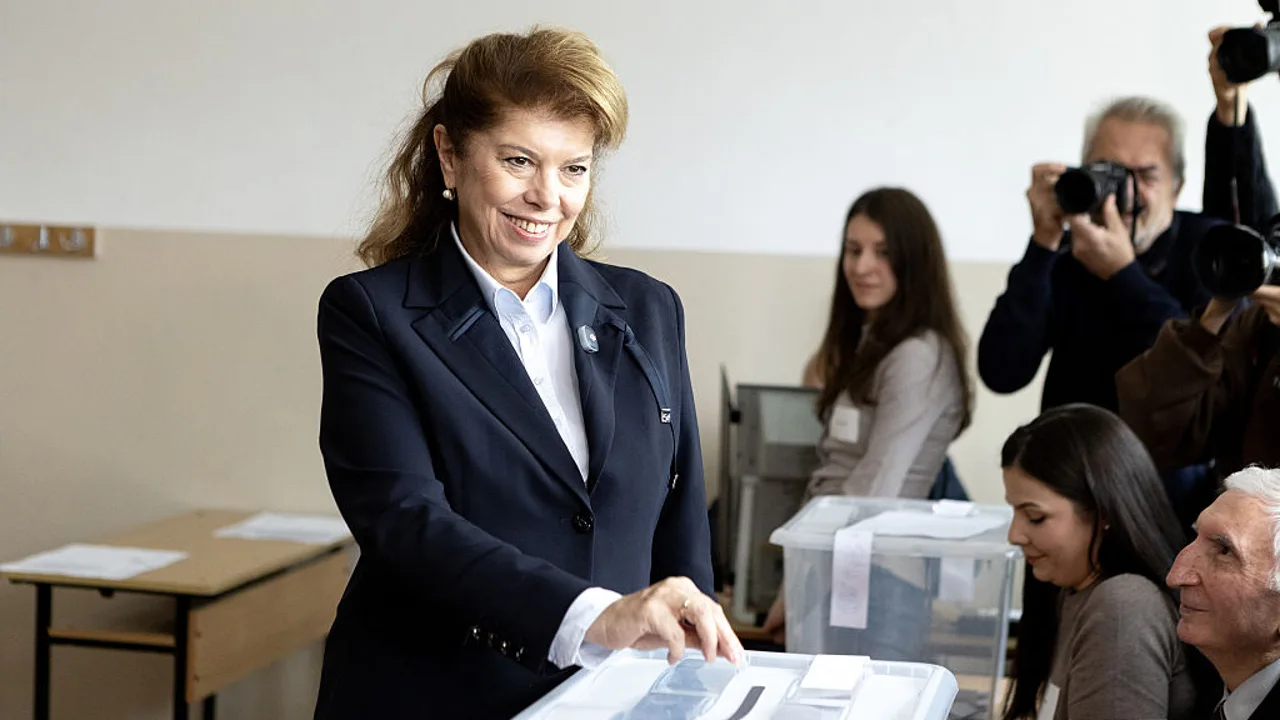
Bulgaria is about to open a new chapter in its political history. Iliana Yotova will become the first democratically elected woman president of the country after clearly winning the second round of the presidential elections held this Sunday, according to preliminary official results.
With 92.39% of the minutes counted, Yotova’s candidacy, accompanied by Kiril Valchev, obtained 1,022,503 votes, equivalent to 57.35% of the votes. His rival, former interim Prime Minister Andrey Giurov, backed by pro-Western opposition forces and accompanied by Georgi Kandev, has obtained 707,310 votes, 39.67% of the total.
For their part, 52,846 voters, 2.96%, have chosen the “I do not support anyone” box. Election day has also been marked by a particularly low turnout, standing at 29.1%.
A triumph with peace as a flag
After knowing the favorable projections, Yotova has proclaimed her victory and has highlighted that her campaign has focused on “income, peace and future challenges.” He also thanked the support received from Progressive Bulgaria, the group linked to the country’s current prime minister, Ruman Radev.
Giurov, for his part, has acknowledged defeat and defended the need to respect the decision of the polls. “This is how Bulgarian citizens voted,” he said.
The campaign has been conditioned by two central issues: the war in Ukraine and the increase in security tensions in the Black Sea, where there has been an increase in drone attacks against commercial ships.
In this context, Yotova has presented herself as a “peace president”, favorable to dialogue with Moscow and close to Radev’s positions. Giurov, on the other hand, has maintained a pro-Western orientation and explicit support for kyiv.
A historic victory with limited powers
The result represents a milestone for the political representation of women in Bulgaria, although the country’s Presidency has more limited powers than those of other European systems, such as the French one.
The head of the Bulgarian state exercises supreme leadership of the Armed Forces, but does not have the power to dismiss the prime minister. Its powers also include the granting and withdrawal of nationality, the appointment of ambassadors and representatives in international delegations at the proposal of the Government, as well as the possibility of vetoing laws and returning them to Parliament for a new review.
Yotova assumed the interim presidency last January, after Radev resigned to run in the parliamentary elections. Now, his electoral victory opens a new stage in the leadership of the Bulgarian State, with peace, relations with Moscow and regional security challenges among the main issues on his agenda.
