
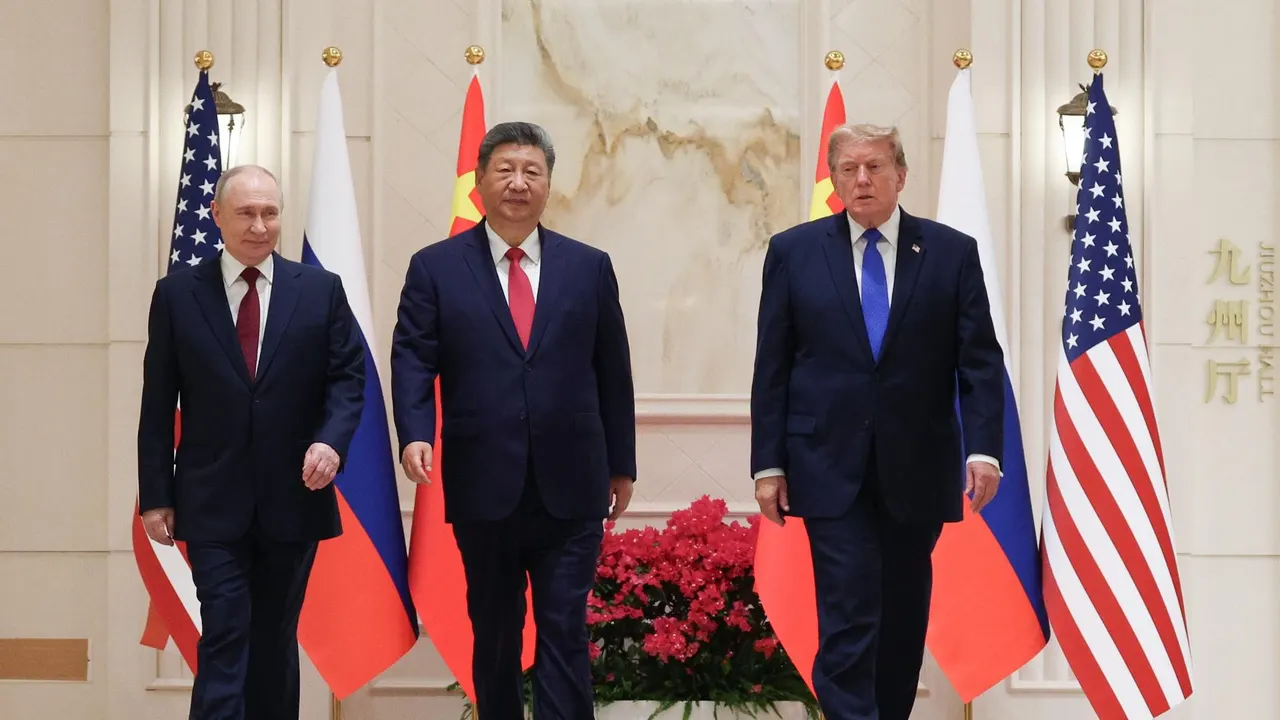
The big international topic of the week has been the summit between Trump, Putin and Xi Jinping in China. It was the first time that the three leaders met at the same table. Some have even spoken of a repeat of the 1945 Yalta conference between Roosevelt, Churchill and Stalin. This is what Putin said about it: “What was wrong with Yalta? That is, what was wrong with it? First of all, in Yalta the victory over Nazism was formalized. I think it would be good to now formalize the victory over neo-Nazism.”
An “empty” and “substantial” summit
But is this comparison accurate and has there really been a Yalta 2.0? As explained by David Gómez and Alba Leiva in The World Order of Julia in the wave“it is an exaggeration”, although it is true that the summit may reflect the return of an international order in which, as in Yalta, the great powers discuss the main international issues, especially at this time of crisis of multilateralism that we are experiencing.
“It seems that a certain logic of concert between powers is being recovered, but the differences are enormous,” explains David. To begin with, for the historical context. “In Yalta, we had the allies meeting to define that international order after the Second World War. Here, there has been neither a shared victory nor a global war conflict; the balance between powers is different because in Yalta, Churchill and Roosevelt gave in to Stalin’s wishes of wanting to control Eastern Europe and in this case, Putin’s Russia does not have that position of strength in Ukraine that the USSR did have with the Red Army,” he explains.
Finally, apart from China, Beijing does not aspire to divide the world into spheres of influence with the United States and Russia, but rather to strengthen its position in the Asia Pacific, but it defends a more multipolar world in which it does not intend for others to prevent it from defending its diplomatic and commercial interests in any corner of the planet. Therefore, I think that notion of traditional spheres of influence is not replicated here.
The results of the summit: concern about the declaration against the ICC
Beyond the symbolism of the photo, what results has this summit left? Has there been any specific agreement or commitment? According to Alba Leiva, it was a summit “with very little substance” in which the only notable thing was a joint declaration signed by the three leaders. A statement in which, despite the fact that the most important issues on the agenda were left out (war in Iran and nuclear disarmament), it was “quite interesting” in the points it reflects:
- Reform the UN.
- Increase production and supply of refined petroleum products.
- Dialogue to reduce nuclear risks (although without a specific agreement, they simply agree to do so).
- Defend the sovereignty of states against the jurisdiction of the International Criminal Court.
This last point is “especially significant” because the International Criminal Court is the court that judges war crimes, genocide or crimes against humanity and Putin has an arrest warrant from the International Criminal Court for alleged war crimes in Ukraine. A “very worrying” point because, as Julia Otero explains, “they definitely want to put an end to it, to the great instrument that guaranteed peace on the planet after 1945.”
“Of course, it means putting an end to those courts that ensure that leaders who comment on these types of crimes or favor them are prosecuted and that is not the case,” explains Alba Leiva.
The war in Iran and the conflict in Ukraine, the main forgotten ones
However, the joint statement does not mention either the war in Iran or the conflict in Ukraine, which was one of the most sensitive issues before the summit. Despite this, Trump did not seem very concerned about this issue: “We sell material to the European Union and they do what they want with it. I guess they give it, mostly, to Ukraine. It’s a shame, it’s very sad, but it doesn’t affect us. In fact, we charge full price. We don’t give discounts. So you could say we make a lot of money from it,” he said.
Why hasn’t Ukraine been an important topic in this meeting if it is the most important thing for Europe? David Gómez explains that Putin “has always wanted to negotiate directly with Trump and Xi a peace agreement favorable to Russia outside of Ukraine and the European countries that, evidently, were not at this table. In fact, Putin was the main promoter of this trilateral summit, so he was interested in this format. But neither Trump nor Xi had any interest in addressing this Ukrainian issue, first because Washington preferred to deal with this issue separately in those Abu Dhabi talks between Russia and Ukraine mediated by the US; and secondly, China maintains a strategic relationship with Moscow, but does not want to commit to Russian demands or take responsibility for those negotiations.
One of the basic principles of Chinese foreign policy is the defense of sovereignty, of the territorial integrity of states, and that is an uncomfortable element in the face of those countries in the global south. In addition, Beijing also fears that aligning fully with Putin will erode those commercial relations that it maintains with Europe and that are important for the Asian giant: “We must not forget that this conflict provides China with certain geopolitical advantages, such as fueling those divisions in NATO and in the West or reinforcing Russian dependence on Beijing because Russia is a country that has increasingly increased its dependence on China.” In the end, what China was most interested in at this summit was to project an image of diplomatic success, of “we are the global geopolitical center,” of a certain understanding between the three powers and not delve into those underlying differences.
Who emerged victorious from the trilateral summit
For Alba Leiva, the big winners of the summit have been Putin and Xi Jinping. The first for three ideas:
- Because in the end the summit consolidates the idea that Russia has stopped being that international pariah for the invasion of Ukraine, but that photo of the three leaders makes it clear who Washington is going to prioritize sitting down to negotiate with or what interests it is going to take into account.
- For the joint statement on the ICC, which leaves Putin in a very good position.
- The fact that nothing more has been confirmed about Ukraine also benefits him.
As for Xi Jinping, the important thing is the narrative because China is the third great power capable of sitting down with the other two, imposing its conditions and inaugurating or saying that it is inaugurating a new international order. And although beyond the clarification the summit has become much emptier, what matters to Xi is to project that they also rule or that they rule more than the US.
Can we say then that Trump is the big loser of this summit? “It is true that he has not managed to involve China with Iran, which was one of his objectives, but he has achieved the declaration on nuclear weapons and he can turn that photo into an argument that the US continues to paint something in the world and build the new world order, but it is true that it is a weakness adapted to the circumstances rather than a strength,” explains Alba.
