
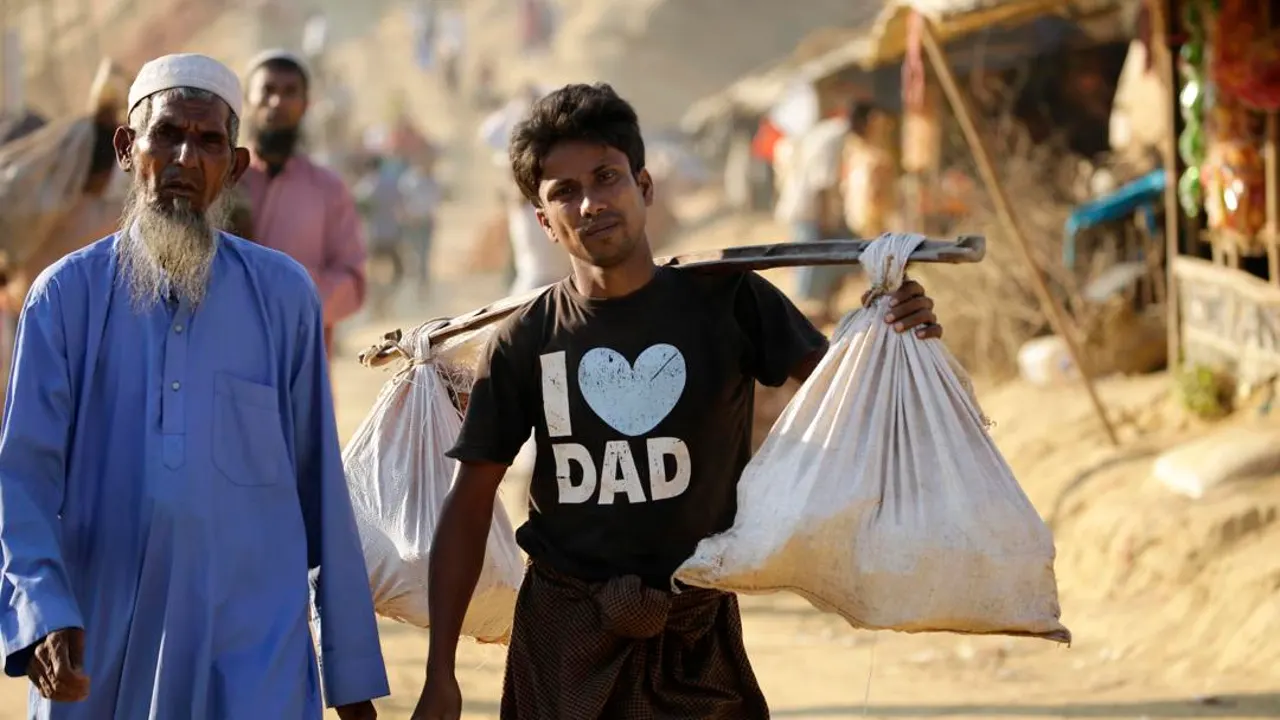
The International Court of Justice (ICJ) concluded this Thursday that Burma (Myanmar) acted with the “intention of destroying a substantial part” of the Rohingya Muslim minority during the 2017 military offensive in the west of the country, in which it considered proven mass murders, sexual violence, attacks against minors and measures aimed at preventing births in this community.
The highest court of the United Nations determined that, after examining all the evidence, “the only reasonable conclusion” that allows to explain Burma’s actions is that there was an “intention to destroy” a large part of the Rohingya population in northern Rakhine State.
This conclusion is fundamental to legally establish the existence of genocide, since the Genocide Convention requires demonstrating not only the commission of certain acts, but also the “intention” to destroy, in whole or in part, a national, ethnic, racial or religious group.
According to the ruling, Burmese security forces committed “indiscriminate killings,” separated and executed men, and perpetrated widespread acts of sexual violence during military operations in 2017.
The judges considered that the evidence supports the estimate that some 10,000 people from this minority were killed during the offensive, in which Burmese forces also committed “acts of extreme violence against minors” and attacked those who tried to flee to neighboring Bangladesh.
The Court also considered it proven that Rohingya villages were “systematically destroyed” and replaced by permanent infrastructure, while the areas were repopulated with people outside this minority.
Likewise, the judges determined that the military offensive caused “serious physical and mental harm” to a very large number of Rohingya and that Burma imposed measures aimed at “preventing” births within this community, conduct also prohibited by the Convention against Genocide.
The 2017 offensive caused more than 700,000 Rohingya to flee to Bangladesh and other countries.
This Muslim minority has been subjected to discrimination and rights restrictions for decades, including the lack of recognition of their citizenship by the Burmese authorities.
The Gambia filed the complaint before the ICJ in 2019, with the support of the Organization of Islamic Cooperation, and eleven other countries subsequently intervened in the procedure.
During the hearings held last January, the Gambian delegation argued that the evidence demonstrated an intention to destroy the Rohingya in whole or in part and presented testimonies from survivors, who testified behind closed doors for security reasons.
Myanmar rejected the accusations and maintained that the military operations in 2016 and 2017 responded to attacks by the Arakan Rohingya Salvation Army (ARSA), which it described as a terrorist group.
The case seeks to determine whether Burma, as a State, failed to comply with its international obligations to prevent and punish genocide, and not to criminally prosecute specific soldiers or leaders.
If the accusations against Burma are confirmed, it would be the first time that the ICJ confirms the responsibility of a State for genocide, the most difficult crime to prove at a legal level, especially due to the need to prove the intention to destroy part or all of the national, ethnic, racial or religious group in question.
The sentence, whose reading is still ongoing and will be one of the longest in the history of the court, will be final and without the possibility of appeal.
