
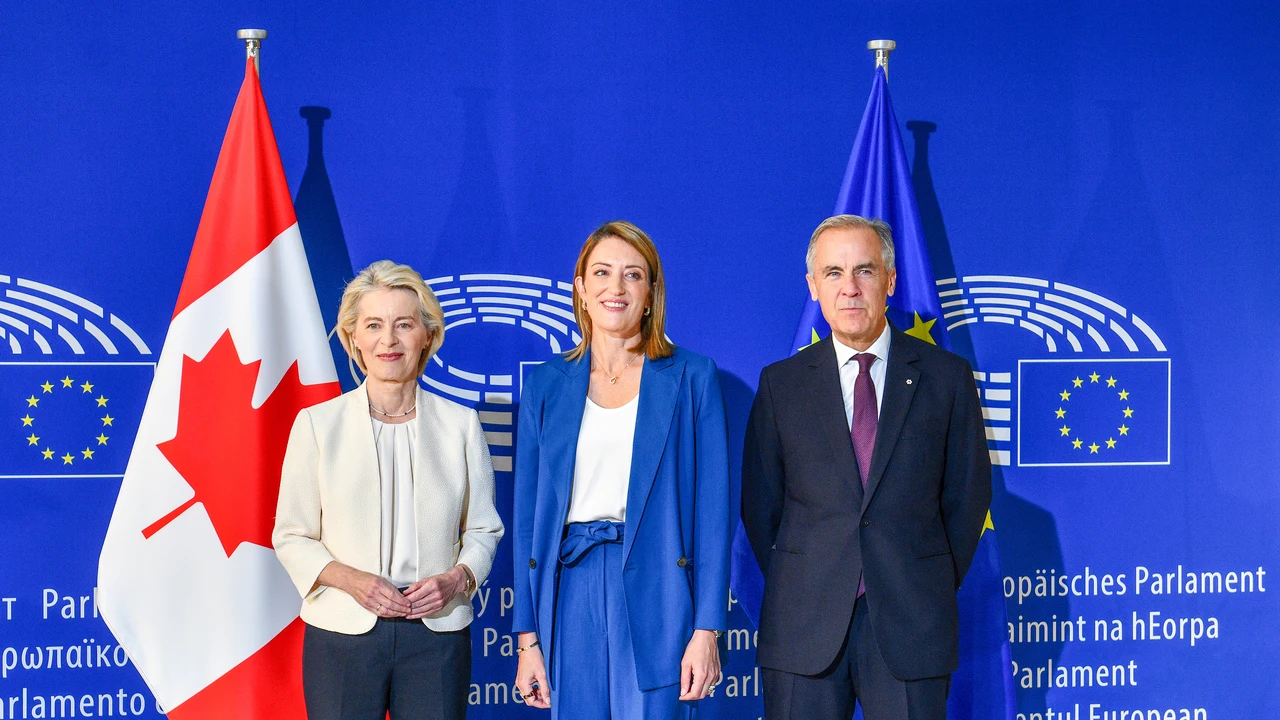
European Commission President Ursula von der Leyen has proposed that Canada become the first “associate member” of the European Union, a status that does not currently exist in community treaties. The initiative seeks to strengthen cooperation between both territories in areas such as defense, energy, technology, artificial intelligence and critical minerals.
The proposal was raised by Von der Leyen during her State of the Union speech held this Wednesday in Strasbourg, with the Canadian Prime Minister, Mark Carney, present in the European Parliament. The president of the Commission assured that she wants to “open the door” for Canada to be the first country to acquire this new status.
Carney has welcomed the proposal and has defended a closer relationship between Canada and Europe. This Thursday, before the European Parliament, he stated that “Europe and Canada are stronger together,” in a context marked by the deterioration of relations between Ottawa and Washington.
What does it mean to be an “associate member” of the EU?
The first issue to clarify is that Canada would not become a Member State of the European Union. In fact, the figure of the “associate member” is not currently contemplated in the European treaties and would have to be legally defined before it could be applied.
The objective would be to create an intermediate formula between the relationship that the EU currently maintains with third countries and full membership of the community club. The proposal aims to allow for much deeper cooperation without Canada having to become a member of the Union.
The rights and obligations that this new status would have are still not known precisely. Its scope would have to be negotiated by Canada and EU member states and, depending on how it is designed, could require changes to the community legal framework.
The initiative aims to go far beyond the commercial sphere. Brussels and Ottawa work on a strategic relationship that includes defense and security, energy, artificial intelligence, technology, education and critical raw materials.
Why now?
The proposal comes at a time of tension between Canada and the United States, its main economic partner and neighbor. The Government of Mark Carney has sought to reduce Canadian dependence on the United States and diversify its commercial and strategic relations.
US President Donald Trump has reacted negatively to the possibility of a closer partnership between Canada and the EU, going so far as to warn of possible tariffs if Ottawa moves in that direction.
A process that is still in an initial phase
At the moment, Canada is not yet an associate member of the European Union. What exists is a political proposal from the European Commission that must now be materialized and receive the necessary support from the Member States.
Brussels and Ottawa plan to continue talks on this new relationship, with an EU-Canada summit scheduled for October in which they could advance the details of the future alliance.
Ultimately, the “associate member” would be a new category of relationship with the EU, yet to be defined, which would allow Canada to significantly strengthen its ties with Europe without becoming one of the 27 Member States. The proposal thus opens up an unprecedented formula for the European Union to establish a particularly deep association with a country located outside Europe.
