
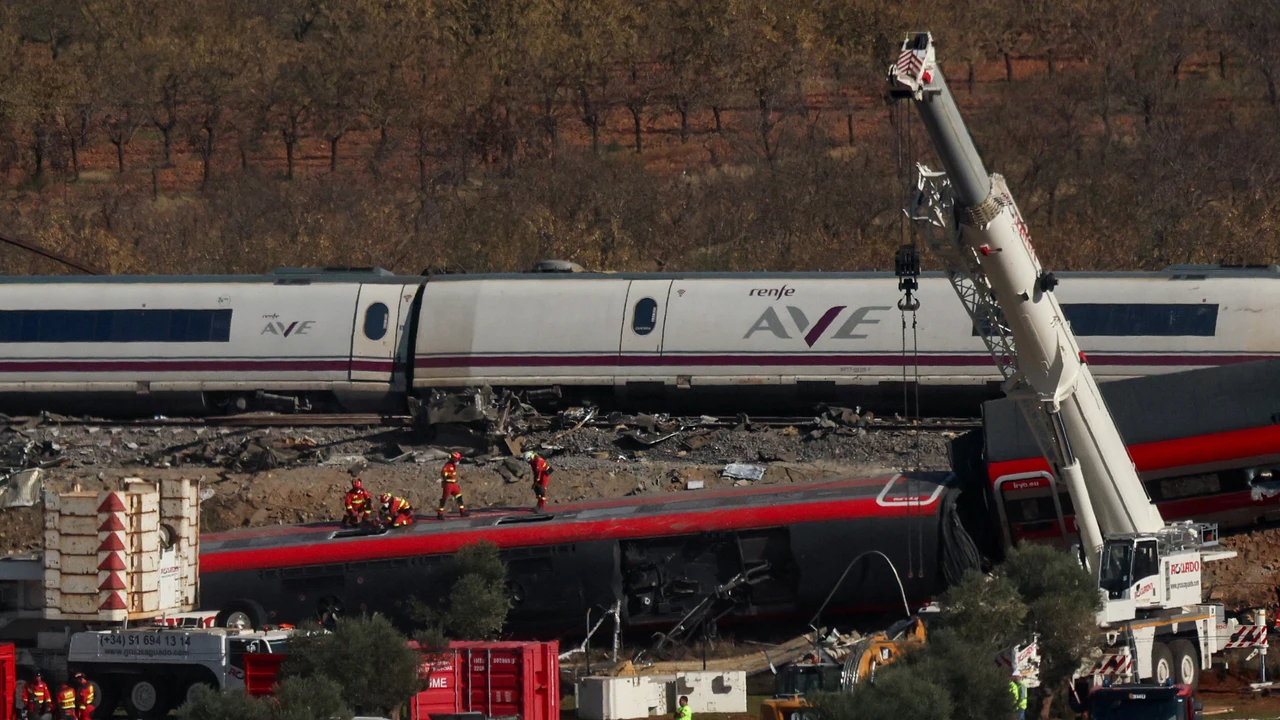
Four days have passed since the tragedy in Urda (Toledo), which cost the lives of 69 people. Late this Saturday, forensic doctors and specialists from the Civil Guard had already identified 56 of the deceased, including all the Spanish fatalities. The remaining 13 would be foreign citizens whose identification is pending actions in the field of international cooperation.
At an international level, the incident is also being monitored very exhaustively. The accident has had a great global impact because Spain is a country that receives a lot of tourism and the catastrophe has reached the front pages of half the world. For this reason, Blas Moreno has compiled in The World Order of Julia in the wave how the international headlines have reported it and analyzes whether this is going to have a negative effect on the image of Spain as a country.
Spain’s international image casts doubt on the system
The world press has been very attentive to the accident, but not only in those countries that touch us most closely, such as the European ones, but also in more distant ones, such as India or Australia, where it has been covered extensively. Always with respect for the victims and paying attention to comparisons. For example, in France, “they wondered if something similar could happen there and the conclusion is that the system is similar and yes, it could happen there too.”
Regarding the image of Spain, the international expert does not believe that the accident will be a “blow in the short term”, since “tourists are not going to stop coming”: “I do not think that people will cancel a trip they had planned to a country due to the accident and nor that we will lose contracts at the level of infrastructure construction.” But it is true that the tragedy “casts an image of doubt about the system in general because it is also related to the end of the legislature or corruption. They are somewhat mixed messages that cause the image of Spain to be compromised.”
What could happen, and which has not yet happened, but is about to happen, he assures, is “that it be used as a weapon against Spain.” He explains that they have not yet asked the president of the United States, Donald Trump, about this, but “I imagine that, as soon as Trump is asked, he will say something pretty bad about Spain.”
China and Japan, the two countries with the most high-speed roads: have they had accidents?
During the conversation with Julia Otero we also wanted to compare how the railway system works in the two countries that have the most kilometers of high-speed rail lines next to Spain. These are China and Japan (Spain is also in the top 3). Have they had accidents of this magnitude there?
Blas Moreno explains that in Japan, no. The most iconic train there is the Shinkansen, the Japanese bullet train, and in that country, a pioneer in high speed, no passenger has died due to a crash or derailment since the system was inaugurated in 1964, despite the fact that Japan is the third country with the most high-speed kilometers. In total, there have been four deaths on these trains, but none of them by accident.
As for China, the country with the most kilometers of tracks with 45,000 kilometers of network, there was a major accident in 2011, when two trains collided on a viaduct. 40 people died and 170 were injured. The investigation attributed the accident to a design defect. This design has since been improved and a new railway safety regulation was approved in 2013. Since 2011, no serious accidents have occurred.
