
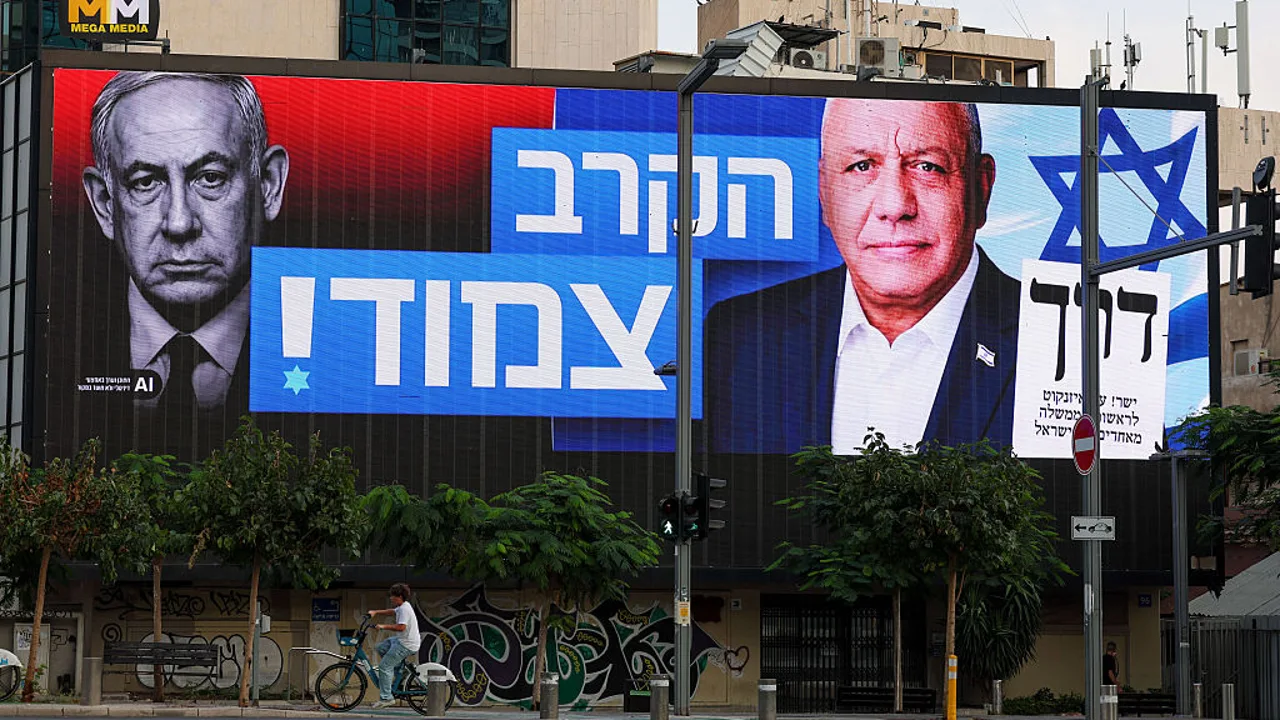
The legislative elections held in Israel have led to a scenario of political blockade that threatens the continuity of Benjamin Netanyahu at the head of the Government, although it still does not guarantee his departure from power. The exit polls broadcast by the main Israeli television networks show a fragmented Parliament, without a sufficient majority for neither of the two large blocs to easily form a Government.
The first projections place the bloc led by Netanyahu at around 51-52 seats, while the opposition formations led by former Chief of the General Staff Gadi Eisenkot would obtain approximately 49-51 deputies, according to the network that makes the estimate. The differences between the polls prevent establishing a definitive winner and force us to wait for the official scrutiny.
The decisive figure is the 61 seats that any coalition needs to achieve an absolute majority in the Knesset, the Israeli Parliament, made up of 120 deputies. Neither of the two blocs seems to have, for now, a simple way to reach that threshold without resorting to agreements with other formations.
The provisional results thus point to a setback for Netanyahu, but also to an incomplete victory for his adversaries. The possibility that the prime minister remains in office while a new coalition is negotiated, or even until other elections are called, keeps political uncertainty open.
Eisenkot capitalizes on Netanyahu’s wear and tear
Former Chief of the General Staff Gadi Eisenkot has established himself as Netanyahu’s main rival by presenting his candidacy as an alternative leadership and an opportunity to open a new political stage. His speech combines a firm position on security with criticism of the management of the current Executive and its political responsibility for the failures that preceded the Hamas attack on October 7, 2023.
Eisenkot has interpreted the electoral projections as a sign of rejection of the continuity of the current prime minister and has defended the formation of an alternative government. However, his ability to convert that result into a parliamentary majority remains uncertain: the parties that oppose Netanyahu maintain ideological and strategic differences that could complicate negotiations.
Netanyahu, for his part, has vindicated the position of his party, the Likud, and has demanded the formation of a right-wing national government. Although the projections place his formation as the individual force with the most votes, the result of his allies does not seem sufficient to ensure the continuity of the coalition that his Executive has supported.
The distinction is important: being the party with the most seats does not necessarily equate to being able to form a government. In the Israeli parliamentary system, the outcome depends on the ability of the various parties to rally support and build a viable coalition.
Participation reaches its highest level in more than two decades
One of the most notable data of the day has been the high electoral mobilization. According to Israel’s Central Election Commission, turnout stood at 77.7%, approximately seven percentage points higher than that recorded in the 2022 elections and at its highest level since 1999.
The turnout at the polls reflects the importance that many citizens attribute to these elections, held in a context of strong political and social polarization. National security, responsibility for the failures that allowed the October 7 attack, the war in Gaza and the subsequent conflicts have conditioned a campaign in which the balance of Netanyahu’s leadership has occupied a central place.
Participation has also been especially strong among Israel’s Arab citizens, who make up about a fifth of the population. Its mobilization could have direct consequences on the distribution of seats and on the possibilities of the different forces to achieve a parliamentary majority.
During the day, delays were reported in several polling stations in Arab towns. The Association for Civil Rights in Israel requested an investigation into whether these delays could be making it difficult to vote. These complaints must be distinguished from irregularities that could be officially proven: by themselves, they do not prove that electoral manipulation has occurred.
The increase in participation also does not allow us to conclude, without definitive disaggregated data, which block has benefited the most. Its effect will depend on the distribution of the votes between the candidates and how many exceed the electoral threshold necessary to obtain representation.
Arab parties can become decisive
Projections attribute to Arab parties between 17 and 19 seats together, depending on the poll. If figures of that magnitude are confirmed, these candidacies could play a decisive role in the negotiations after the elections.
However, its potential influence faces a major political obstacle. Both Netanyahu and Eisenkot have expressed reservations or rejected the possibility of incorporating Arab parties into their respective government coalitions. This position reduces the options of reaching a conventional majority, although it does not eliminate all alternatives.
One of them would be the formation of a minority government that received external support from certain parties or that could pass a parliamentary vote thanks to its abstention. This possibility would depend on the political conditions demanded by the Arab formations and the willingness of other opposition parties to accept that formula.
The result also increases the negotiating weight of religious and nationalist formations. Ultra-Orthodox parties and radical right forces allied with Netanyahu could demand political, budgetary or legislative concessions in exchange for supporting a new Executive.
According to projections collected by the Israeli press, the parties of Itamar Ben-Gvir and Bezalel Smotrich would jointly obtain around 13 seats. Although the result would represent a setback with respect to the expectations that had accompanied some of these parties, their ability to influence the formation of the Government will depend on the final parliamentary arithmetic.
October 7 and subsequent wars mark the vote
These elections are the first at a national level since the Hamas attack on October 7, 2023, which triggered the war in Gaza and opened a stage of regional confrontations with repercussions in Lebanon and Iran.
The balance of the Israeli military response, the hostage situation, the security of communities near Gaza and political responsibility for intelligence failures have been central elements of the electoral debate. Netanyahu has defended his decisions and the results of Israeli military operations, while his adversaries have questioned his leadership and the government’s ability to guarantee the country’s security.
The campaign has also been developed amid international criticism of Israel’s actions in Gaza and the deterioration of its relations with some of its foreign partners.
Eisenkot has tried to take advantage of the prime minister’s wear and tear without presenting himself as a candidate in favor of a radical break with Israeli security doctrine. His military career and his firm positions against Hamas allow him to compete for the vote of sectors that question Netanyahu, but also consider national defense a priority.
This combination helps explain why the elections have not resulted in a simple division between supporters of a tough security policy and advocates of a more moderate alternative. The main electoral confrontation also revolves around who should lead the country and who deserves to take responsibility for the events of the last three years.
