
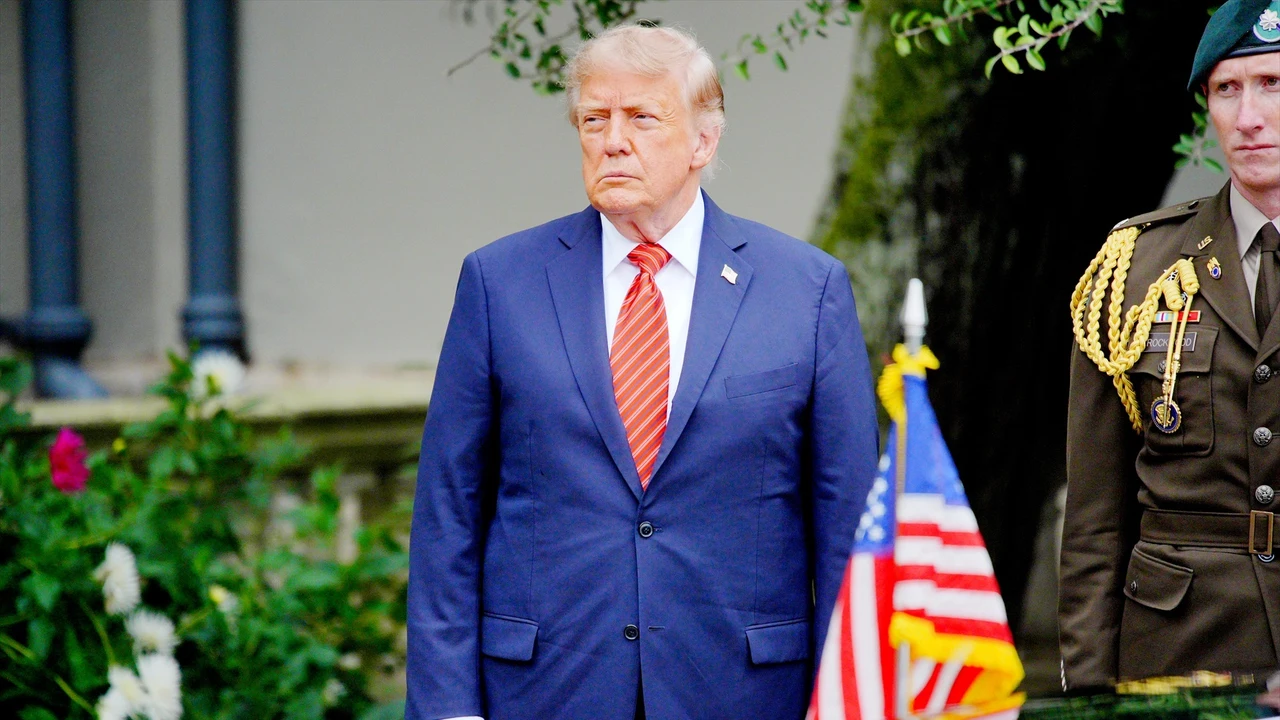
The President of the United States, Donald Trump, announced this Friday a security agreement with Greenland, an autonomous territory of Denmark, which in practice would consolidate the permanent US military presence on the Arctic island and would completely veto the presence of China and Russia.
The agreement, described by Trump himself as “historic”, will be signed next week, during the UN High Level Week in New York, and requires parliamentary approval from both Greenland and Denmark.
The announcement comes after earlier this year Trump caused a crisis in relations with Greenland, Denmark and the rest of NATO countries by suggesting the possibility of invading the island, considering it a strategic objective for the security of the United States.
What is in the agreement?
Although the full content of the agreement has not yet been released, US sources assure that it guarantees the United States a permanent role in the security of Greenland and that any adversary of Washington will be prohibited from having a military presence or unauthorized investments on the island.
According to Washington, the pact gives the United States the ability to “do what is necessary in Greenland” to ensure the security of the island and the United States, including a permanent presence on the island and overflight rights, in addition to allowing an increase in the number of US bases if necessary.
Currently, the United States only has one military base on the island, Pituffik, after decades of reducing its presence, although Danish authorities have indicated that this policy was a decision by Washington.
The new agreement explicitly prohibits the presence in Greenland of bases of any country that is not part of NATO, so neither China nor Russia could establish bases or deploy troops on the island.
The pact, also according to Washington, is permanent and will continue to apply even in the event of eventual independence of Greenland, whose people have the right to self-determination from Denmark.
What do Denmark and Greenland say?
The Danish and Greenlandic governments confirmed in a statement that they intend to sign an agreement with the United States next week to “strengthen security” on the Arctic island, of which they did not offer further details.
Danish Prime Minister Mette Frederiksen welcomed the “good prospect” of an agreement that “strengthens common security” and, at the same time, “recognizes the sovereignty and territorial integrity” of Denmark and the “right of the people of Greenland to self-determination.”
In the same note, Greenland Prime Minister Jens-Frederik Nielsen added that the agreement “recognizes the interests” of the island, as well as its “place in international cooperation.”
Why now?
Greenland, with about 56,000 inhabitants and considered the largest island in the world, has gained strategic importance due to increased competition in the Arctic, melting ice, which opens new sea routes, and interest in its mineral resources, including critical materials.
Washington fears that Russia will expand its military activity in the region and that China will gain influence through investments in mining, ports, airports or telecommunications.
Trump, who already showed interest in the island during his first term (2017-2021), generated a crisis at the beginning of this year by insisting on buying it or even militarily invading it, something that was rejected by both Nuuk and Copenhagen and that put NATO in a delicate situation, given that the alliance would have to protect that territory in the event of a US attack.
In January, the Republican announced a framework agreement to reach an understanding and, since then, he has toned down his rhetoric on the island, until the announcement of the final agreement this Friday.
