
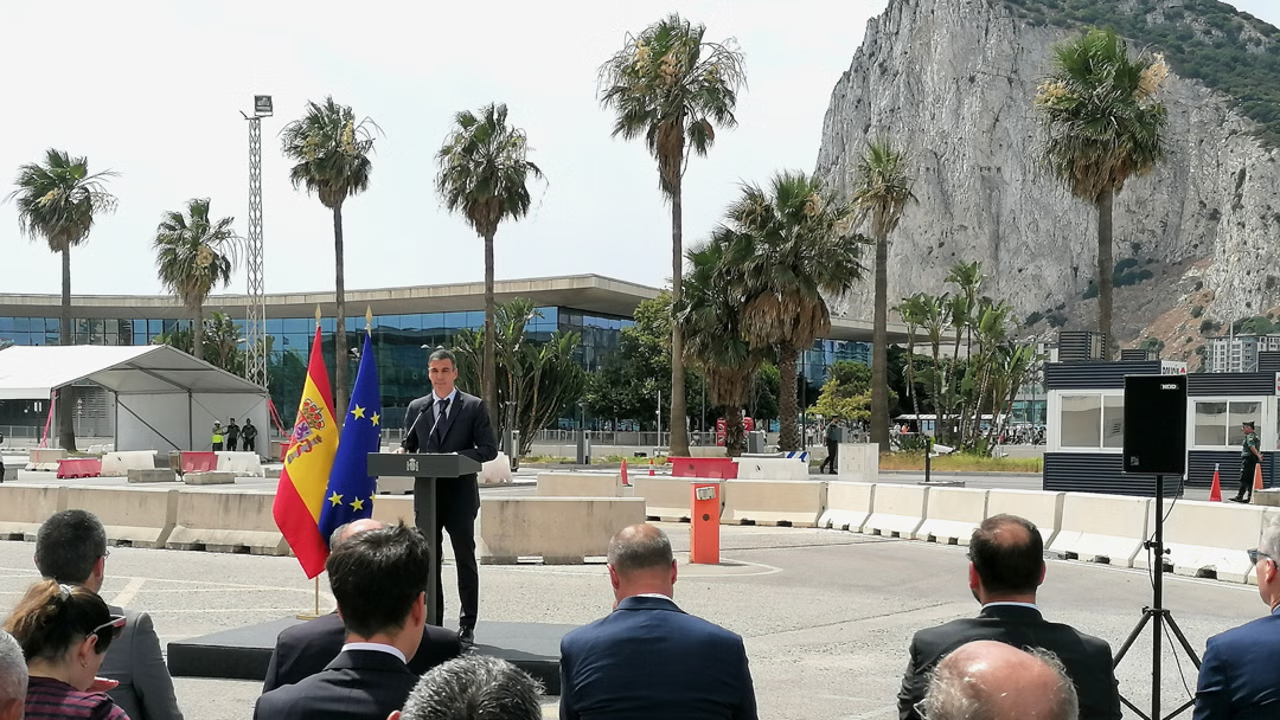
On July 15, we experienced a historic event: the removal of the fence that separates Spain from Gibraltar, news that a few decades ago would have made headlines around the world and that, due to the speed of information that currently exists, has not had much weight in the daily news.
Fernando Arancón and Alba Leiva appear surprised in The World Order of Julia in the wave for the little impact that the news has had because it really represents a “historic change for relations between both countries.” The fence was built between 1908 and 1909 as a hard border in the area of Gibraltar, which was a neutral and demilitarized zone, but over time and de facto it ended up mostly by the United Kingdom and a piece by Spain (the northern side).
They explain that this hard border would be to control the traffic of people and goods, and now, with the change, what is done is that “it moves to another place; that is the important thing.” What Gibraltar does is integrate into two spaces:
- Schengen Area: free transit and parallel to the European Union.
- Community Customs Union: from now on it covers Gibraltar.
And what does this imply? That the border between Spain and Gibraltar will be free transit and will move to the Gibraltar airport and port to control the entry of passengers. For this reason also, “the Civil Guard and the National Police will be present in those places as representatives of that Customs Union and Schengen area to control that area together with the Gibraltar police.”
This is practical, but symbolically “there is much more and it is an important part.” In the end, “integrating Gibraltar more clearly with the Campo de Gibraltar region makes the reestablishment of a hard border much more difficult, if not impossible, because the border continues to exist and a very obvious point of friction between Spain and the United Kingdom is also eliminated.”
The trigger was Brexit
How did it get to this point? Because the issue of Gibraltar has always generated a lot of tension with the United Kingdom, even more so in the context of Brexit. To understand the magnitude of the tensions, the Spanish Royal House did not attend Charles’s wedding with Diana of Wales because, precisely, they were beginning their honeymoon in Gibraltar.
The trigger for this agreement “was Brexit”, an essentially English phenomenon (Scotland voted in favor or Gibraltar). The departure generated a problem for the border adjustment of many British territories outside the island of Great Britain. The most obvious case is Northern Ireland, but there was also Gibraltar because when it left the European Union, it became a much harder border.
This was “very harmful” for places like Gibraltar or the surrounding region because they had the “incentive to reconnect with Spain” and it was good for Spain to attract Gibraltar, so the British Government would only lose if it did not facilitate the negotiation. “Hence, London has let Gibraltar do its thing and no British government has placed too many obstacles,” they explain.
The impacts of the agreement
The images we have seen of people celebrating being able to cross without having to carry their ID or passport are of great joy or relief, but who benefits most from the agreement? What impacts will it have on the Campo de Gibraltar territory in the future?
On the Spanish side, the benefit is very evident. Let’s think that “Gibraltar already had obvious problems, such as housing. What is going to happen is that Gibraltar is going to outsource the entire issue of housing and economic dynamism in the surrounding Spanish municipalities. In fact, La Línea approved a new general urban planning plan to build housing in anticipation of the enormous number of workers that a Gibraltar without so many barriers with Europe will bring,” they say.
Gibraltar airport until now only had flights with the United Kingdom, which was allowed. Now, with this new agreement, “you will be able to have flights with other Spanish and European airports.” Flights from all over the world will be able to come. The nearest airports are Jerez, which mainly serves Cádiz, and Malaga. The entire area of Tarifa, Sotogrande, Zahara “has gained an airport that will surely bring many tourists and commerce to the area.”
It will be necessary to see if this dynamism is transferred to “ports like Algeciras”, which is on the other side of the fence, which is one of the most important in Spain, and which in recent times has been having a hard time getting started.
Does taxation change?
And also the element of taxation, because “Gibraltar used to be positioned as a tax haven that no longer qualifies for any OECD or EU list”, but in practice it continues to have tax levels much lower than the Spanish ones, which generates unfair competition. Therefore, any profit obtained outside of Gibraltar is exempt from taxation and for Gibraltarians, the maximum personal income tax is 28% and corporation tax is 15%. In Spain, this is almost double.
“We will have to see the dynamics of how this new taxation will fit together; although the agreement raises those rates a little, it will be a challenge in the future that will redefine the region,” they conclude.
