
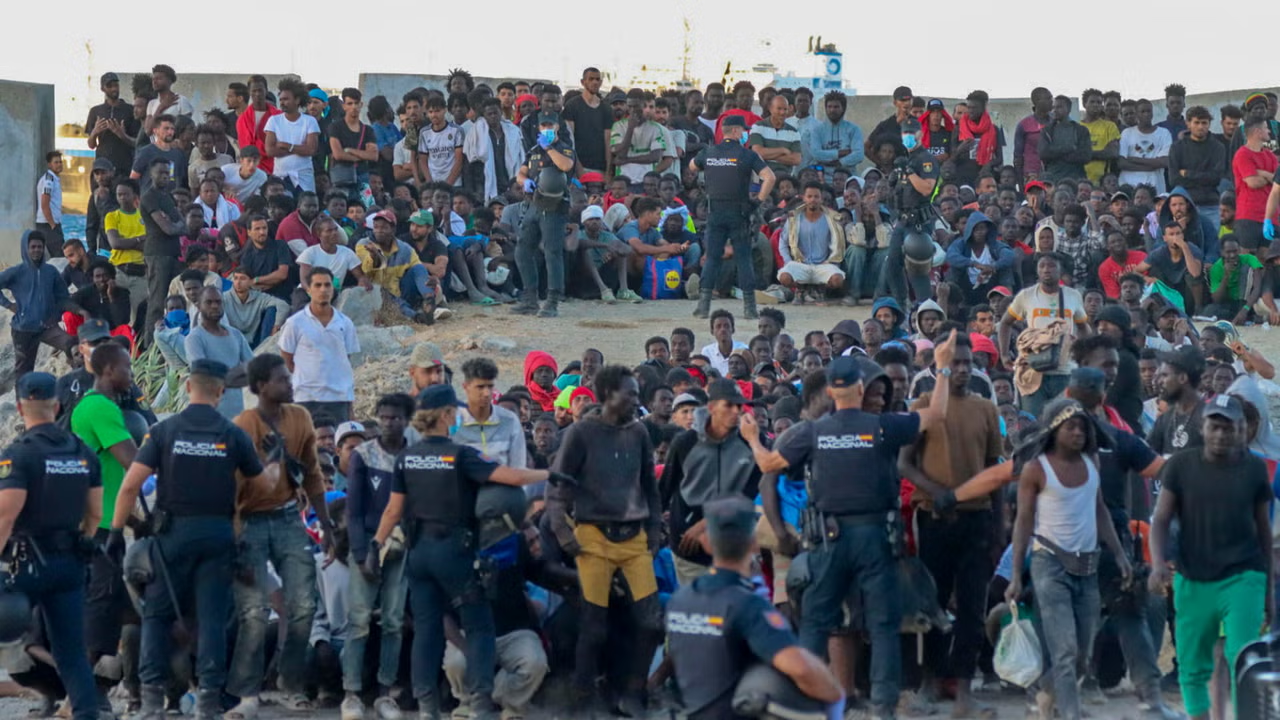
Ceuta remains far from recovering normality after the massive entry of more than 70,000 migrants on July 30, of which between 8,000 and 11,000 remain in the city, according to calculations by the president of Ceuta. Juan Vivas appeared before the press this Saturday to question the figures reported by the central government, which put the number of people still in Ceuta at around 2,500, and to ask for “transparency in communication” and a “proportionate” response.
At an international level, the situation is also complicated for Spain. After the support received by several of its European partners, Italy decided to reactivate border controls until August 15, to which Spain responded by reactivating its border controls randomly at ports and airports for travelers from Italy until September 7.
Morocco, after the crisis: more aligned with Spain because the image projected “is not good”
And Morocco? In The World Order JELO in summerLola Ilina and Eduardo Saldaña explain that “it is increasingly clear” that Rabat knew what was going to happen and that he let it happen. Although the question is “to what extent did he know” that so many people were going to cross or if, really, “it got out of hand.” They assure that it is difficult to know because the Spanish Government’s strategy is to “avoid singling out Morocco by all means” because they know that a more direct diplomatic confrontation with Rabat could make Morocco “decide to further increase this migratory pressure.”
The fact is that right now Rabat seems to be very aligned with Spain, something normal, since the image that has been projected internationally by the North African country “is not good at all.” However, international experts warn that we must be careful because this situation with Morocco “does not have to last long.”
“We have already seen that in other years, when Rabat crossed a red line, it was later very willing to help as if it had done nothing, but the reality is that a new limit has already been set and the response capacity has been measured,” they explain.
Because in the end, what has been shown is that neither Spain nor the European Union are prepared to face a crisis equal to or greater than the one we have experienced: “The response we have seen from the European partners has left much to be desired, for example, there is the fight with the Italian Government.”
The progress in the European Union is good and is noticeable “when it does not exist”
Eduardo Saldaña explains that when a situation like the one that is being experienced between the governments of Italy and Spain occurs, it is “a very bad symptom” that shows that in Spain “we should take note because, in the face of the instability caused by immigration – an issue that greatly strains the European Union -, we have not seen Italy, Denmark or other countries align with Spain, but rather we have seen how internal political logic takes precedence over the rest and that is why we have the situation we have with Italy.”
They consider that the Government of Giorgia Meloni is doing very well at the level of internal policy. Like the Government of Spain, which also finds it very good to “fight” with the Italian Government because it is an “enemy” and thus “diverts attention.” But ultimately, Spain “has to take note because in a crisis with Ceuta and Melilla, perhaps we do not have to assume that all our allies are going to be there at the first opportunity, and above all, with the migration issue. It is becoming clear that the European Union is not aligned when it comes to facing the migration crisis.”
