
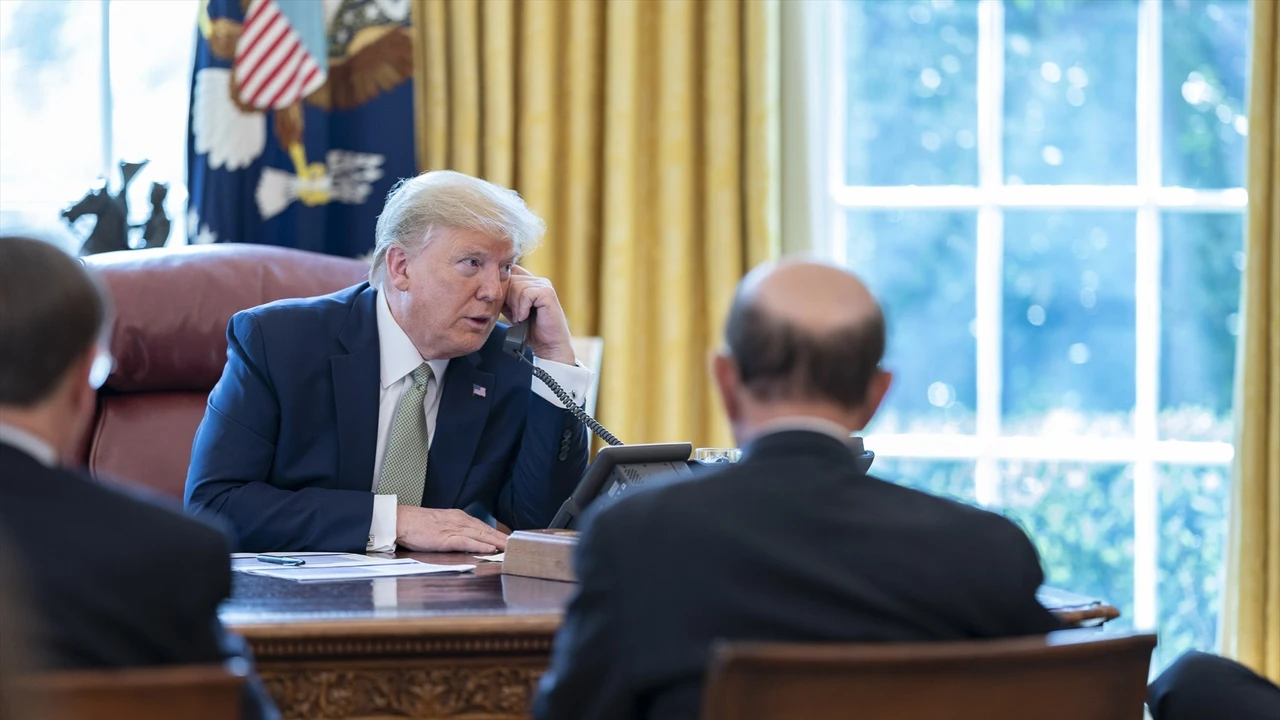
US President Donald Trump announced this Saturday that the provisional agreement with Iran will be signed on Sunday and that the signing will allow the reopening of the Strait of Hormuz. This was stated by Trump on his social network, which highlighted that the agreement includes that Iran not have nuclear weapons “neither by purchasing them, nor by developing them, nor in any other way.” However, the Iranian spokesperson has delayed the signing until “the next few days” and has insisted that the document focuses “on the end of the war and, for the moment, it has been decided not to deal with the nuclear issue.”
The waters may calm down, but for a few months
Eduardo Saldaña and David Gómez have explained in The World Order of Julia in the wave It is true that Iran “sees positive progress” in the negotiations, as does Pakistan, but it is not being as “effusive” as Donald Trump, “who wants to align it with his birthday party.” It is true that there is progress because the United States “has a clear interest” in signing the agreement.
However, experts in international politics rule out that this is a definitive agreement because there are still many things at stake: “No matter how much this ceasefire is signed, we are not going to see a drastic change in the situation in the Middle East. The dust may calm down, but it is true that it is very likely that this will be during the months that the US needs for the elections, but in the end, the lesson that Iran takes from this is “I have a lot of power and ability to close it” and no one assures it that Israel will not return. to attack them.”
A “less ambitious” agreement and with “fewer guarantees”
The agreement would extend the ceasefire for 60 days, reopen the Strait of Hormuz and postpone for some time talks on Iran’s nuclear program, the main sticking point in every negotiation that has taken place so far. “We don’t know where these conversations are going to go,” so “it’s possible that this could escalate again.”
What is clear is that the move has not gone very well for Donald Trump and proof of this is what the former Minister of Foreign Affairs, Arancha González Laya, said this Saturday on Julia en la Onda, who assured that “any peace agreement” that the US and Iran could reach would be “less ambitious” than the agreement that was negotiated with Iran in 2015. “Less ambitious and with fewer guarantees,” say Saldaña and Gómez, because “the lesson learned Iran has is that they don’t bomb North Korea. Why? Because it has a nuclear weapon and that is the definitive deterrence tool. So, the Iranians, after the assassination of Khamenei, “have taken note that they must rearm.”
The other terrible consequence that the war that Israel and the United States started has left is that the red line that was international pressure with the straits has been crossed: “Before there was a general agreement of ‘we are not going to play with the straits’ and Iran has shown that it is willing to do so.” So, basically, what Donald Trump is going to do is “reach an agreement to restore the ‘status quo’ that existed before the war he started.”
