
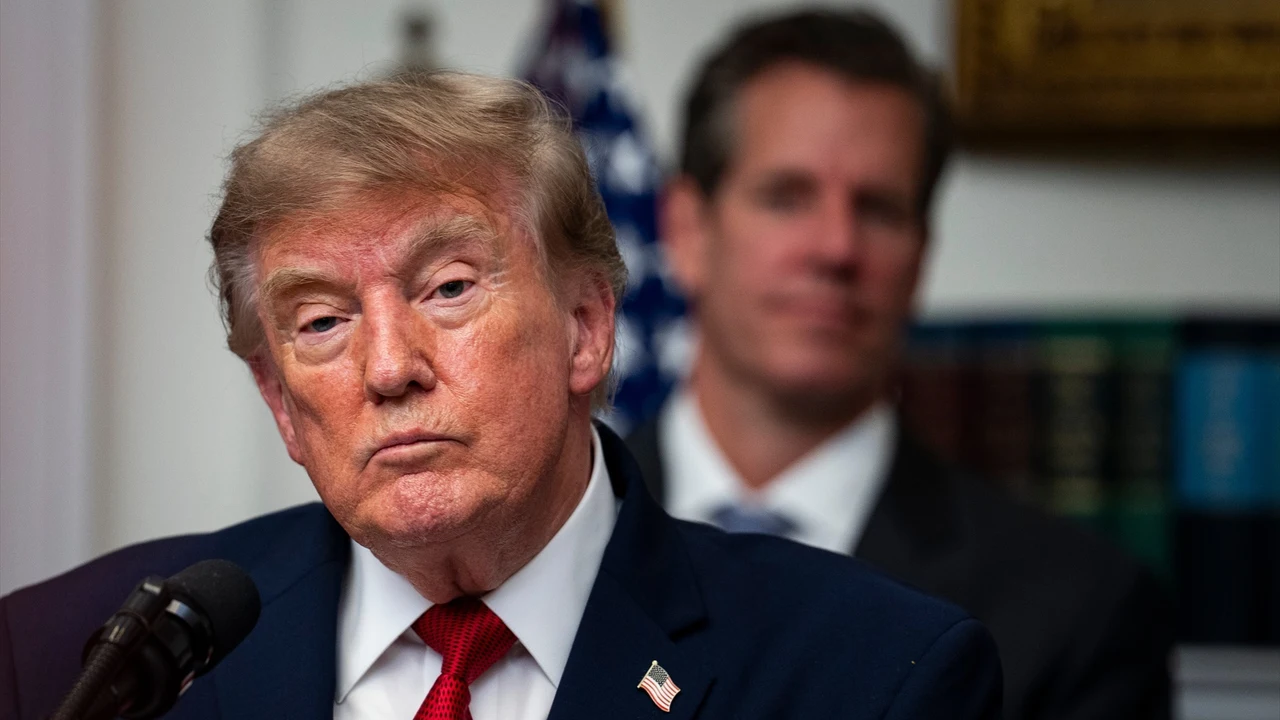
The Democrats sweep the US midterms and Trump suffers a severe setback. The Democratic Party has had one of the best nights in its recent history by regaining control of the Senate and the House of Representatives in a clear defeat for Trumpism, with territories such as Texas or Kansas that have ended the day of Democratic ‘blue’.
The data is especially relevant because the Republicans faced these elections with a majority in both chambers and with the possibility of consolidating Trump’s political program during the second half of his presidency.
The loss of the Senate is a major institutional blow. The Upper House has decisive powers in confirming presidential appointments, including judicial and diplomatic positions. A Democratic majority could block or slow down Trump’s appointments and turn each legislative negotiation into a more difficult exercise.
The magnitude of the Republican setback can also be seen on the electoral map: several states that had supported Trump in 2024 have registered highly relevant Democratic victories.
Texas, Georgia, Ohio and South Carolina: the cracks in the Republican map
One of the most significant elements of the day is the loss of Republican ground in states that for years have been important conservative bastions.
Texas probably represents the most symbolic change. Democrat James Talarico has won the Senate seat against Republican Ken Paxton. In addition, Gina Hinojosa has won the gubernatorial election against Greg Abbott. If these results are confirmed and consolidated, Texas would have extraordinary political significance: it would not only be a Democratic victory in a state contest, but also the rupture of one of the main electoral strengths of the Republican Party.
Georgia also offers a sign of change. The Democrats have won the governorship with Keisha Lance Bottoms, recovering a position that the party has not controlled since 1998, according to the first results published. The state, which had already demonstrated its electoral competitiveness in recent presidential cycles, once again places itself at the center of the American political transformation.
Ohio is another especially relevant territory. Democrat Sherrod Brown has regained his Senate seat by defeating Republican Jon Husted. The result calls into question the Republican Party’s ability to maintain its hegemony in industrial states of the Midwest, where the workers’ vote and concerns about jobs and the cost of living can change traditional alliances.
South Carolina adds another alarm signal for Republicans: Democrat James Talarico is not the protagonist there, but the Republican losses in the Senate also include this state, according to Axios’ preliminary balance. The geographical extent of the defeats is more important than any isolated victory: it indicates that the opposition has managed to compete in territories where until recently it had structural difficulties.
In contrast, Florida has maintained its Republican orientation. Byron Donalds has won the governorship against David Jolly, consolidating the continuity of conservative control in a state that has become one of the main centers of strength of the Republican Party.
The reading, therefore, is not that the United States has stopped being a politically conservative country, but that the Republican map presents fissures and that the coalition that allowed Trump to return to the White House does not seem to have kept its capacity for mobilization intact.
Why are traditionally Republican states changing?
The result cannot be explained exclusively by a punishing vote against Trump. The available data points to a combination of economic, social, demographic and political factors.
The cost of living and economic discomfort is probably the most determining element. According to exit polls collected by Reuters and the Associated Press, the rise in the cost of goods and services, the economic situation of families and the perception that the Government is not responding adequately to these problems have weighed considerably on the vote.
The issue is particularly sensitive for Trump because his return to power was accompanied by promises of economic recovery and improved purchasing power. When citizens do not perceive these improvements, electoral responsibility falls on the ruling party.
The impact of foreign policy. The war with Iran and its economic consequences, especially on energy prices, have contributed to presidential wear and tear. Foreign policy can mobilize the most ideological sectors, but also generate rejection among voters who believe that internal problems should have priority.
The rejection of polarization and presidential management. The results also reflect a demand for greater institutional control. A part of the electorate has used the legislative elections to limit Trump’s power, even without necessarily identifying with the entire Democratic program.
Demographic and electoral changes. The 2024 Republican coalition had made gains among young voters, African-American men and Hispanic sectors. However, preliminary data from Reuters points to a loss of Republican support among several of these groups in 2026.
Republican support among voters ages 18 to 29 would have fallen from 40% in 2024 to 25% in these elections. Among Hispanics, it would have gone from about half to about a third.
These movements are especially important in Texas, where the growth of the Hispanic population and the evolution of metropolitan areas have been modifying the electoral possibilities of both parties for years. However, it is advisable to avoid a simplistic interpretation: demographic change does not in itself guarantee a change in votes.
The wear and tear of Republican candidates. The quality and image of the candidates has also influenced. In Texas, the controversies and corruption allegations that have surrounded Ken Paxton hurt his Senate bid. In Ohio, voters considered Jon Husted too closely aligned with Trump, while Sherrod Brown managed to regain support among young people, moderates and women.
This shows that Trumpism can continue to have a considerable electoral base, but that its identification with specific candidates can also become a liability.
For his part, the head of the US Executive commented on his social network Truth Social, that if he had been on the ballot his party would have swept.
“I wasn’t on the ballot, and if I had, we would have won BY A CRUSHING VICTORY!” he declared.
The political meaning of defeat for Trump
The result has three fundamental consequences.
- Trump loses legislative capacity.
If the Democrats also consolidate the majority in the House of Representatives, the president will find himself facing a Congress controlled by the opposition in both chambers. That means that he will have much more difficulty passing new laws, promoting economic reforms, obtaining financing for certain initiatives and carrying out central parts of his program.
The Senate takes on additional importance because it will be able to block presidential appointments and exercise stricter control over the Administration.
- A stage of investigations and institutional confrontation.
Democrats have announced that they intend to intensify parliamentary oversight of the Executive. Congressional committees can call appearances, request documentation, open investigations, and issue subpoenas. This does not mean that Trump automatically loses his presidential contest, but it does mean that his room for political maneuver is reduced.
The president himself has anticipated that he will resort to the veto to prevent Democratic initiatives, a circumstance that increases the possibilities of legislative blockage.
- The Republican Party will have to face its own internal crisis.
The defeats have reopened the debate about the electoral cost of absolute identification with Trump. Some Republican leaders attribute the results to the president and his team, while other sectors may interpret that the party needs to deepen its populist and nationalist discourse to win back its voters.
This division may become one of the main problems for Republicans over the next two years: deciding whether to maintain a strategy of unconditional loyalty to the president or whether to recover some political autonomy.
