
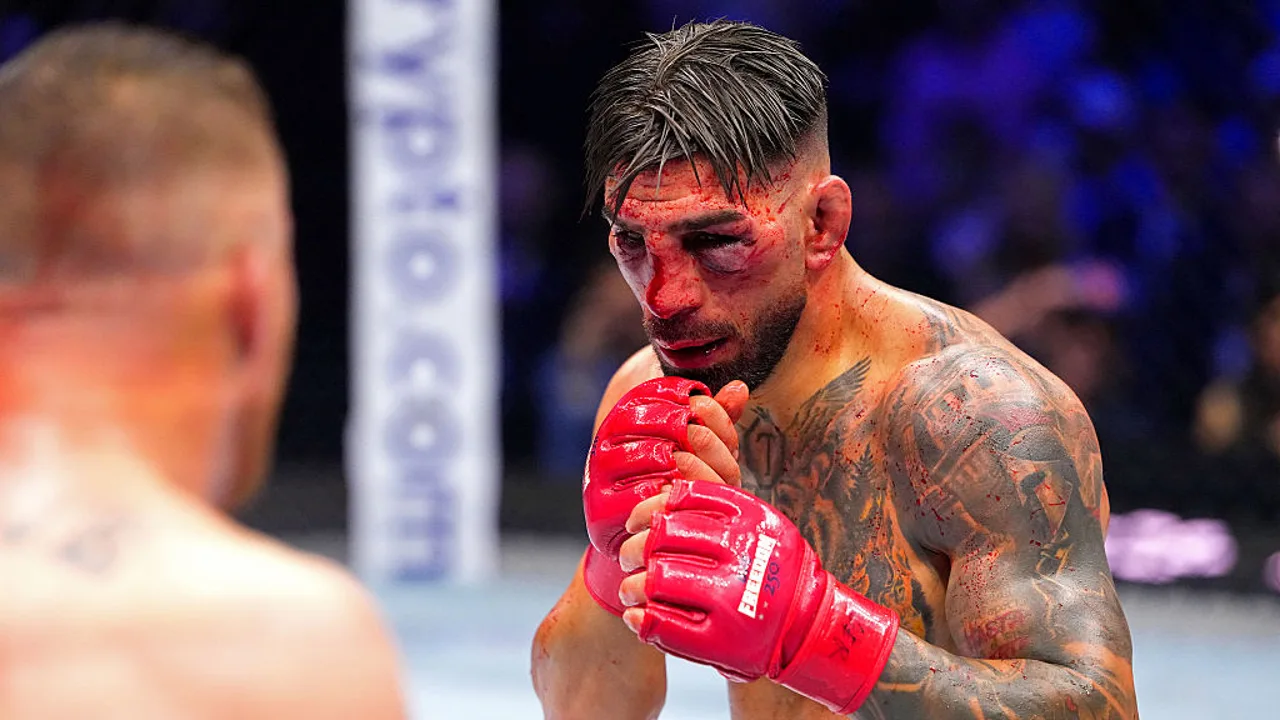
Not even in the most solemn moments of its history did the White House house anything like it. Between columns, presidential portraits and institutional memory, an octagon emerged. And inside, a war. Justin Gaethje’s victory over Ilia Topuria not only resolved the most anticipated fight of the year: it ended up shaping an evening that, in the eyes of the United States and the world, constantly oscillated between the historic and the openly eccentric.
The celebration of mixed martial arts merged with the American national holiday, amid the possible end of the armed conflict with Iran. With a very attractive fight card, the Trump Government kicked off in an unprecedented way the national celebrations for the 250th anniversary of the Declaration of Independence of the United States that will culminate with the celebration of the 4th of July.
Gaethje breaks Topuria’s undefeated record in a war of attrition
Ilia Topuria arrived as Lightweight champion, without having lost his Featherweight belt, undefeated with a record of 17-0 and becoming one of the global faces of the UFC after his victory against Charles Oliveira. Almost a year after his last fight against the Brazilian, the Hispanic-Georgian reappeared in the most unlikely scenario possible, on the national day of the stars and stripes flag and before one of the most influential politicians in the world.
His entrance already set the tone: from the Oval Office itself to the Ellipse of the presidential gardens, as always to the rhythm of the theme from the film ‘El Mariachi’ by Robert Rodríguez. In front was Justin Gaethje, ‘the American Dream’, interim champion and ideal figure for a night designed in a national key.
The fighter from the state of Arizona arrived as the least favorite despite having won his last fights, due to the knockout he suffered in 2024 against Max Holloway that would later be knocked down by the Alicante-based fighter.
The combat was immediate and fierce. In the first round, Gaethje punished Topuria’s face with unprecedented harshness. The champion resisted and responded, especially with body blows that in the second round were close to leading to a victory.
But the fight turned towards attrition. Gaethje, based on jabs and blows that found no defense, grew, imposing rhythm and accumulating damage. In the third round, Topuria began to stagger, leaving an image rarely seen to date.
At the end of it the ‘Matador’ confessed in his corner that due to the blows received he could not see out of his right eye.
The medical debate was inevitable. Although it was initially advised against continuing, the champion’s insistence made the referee allow a fourth round that ended up confirming the obvious. Exhausted, lacking precision and unsuccessful in his attempts to take the fight to the ground, Topuria was left exposed and with an obvious problem that prevented him from fighting at 100%.
At the end of the round, the referee stopped the fight and declared Gaethje’s victory by default. A decision protested by the fighter, but supported by those around him, including his brother, also a fighter from the company, Alek Topuria, who supported the now former Lightweight champion in leaving the event.
A White House converted into a combat scene
Because what happened goes far beyond the result. The White House—a political and institutional symbol par excellence—was transformed into a mixed martial arts venue on Donald Trump’s 80th birthday, and as mentioned, it also coincided with Flag Day and as the start of the 250th anniversary of the Declaration of Independence that will culminate on July 4.
Expectations were high after a historic previous press conference held at the Abraham Lincoln Memorial, the site of events as momentous for the country as the ‘I Have a Dream’ speech that contrast with the discipline. The image was as powerful as it was disconcerting: fighters entering the octagon, crossing hallways with portraits of presidents, leaving from historical rooms of the residence.
The south façade hosted the combat while the ‘President’s band’, made up of marines, played music at the entrances. Veterans and war heroes escorted the fighters.
All of this accompanied by a constant visual narrative: The figure of former presidents such as George Washington or Ronald Reagan, the creation of the flag, “the land where freedom prevails”, Pearl Harbor, Normandy or the fight for civil rights.
The event left no room for ambiguity. Uniforms inspired by the American flag replaced the usual freedom of the fighters. The controversial flight attendants also adopted that aesthetic. There were even recreations of soldiers from the colonial era.
The “USA” chants were constant every time a local fighter stepped into the octagon.
The event was surrounded by messages such as the one presented by country singer Zac Brown, who expressed that we must “give love to those who keep us safe and free,” while songs like American Pie played and images of the country’s military and social history were projected.
Lights, power and a tribute to military power
The event brought together 5,000 VIP guests, with a strong military presence and figures such as Mark Zuckerberg, whose company Meta announced glasses with artificial intelligence for blind veterans during the event. He also highlighted the presence of businessmen such as Kris Marszalek, CEO of Crypto, a cryptocurrency exchange application and main sponsor of UFC 250; or boxing personalities such as the British Tyson Fury
The cost, according to TKO Group Holdings CEO Mark Shapiro, was about $60 million. The company run by Trump’s friend, Dana White, assured, will not obtain direct benefits from this event, and they see it as “a long-term investment” based on “earned publicity.”
The sporting event operated as a large-scale image operation in which sport, American politics and entertainment were intertwined without clear precedents.
Results that broke the script
Not even the sports plan completely followed the patriotic story. Brazilians Mauricio Ruffy and Diego Lopes beat Americans Michael Chandler and Steve García. Derrick Lewis, designated as Trump’s favorite, also fell, defeated by his compatriot Josh Hokitt. Only Sean O’Malley joined Gaethje in the home team’s victory.
On the other hand, the co-main event stood out where the Frenchman Ciryl Gane knocked out the Brazilian Alex Pereira and took the interim heavyweight belt.
Unrepeatable from a sporting perspective, extravagant from a political and social perspective.
The closing, however, did respond to the script desired by the festivity: Gaethje, the American fighter, defeating the great international star in the symbolic center of the power of the North American nation.
But the final sensation transcends the result. The White House hosting a combat event, surrounded by military symbols, patriotic narrative and political staging, leaves an image that is difficult to classify.
Historical, without a doubt. Spectacular, too. But for many, inevitably, strange.
