
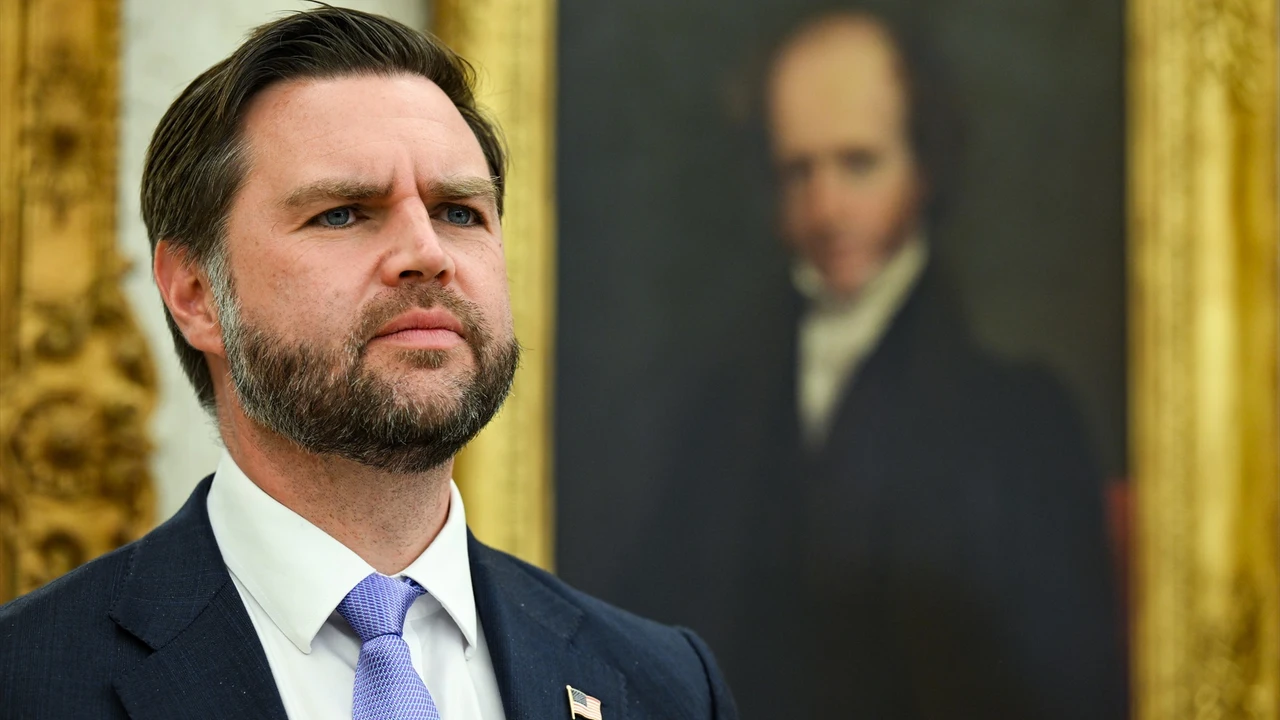
The overwhelming Democratic victory in the midterm elections has altered succession plans within the Republican Party and has forced JD Vance to make a move. The vice president of the United States has taken advantage of the defeat to distance himself from Donald Trump, claim that he opposed the war in Iran and present a roadmap with which he intends to prevent his party from suffering an electoral setback again.
The journalist Pablo Suanzes has explained in The Compass that Vance published a long message on social media in which he attributed the election result to the war in Iran. His diagnosis allows him to recover a position that he had already defended before the intervention: that of someone who was against the military operation and believes that events have proven him right.
“I was against, they didn’t listen to me. I was right. It has been proven. Vote for me, I’m the one who understands things,” Suanzes summarized about the message that, in his opinion, also functions as a launch of Vance’s own campaign.
Four lines of action
The vice president has proposed four lines of action to avoid a new republican disaster according to the journalist. The first is to immediately end the war in Iran. The second, focus the agenda on inflation and the cost of living. The third is to recover the principle of America First, with a policy that prioritizes the problems of Americans over interventions abroad and reactivates the MAGA movement. Finally, he proposes changing the United States’ relationship with Israel.
The election result has also changed Vance’s prospects for the upcoming presidential elections. Before the elections, a result acceptable to the Republicans would have left, according to the director of the Franklin Institute of the University of Alcalá, José Antonio Gurpegui, the vice president’s candidacy practically uncontested.
Gurpegui recalled that even Marco Rubio had stated that he would not run if Vance took the step. However, the electoral setback has weakened that position. The vice president is, in the expert’s opinion, “one of the figures most affected by the defeat,” precisely because of his role as Trump’s possible political heir.
The analyst has pointed out that Vance had a prominent role in a convention held in Dallas in August, in which numerous representatives avoided appearing with the president. That quote seemed to reinforce the idea that it would be the vice president who would pick up Trump’s baton, ahead of Rubio.
Now, however, Gurpegui believes that the elections have considerably expanded the range of possible presidential candidates in both parties. The republican succession is once again open.
Vance seeks to differentiate himself from the Iran war
The distance that the vice president is trying to establish with Trump is especially significant given his position during the process that led to the military intervention. According to Gurpegui, Vance was not present at the first meeting with Benjamin Netanyahu, but he did attend the next one, when the decision was made to support the Israeli initiative against Iran.
In these conversations, the vice president would have expressed his opposition to the intervention, in line with other members of the Administration and advisors to the president. However, none of them managed to convince Trump to desist. Gurpegui has pointed out that figures such as Marco Rubio and the director of the CIA also expressed their reservations, although the president’s decision ultimately prevailed.
The war has become one of the factors that explain the electoral punishment of the Republicans. In addition to its economic consequences—especially the increase in the cost of fuel and other products—the conflict has collided with one of Trump’s main promises: to end wars abroad and concentrate the Government’s efforts in the United States.
