
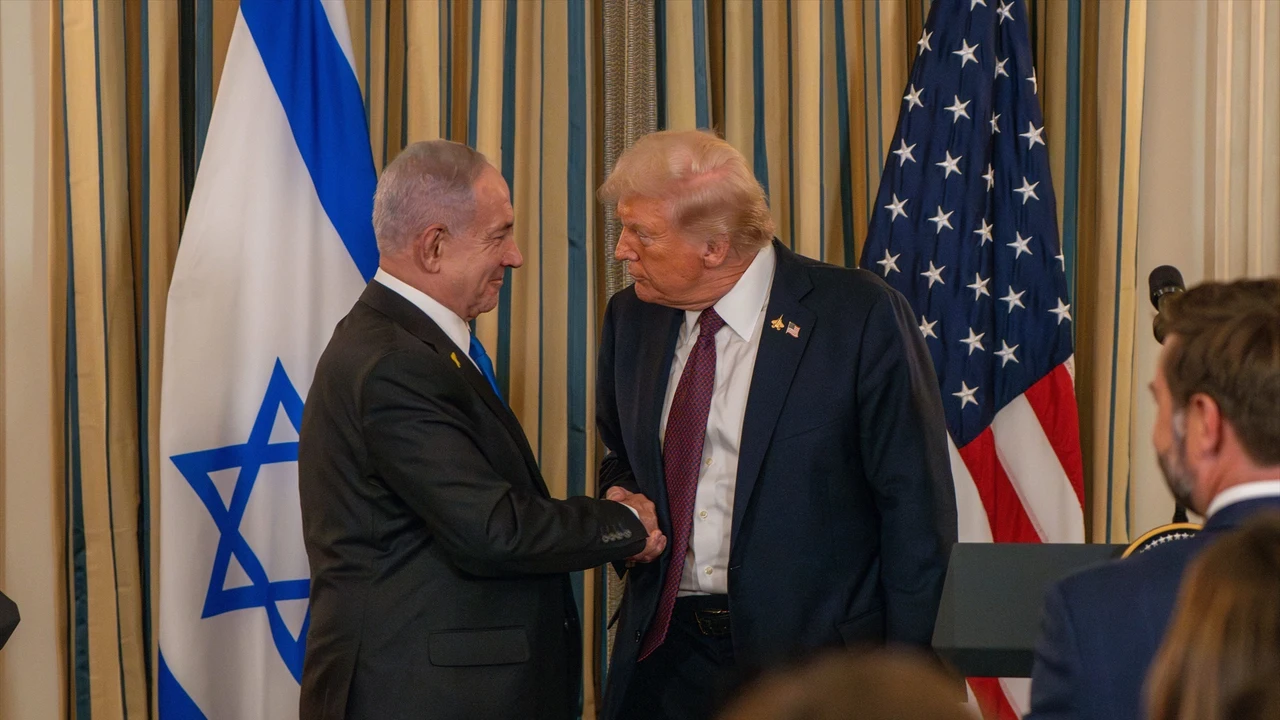
Carlos Alsina spoke with Haizam Amirah Fernández, executive director of the Center for Contemporary Arab Studies, to analyze the peace agreement announced by Pakistan between the United States and Iran and the uncertainties that still surround its application.
The agreement, celebrated by US President Donald Trump, comes after weeks of tension in the Middle East. However, its stability has been called into question in recent hours after the Lebanese National News Agency reported at least two Israeli attacks in the country. In addition, the Israeli Defense Minister published a message on social networks in which he assured that the Israeli Armed Forces should not abandon southern Lebanon.
A failed war
According to Amirah Fernández, the offensive promoted by the United States and Israel pursued two main objectives: to provoke a regime change in Iran and to significantly reduce its military capabilities. In his opinion, none of those purposes has been fully fulfilled.
The expert considers that the main risk was that the military escalation would end up getting out of control and leading to a large regional conflict. “The world has taken a step away from the edge of the cliff,” he said, alluding to the scenario that would have involved an indefinite closure of the Strait of Hormuz or a possible blockade of the Strait of Bab el-Mandeb by the Houthis.
However, he warned that there are still actors interested in reactivating a large-scale war. In that sense, he pointed directly to the Israeli Government.
Israel, an obstacle to peace
Looking ahead to the signing of the memorandum of understanding between the United States and Iran, scheduled for this Friday, Amirah Fernández considers that the majority of the actors involved have incentives to consolidate peace. In the case of Trump, he pointed to the erosion of his popularity in the face of the upcoming midterm elections. On the part of Iran, he highlighted the delicate economic situation derived from the sanctions, the international blockade and the continuous attacks suffered by the country.
In his opinion, Benjamin Netanyahu’s Executive maintains different objectives, with incentives to prolong the conflict and continue military operations in different parts of the region, especially in Lebanon.
Amirah Fernández maintained that the Israeli Government is carrying out what she defined as “a covert annexation” of large areas of southern Lebanon, 65% of Gaza and part of southern Syria.
For the analyst, the only way to stop new military operations is for Israel to begin to feel the costs of hindering the White House’s attempts to stabilize the Middle East. Likewise, he stressed that, if the United States maintains its military, intelligence and diplomatic support for Israel, the incentive to continue with this strategy will continue to exist. “This is the time to see who’s in charge: Donald Trump or Benjamin Netanyahu,” he said.
“You don’t need big words, you need actions.”
The executive director of the Center for Contemporary Arab Studies concluded that diplomatic statements or gestures are not enough to consolidate peace. “We don’t need big words, we need actions,” he stated, warning that, if these commitments do not materialize, the region could once again face situations of maximum tension.
