
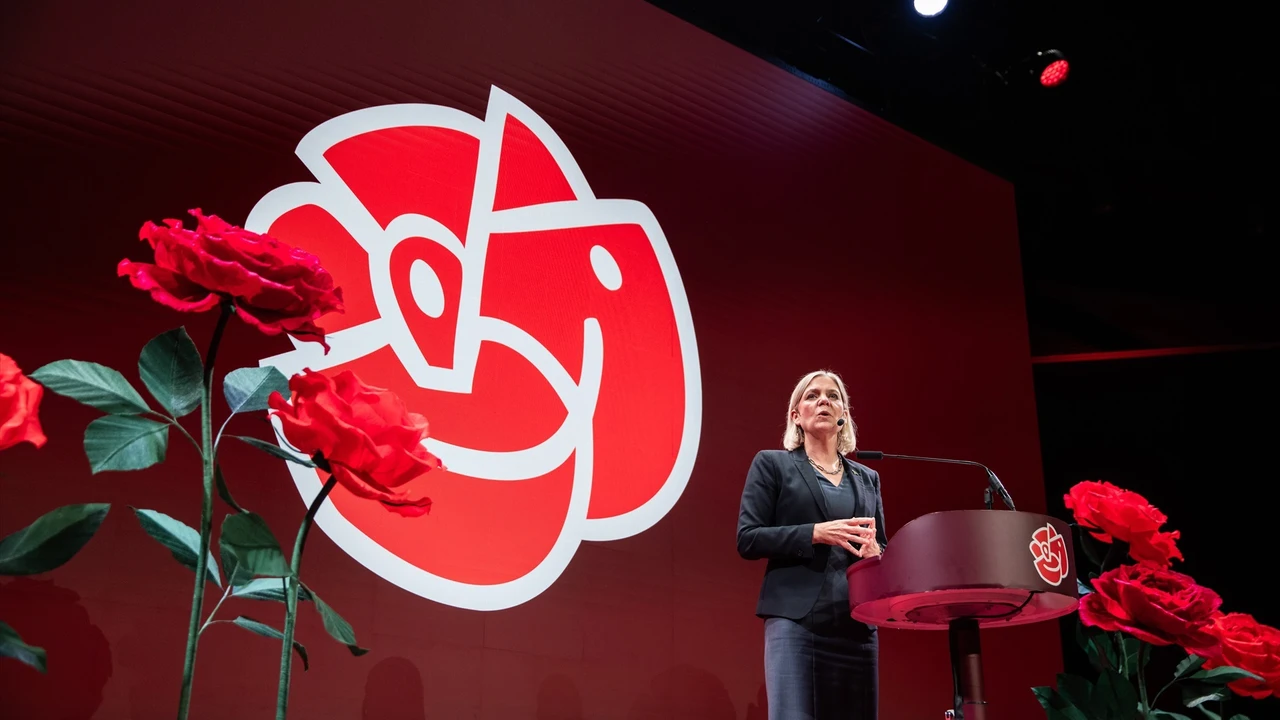
Social democracy in the European Union is crumbling, losing ground and suffering one of its worst crises in decades while continuing to search for the recipe to stop the rise of the extreme right.
In France, the Socialist Party has seen how both the extreme right and La Francia Insumisa dispute what was its political space. In Italy, the historic Socialist Party was completely devastated after the corruption scandals of the 90s until it ended up disappearing. Also Portugal, where the prime minister today is conservative. And something similar happened in Greece with Pasok, which stopped being the hegemonic force to become a very weakened party after the financial crisis. The Social Democrats are deflated and currently only govern in Spain, Denmark and Malta. And if we look outside the European Union, there is the United Kingdom.
“Social democratic parties have to renew themselves or die”
Experts wonder if the agony of social democracy in Europe is irreversible. One of the keys is that the workers’ vote is no longer just the exclusive heritage of the traditional left, as admitted by Javier Martín Merchán, political scientist and professor at the Universidad Pontificia Comillas. The expert points out that “there is a core moderately protected by the traditional policies of the social democratic parties, which the literature calls insidersand increasingly there is a periphery of precarious workers who are generally those made up of young people, some immigrants, the unemployed over 50 years old and those are what we generally call the outsiders“The explanation, according to Javier Martín Merchán, is that if social democratic parties decide to neglect these groups, they logically feel attracted to other types of political formations that tend to be either populist or radical right-wing in nature.
“Sweden is an exception and we cannot expect any resurgence of social democracy in the rest of Europe”
The Swedish case is the exception within a bleak panorama: the Social Democrats have just won – barely – causing the resignation of their conservative prime minister. “If we talk about that traditional center-left gap that we have called social democracy for many years, Sweden is an exception and we cannot expect any resurgence of social democracy in the rest of Europe,” as this professor from the Comillas Pontifical University admits.
Martín Merchán assures that “we are reaching a point of no return in Europe in which social democracy is dying, there is no going back, unless we understand that social democracy can mutate into something very different from what it was in its day.” Because “social democratic parties have to renew themselves or die,” he says, “they have to say something about that or it will be the radical right parties that capture all that discontent around issues related to immigration, precariousness, the frustration of expectations or the failure of the welfare state.”
