
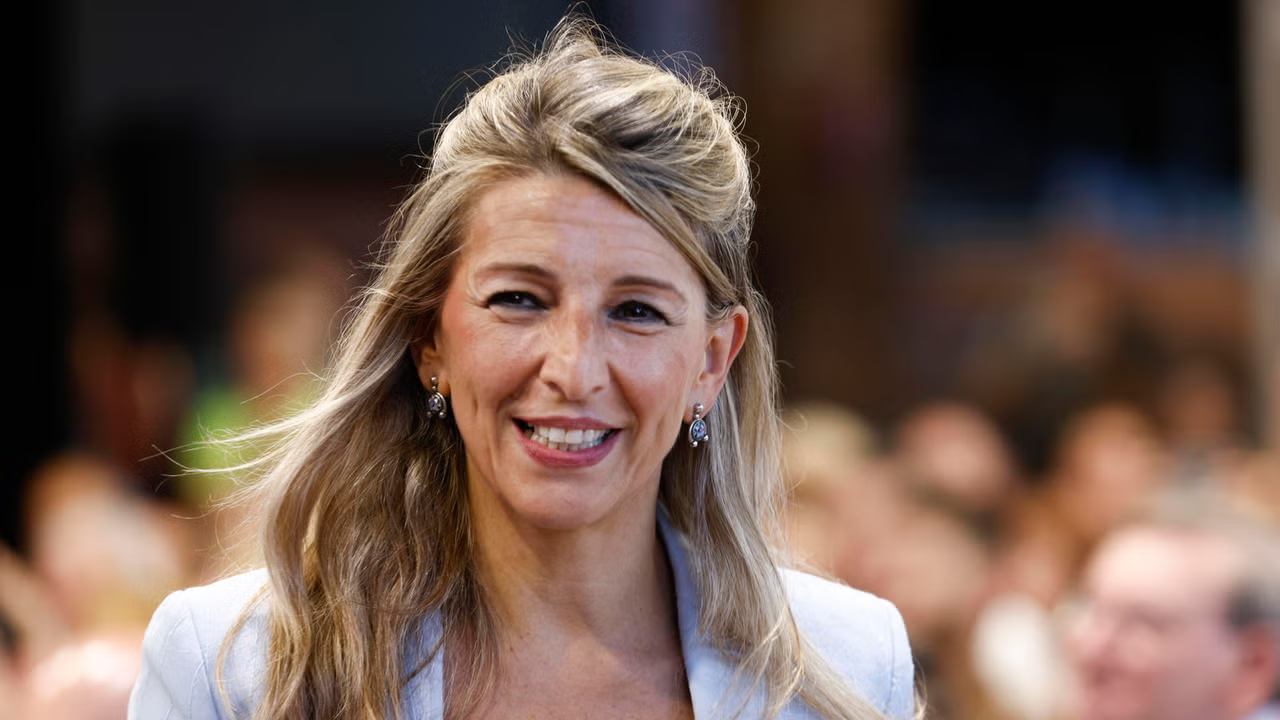
Pedro Sánchez announced by surprise early this Thursday the candidacy of Yolanda Díaz to head the International Labor Organization. “It is an honor to announce the candidacy of Yolanda Díaz to lead the ILO. For the first time, a woman and our country would be at the head of this fundamental institution for the defense of decent work and social justice,” the President of the Government wrote on Twitter.
“Yolanda has demonstrated with policies and results her commitment to labor rights, social dialogue and the prosperity of Spain. Her experience, her career and her vocation for consensus make her an excellent candidate to lead the ILO,” Sánchez’s message continues on social networks.
The announcement by the leader of the Executive has taken the world of politics by surprise, with a PP that was quick to criticize said candidacy. “The price that Yolanda Díaz has set to cover up Sánchez’s corruption. This way everything is better understood,” said Miguel Tellado, general secretary of the popular party, who has also left a message of rejection on their official account: “We already know the compensation for keeping everything quiet.”
What is the ILO, what is its function and how much would Yolanda Díaz earn?
The ILO, founded in 1919 and the first specialized agency of the United Nations, brings together governments, business organizations and unions from its 187 member states. It has a tripartite structure and is positioned as the main forum for the development of labor standards, the promotion of employment, social protection and the strengthening of social dialogue.
Díaz would receive a base salary that is approximately between 137,000 euros and 150,000 euros annually and taking into account the published UN salary tables.
For now, the vice president would face the elections with the Togolese Gilbert F. Houngbo, who has held the general directorate since 2022. The base salary is The ILO Governing Council will hold private sessions with the candidates on November 9 and the secret vote will be held on November 16. Following this, the new CEO’s term will begin on October 1, 2027.
In addition, the mandate of the ILO general directorate is five years. For a candidate to be elected, he or she must obtain the votes of more than half of the members of the board of directors with voting rights.
The qualities of Yolanda Díaz that Moncloa highlights for her candidacy
From Moncloa they highlight that Díaz, as second vice president of the Government and Minister of Labor and Social Economy, has promoted some of the main labor and social reforms of recent years, all of them within the heart of social dialogue with 30 agreements. Specifically, during these years, he promoted the labor reform agreed upon with unions and employers, the platform law or the largest increase in the interprofessional minimum wage in democracy.
Therefore, the Government believes that, with this candidacy, Spain aims to strengthen “a key institution to face the challenges of the labor market” in a context of “profound economic, technological and environmental transformations”, reinforcing the role of the ILO as a “global reference in the defense of decent work and social justice”.
Spain is the country in the world that has signed the most agreements with the ILO (141). If elected, Yolanda Díaz would be the first Spaniard and the first woman to lead the ILO.
Pablo Iglesias criticizes Sánchez’s announcement
The former vice president and former leader of Podemos, Pablo Iglesias, has assured that the Government of Pedro Sánchez has rewarded the Minister of Labor, Yolanda Díaz, for “the services provided” when presenting her candidacy, while noting that she is going to become the “highest paid member of the Workers’ Commissions in history.”
Iglesias has reacted in this way on RNE, where he has indicated that he does not know if she is a good candidate, although he has pointed out that the Government “rewards those who have to reward with this type of appointments.” As he explained, this position for the ILO corresponds to “apparently very important figures”, who usually “no one knows” but who are “very well remunerated”.
“It implies that someone after having been in a Government is rewarded with a position without political pressure, with salaries surely much higher than those earned by a minister or a former vice president. It is a reward for the services provided,” summarized Iglesias, who has shown his “pride” because, as he said, the Podemos officials who passed through the Government were not offered “an international organization, nor an embassy nor any of these awards.”
In his opinion, the director general of the ILO earns more than a president of the Government or a secretary of State in Spain. “It is going to be the highest paid CCOO affiliate in history,” Iglesias concluded.
