
The anti-immigration movement March and March will continue to pressure migrants and refugees to leave the country as soon as possible. Their intention is to continue their demonstrations every Thursday.
By Rafael Armada from Johannesburg
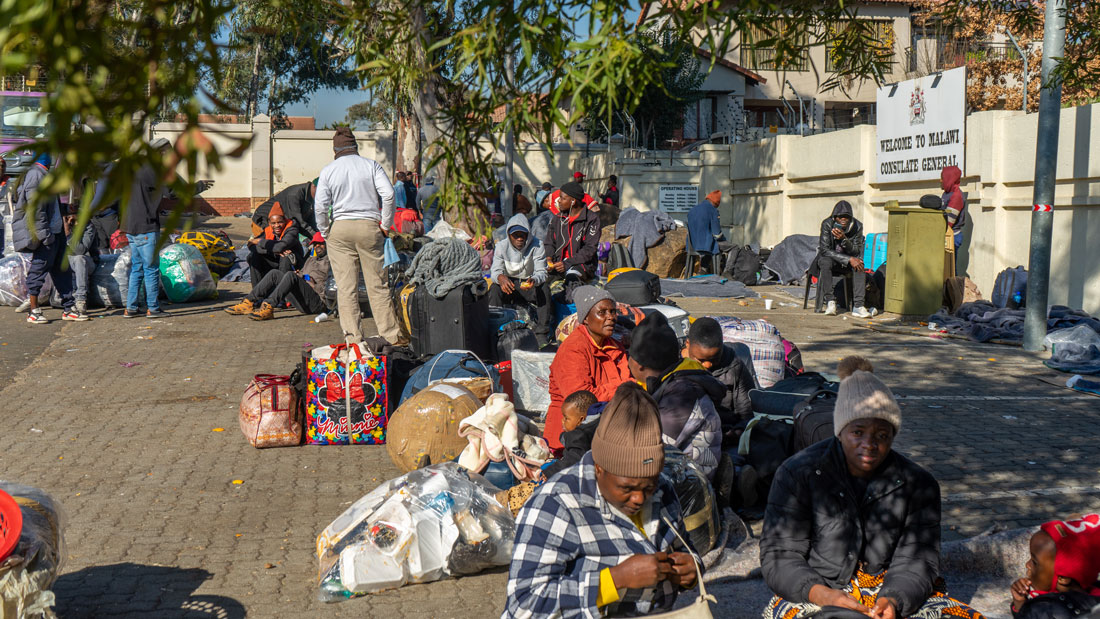
Hundreds of Malawians are gathered outside their consulate in Johannesburg waiting for the opportunity to be repatriated. Many have spent the night outdoors waiting for transportation, which is delayed, to return them to their country of origin. They flee from a land in which they do not feel welcomed and their words reflect the pain of their recent experiences.
Margareth arrived in South Africa with her sister five months ago. She left her children in Malawi and settled in Durban as a domestic worker. They began to threaten her employer and also her, telling her that they would burn her house down. He admits that he could not go to work or to the stores because they harassed him to leave the country. The owner of his house also asked him to leave it. He now leaves South Africa with a heavy heart.
Tzifundo has been coming several times and on this last occasion he did so last August. I worked in a shop in Johannesburg. His documents were not in order and the business owner asked him to leave the job due to anti-immigration pressure. At the moment he does not plan to return to South Africa. If some arrived in the country recently, others did so several years ago, like Daniel, originally from Lilongwe, who arrived in Pretoria in 2013 looking for work that his homeland did not offer him.
Several thousand Malawians left these days for Messina, a South African town on the border with Zimbabwe, where last weekend more than 20,000 migrants crossed to leave South Africa, according to Matseliso Ntsoelikane, national director of the Jesuit Refugee Service (JRS).
About 200 migrants are concentrated at the Zimbabwe embassy, but here things are more organized. A bus waits and people begin to load it with their luggage. However, one feeling seems to take over all of them. Their faces show the frustration of those who could not fulfill their dreams.
The demonstrations carried out by March and March On June 30, they were more peaceful than expected, as the Daily Maverick newspaper recognized the next day, but the organizers’ intention is firm and they intend to continue demonstrating every Thursday, thus putting pressure on migrants and refugees to leave the country.
For the South African Comboni Father Francis Manana, behind the anti-migration movement there is a clear political intention to weaken the African National Congress, which has failed in the management of social affairs in a country where unemployment, corruption, inequality and poverty continue to grow. With local elections in November so close, the anti-immigration movement blames weaker African neighbors for an ever-deteriorating social situation. The departure of migrants will undoubtedly further weaken the fragile South African economy.
