
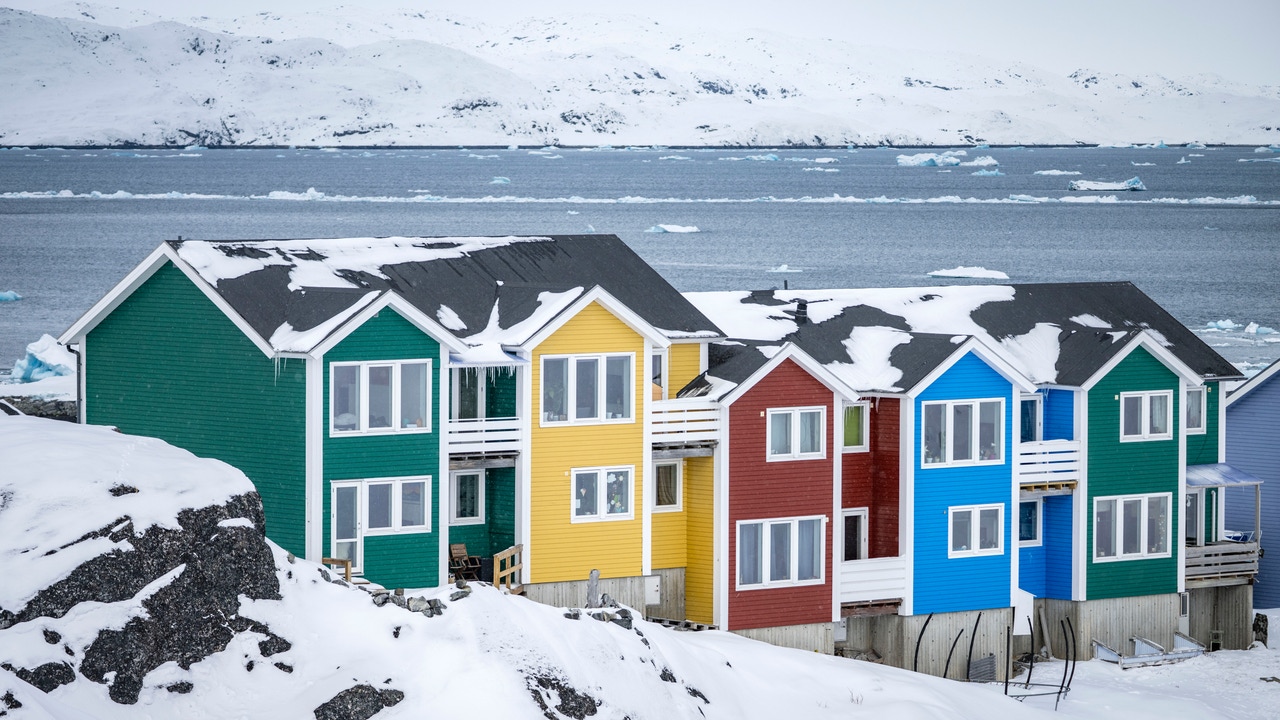
Donald Trump has shown special interest in the island of Greenland, located between the North Atlantic and Arctic Oceans, due to its geostrategic importance and its mining resources. Despite the refusal of the Greenlandic prime minister, who has reported that they prefer the Greenland we know today, the president of the United States remains obsessed with taking over the territory. “I don’t know who he is or I know anything about him, but that’s going to be a big problem for him,” Trump declared in a threatening tone.
Today, the enormous island located at the northeastern tip of the American continent is established as an autonomous territory integrated into the Kingdom of Denmark, like the Faroe Islands. Despite belonging to the Danish kingdom, it has a high degree of internal autonomy that has evolved over time from European colonization to its current status.
History of Greenland
Greenland was inhabited by indigenous Inuit peoples for millennia, although around the year 986, Norse settlers from Iceland began to settle on the western coast of Greenland, founding several settlements in the fjords in the southwest of the island. In 1261, those same settlers accepted Norwegian sovereignty. The Norse presence lasted for several centuries, until the beginning of the 15th century, when the settlements were gradually abandoned and ceased to exist.
The modern Danish presence in Greenland dates back to 1721, when missionary Hans Egede established a mission supported by the Danish crown that began formal colonial administration. Later, in 1814, Greenland was internationally recognized as a Danish colony after the dissolution of the Denmark-Norway union.
From colony to autonomous territory
In 1953, when the Constitution of Denmark was adopted, Greenland officially ceased to be a colony and was incorporated as part of the Kingdom of Denmark with representation in the Danish parliament and Danish citizenship for its inhabitants. Later, in 1979, a referendum approved the statute of Home Rulegranting the territory the ability to manage its internal affairs such as education, health or fishing, although Denmark maintained control over defense, foreign relations and currency. Finally, 30 years later, with the passage of the Self-Government Act of 2009, Greenland acquired additional powers over internal affairs such as justice, natural resource management and police, among others, while the statute recognized Greenlanders as a people with the right to self-determination under international law.
American interest
Already in 1867–1868, shortly after the purchase of Alaska, Secretary of State William H. Seward promoted studies and internal discussions on the possibility of acquiring Greenland for the United States, attracted by its strategic location and wealth of natural resources. After World War II, President Harry S. Truman officially offered to buy it in 1946 for $100 million in gold, an act that Denmark rejected, although the US military presence in the Arctic was consolidated with bases such as Pituffik.
With Donald Trump, American interest in the island has been reawakened. This Tuesday, the Prime Minister of Greenland, Jens-Frederik Nielsen, assured that if they have to choose “we prefer Denmark.” “Denmark, the European Union and NATO. We prefer the Greenland we know today. This is not the time for divisions and discussions, it is the time to remain united and continue building based on the community we already have,” he stated, ensuring that the territory “is not for sale.”
Faced with the statements of the Prime Minister of Greenland, Jens-Frederik Nielsen, Trump has responded harshly, warning him that his insistence that the island remain under Danish sovereignty “could cause big problems”, amid the escalation of tensions over the future of the Arctic territory.
