
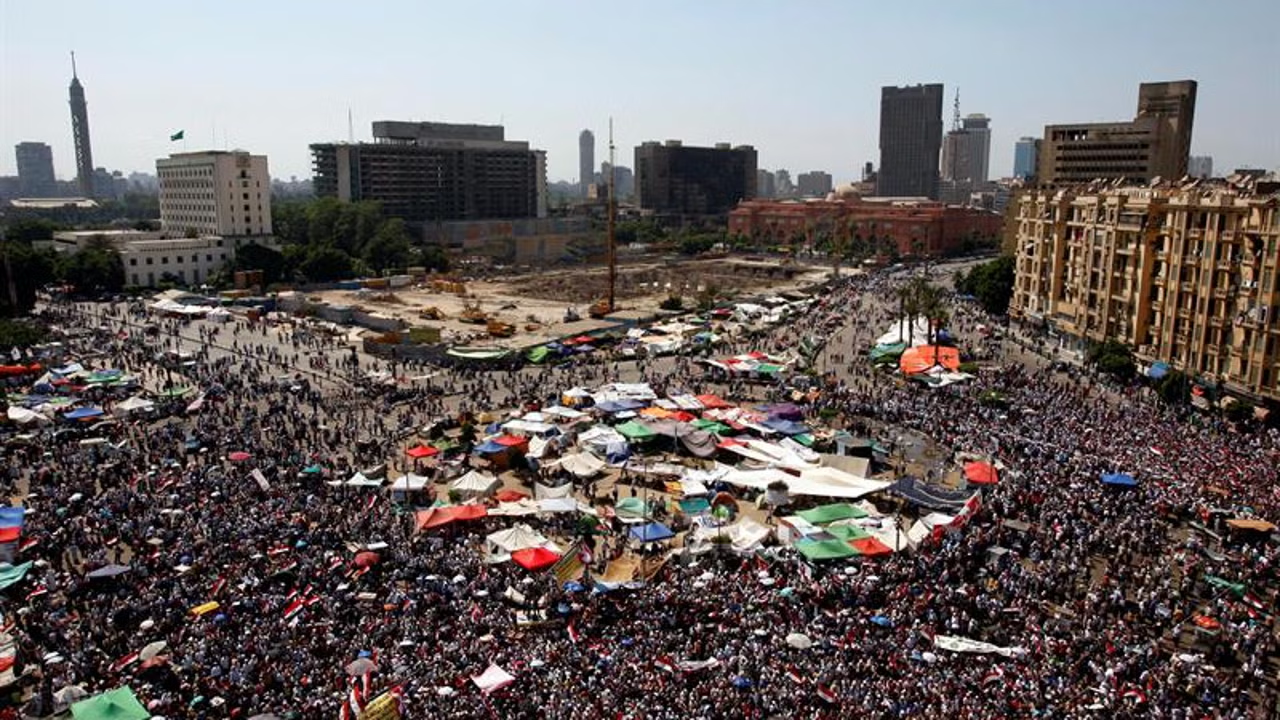
The images of thousands of people filling Tahrir Square in Cairo (Egypt) went around the world in 2011. Tunisia, Egypt, Bahrain, Libya and Syria were the scenes of a wave of protests that made regimes that seemed immovable falter and fall. Fifteen years have passed and the consequences of that Arab Spring continue to mark not only the Middle East, but also Europe and a good part of the international order. The co-director of The World Order, Eduardo Saldaña, has analyzed in JELO in summer the legacy of those Arab revolts, events that, in his opinion, will end up being considered one of the moments that defined the first quarter of the 21st century.
The immolation of a street vendor in protest against the authorities was the spark that lit the fuse of unrest that showed that civil society could organize and stand up to authoritarian governments. However, all that glittered was not gold because “the misnamed ‘Arab Spring'” not only caused the fall of leaders who “seemed eternal,” but also caused wars to break out, mechanisms of repression were reinforced in many countries, and instability opened new spaces for jihadism.
The rise of the Islamic State
One of the most important effects of the uprisings was the Syrian war, whose instability was taken advantage of by various jihadist organizations to gain strength and recruit followers. Although jihadism already existed before (Al Qaeda had been operating for years), divisions within it increased and new forces emerged such as the Islamic State, which managed to grow and even proclaim a caliphate, an event that had an immense symbolic weight for the jihadist movement.
The consequences of the emergence of the Islamic State not only affected the Middle East, but also Europe with a succession of attacks that hit different countries: France, with Charlie Ebdò and Bataclán; or Spain, with the attacks on the Ramblas in Barcelona and Cambrils.
“We would not understand today’s Europe without the Arab revolts”
But the impact of the protests in Europe and the world went beyond the Islamic State attacks. According to Saldaña, “we would not understand today’s Europe without the Arab revolts.” The wars in Syria and Libya caused large movements of refugees to Europe and placed immigration at the center of the political debate. The initial response was that ‘Welcome Refugees’ from Angela Merkel’s Germany, but it soon gave way to a Europe more concerned with reinforcing its borders and containing migratory flows.
The rise of jihadist groups and attacks also fueled greater concern for security and made nationalist discourses grow; and it also changed the relationship of the Western powers with the countries of the Middle East. Because? Because the revolts, in their beginnings, were seen as an opportunity to open up and extend democracy, but the chaos that followed and the growth of Islamism changed that perception, which made stability take priority. That is, many Western governments preferred to accept collaboration with authoritarian regimes to avoid new crises and instability.
The problems are still there
However, despite the impact and magnitude of the Arab revolts, the problems that gave rise to them have not completely disappeared. Inequality, poverty, lack of opportunities and social discontent are still there. According to Saldaña, governments learned the lesson in 2011, but not to improve the living conditions of their citizens, but rather “the mechanisms of repression to avoid any new social outbreak.”
Therefore, the journalist’s conclusion is that the story of the Arab Spring is not over yet and that it is only “a matter of time before we see an outbreak again in some countries in the region.” The great unknown? Know what form that discontent will take. Whether it will once again translate into a democratic demand or whether it will be taken advantage of by Islamists and other more authoritarian forces.
