
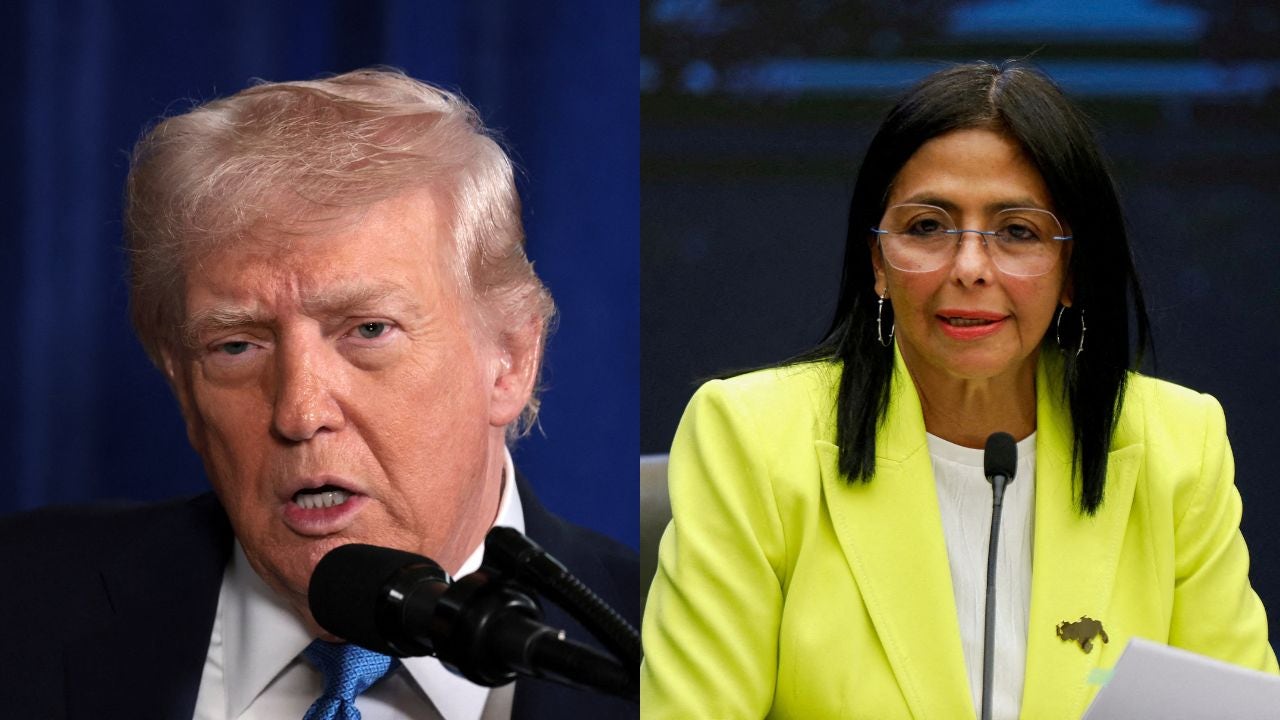
More than a week after the United States attack on Venezuela and the capture of Nicolás Maduro, the Government of Delcy Rodríguez is adjusting to the situation. It seems that the regime has already understood that the only way to maintain power and the benefits derived from it is to cooperate with the United States, hence the change in rhetoric that is being seen in recent days.
As analyzed from ‘The World Order’, internally there has been an attempt to maintain the idea of the Bolivarian revolution, but bridges are being built in a way that has never been seen before. The reason? The capture of Maduro sent a very harsh message against the entire organization of the Venezuelan regime: “If we have done it with him, we can do it with you later.”
What is clear is that the Government is trying to reorganize internally despite the tensions between the different centers of power. The Rodríguez brothers are betting on building those bridges and pleasing Donald Trump, since they know that it is the guarantee to remain in the Government: “The objective is to buy time while waiting for Trump’s focus to change or for there to be an election and Trump to disappear,” the experts explain.
The fundamental role that Delcy plays in the face of oil company skepticism
Although the president of Venezuela is letting Washington do its thing on oil matters – because she knows that this continues to be the priority for Donald Trump – the fact is that Delcy Rodríguez also plays a fundamental role in the success or failure of the US president’s plan for Venezuela.
This Friday, the president met with the oil companies to ask them to invest their money in Venezuela: “American companies are going to invest at least in Venezuela. They need the protection and security of the Government so that when they spend all that money, it is available and they can recover it. The plan is to invest close to 100,000 million to rebuild the capacity of the infrastructure.”
“It is impossible to invest”
Donald Trump made this statement emphasizing that the Government’s guarantee is needed. Because? Because of the skepticism that investing companies have. The CEO of ExxonMobil, Darren Woods, said that right now it was not possible to invest in Venezuela due to the risk that this entailed. They have not forgotten the million-dollar losses they recorded when Hugo Chávez decided to nationalize the sector almost 20 years ago. For this reason, they do not want to put their money so that several years later, the political situation changes and they are left without it.
Hence they ask for a series of guarantees from Donald Trump and that he wants to give them, since in the end he needs all the oil companies to join “the winning horse” which is the intervention in Venezuela. The president spoke of “total security,” but it is true that he did not give details or commit to providing federal resources.
The future of Venezuela
So what will we see in the future? Eduardo Saldaña and Fernando Arancón explain that, most likely, the Venezuelan market, supported by Delcy and the Bolivarian Government, will open up to oil companies and that, in addition, the Federal Government of the United States will guarantee investments so that both these oil companies and the banks that lend them money, do not fear that any change or instability in the country will put the investment at risk.
The United States will deposit the money from the sale of Venezuelan crude oil in American banks to force this investment guarantee and for companies to lose the fear of putting their money in Venezuela: “It is like the Rare Earths agreement with Ukraine, the same model was made there. Companies enter, exploit the resources, the profit they make will go to a fund that will be used to rebuild the country. It is about generating a kind of circular economy in which American companies from different sectors can be profiting, from which they extract to those who rebuild the country.
Because the idea is that companies buy from Venezuela, but pay the United States, which will then revert the money in Venezuela: “They build you a highway or train track, but it is done by an American company, not a Venezuelan one and much less a Chinese one. Perhaps in the future, the United States will rebuild the country, but it will be through its business.”
