
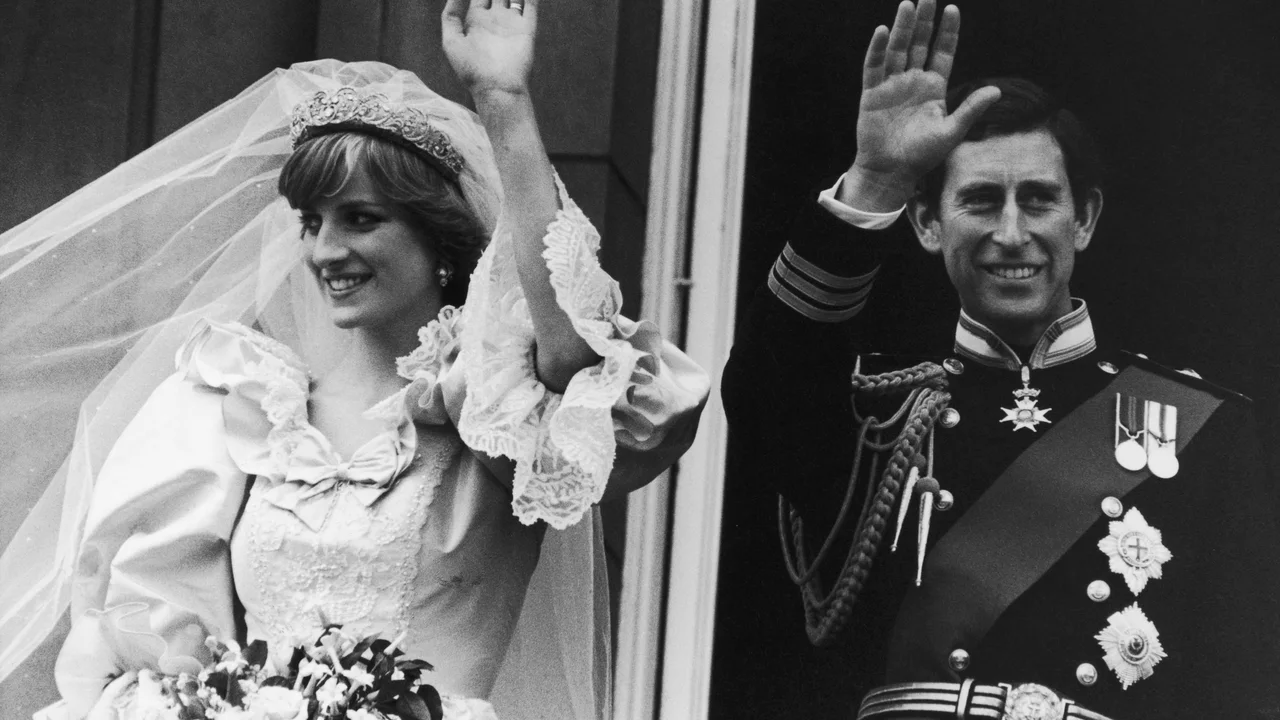
Thirty years later, August 28, 1996 remains a key date for understanding the history of the British monarchy. The day the divorce of Charles, then Prince of Wales, and Diana of Wales was made official, was not the end of a love story, but the administrative conclusion of a breakup that had been exposed to public opinion for years.
The marriage, which had been celebrated with a mass ceremony in 1981, had been officially separated since 1992, when the British Prime Minister, John Mayor, announced the breakup in front of the House of Commons. Four years in which the couple’s difficulties left the private level to become an international spectacle. The press, which followed their every move, turned their conflict into a permanent competition: Charles against Diana, the heir against the princess and the institution against a woman whose popularity had acquired a dimension that was difficult to control.
“There were three of us in this marriage”
In 1995, Diana gave the BBC the famous interview on the Panorama program, in which she spoke about Charles’s relationship with Camilla Parker Bowles, current queen consort, and the difficulties of their marriage, something that Charles would previously acknowledge and that would break the main code of the royal family, silence.
This interview had both personal and political consequences when shortly afterwards, Queen Elizabeth II informed the couple that they had to formalize their divorce. A definitive agreement that would be closed in February 1996 and its so-called absolute decree on August 28 of that same year.
A divorce negotiated in terms of power
For Diana, something more difficult to quantify was at stake than the distribution of assets. What place would she occupy after the divorce? And, above all, what margin would she retain to serve as a mother and public figure?
The agreement allowed her to retain her residence at Kensington Palace and a financial compensation of 17 million pounds, but would also strip her of her Royal Highness treatment, becoming Diana, Princess of Wales. A merely protocol detail that masked belonging to the royal family and an institutional position eliminated even though she was the mother of the future king’s children.
A freedom that came after breaking with the institution
Paradoxically, the divorce also allowed Diana to construct her public identity more independently, transforming the loss of her position into a different form of power.
Away from official obligations, she turned this popularity into a platform to defend humanitarian causes, from the fight against landmines to raising awareness about HIV/AIDS and the situation of the homeless.
He projected an image of closeness and empathy that contrasted with the traditional distance associated with the monarchy that gave him the spotlight that would end it.
The exhibition had a price
During the early hours of August 31, 1997, Diana died in Paris after the car in which she was traveling with Dodi Al Fayed, her then partner, suffered an accident while being chased by photographers.
The death of Diana, who was only 36 years old, caused a global shock and once again put the behavior of the media and the pressure to which she had been subjected for years under discussion.
Two people and an institution
A story that should not be understood as a confrontation between husband and wife, but as a reflection of profound inequality when, within an institution built for centuries around dynastic continuity, a woman’s place is reduced to the man she married.
Diana had to build her identity outside of herself, leaving behind a monarchy that could withdraw her treatment but not decide what to do with her influence and her voice.
Voice with which she not only broke with her marriage, but with the idea that a woman should be defined by the place she occupied next to a man.
