

Mindelo hosts the most famous carnival in Cape Verde
Mindelenses in the diaspora return to the city at three special times: the Bahía das Gatas music festival, on New Year’s Eve and New Year’s Eve, and at Carnival. This last festival causes the city’s population to multiply by two. The brilliance of the parades through the seven streets of the carnival route is possible thanks to the work of dozens of people who enhance one of the most recognized festivals in the country.
Dina Moreira does not see the carnival parade. It’s a loose verse. The cause? The carnival itself. Or, to be more exact, its previous one. This woman is the owner of Dinamor Confections, a textile workshop located in a neighborhood of the city where, with several weeks left until the parade, 20 people – twice as many as the rest of the year – work piecework to be able to make the dresses – the ‘fantasies’, they say – that will be worn by the members of two carnival groups: Monte Sossego and Samba Tropical. At Dinamor some cut, others adjust pieces, others sew. But, as we were going, Dina doesn’t see the parade. “The two days before I don’t sleep,” he explains. The body can’t handle it anymore. He asks for rest.
–What is the most complicated thing to make? –we asked.
–There is nothing easier or more difficult. Time is the most difficult.
The dressmaker, with 20 years in the profession, knows that the armhole of the watch is the one that puts the most pressure.
This is noticeable in the workshop activity. Although it’s worth it. The carnival, which takes up time and resources, also represents an important part of the sector’s income in Mindelo. Kátia Ferreira, who also makes fantasies for Monte Sossego, confirms this: “It helps me maintain the business.” In the months before the carnival, seven people work in his workshop. The rest of the year only two.
Kátia’s atelier is in a floor that looks like a bunker. You have to let them know by phone that you are out. You call and wait. When you go through the door, you notice that the opening system is attached to a rope that falls along the entire length of the staircase. You go up one floor and another and there is the rope, as if it were a thread of life. The other end is in the workshop. The system is simple. Flames. From the workshop they pull the rope. And the door opens. In the absence of an intercom and no time to go up and down stairs, ingenuity triumphs.
Kátia’s workshop is much smaller than Dinamor. It’s a flat. The core is in the living room. In one of the rooms the finished pieces. In another, remnants that, in a few weeks, will give shine and luster to the Mindelense carnival. Unlike Dina, Ferreira does watch the parade. In reality you see it from within, because it parades. Whether or not you sleep the previous 48 hours. He’s been doing it for 18 years. In 2020 he was a flag bearer, one of the most prominent figures in each school. In addition, she combines the last five with sewing. “I like being stressed,” she says, laughing. She has to make 70 dresses. This year’s designed by Valdir Brito. For Kátia, time is also a handicap. Although he adds another: the materials. It is not easy to find in Mindelo what you need to complete your fantasies. They pull resources inside and outside the island. Inside and outside Cape Verde. The diaspora is also responsible for facilitating the supply of beads, fabrics or accessories for the carnival. Everything to arrive on time for the appointment. «Many nights I get up and come to the workshop. “I work better in silence.” The antithesis of what is experienced during carnival days.
A town festival
Mami Estrela, university professor and social activist, co-author of the Strategic plan of the Carnival of São Vicente and São Nicolaupresented in 2014, recognizes that “the people are the owners of the festival. “They are the ones who make it.”
That invisible trick is spread throughout the city. It may be the semi-hidden apartment where Kátia sews. But also a workshop or scrapyard – it is not clear at first glance – where 12 men weld iron structures. They review sculptures on dilapidated trailers. Or they eat and rest for a while in the shade. Everyone knows what is cooked there, but, at the same time, no one knows what is done there. It is the estaleiro –’shipyard’, in Portuguese– where the Monte Sossego group builds its floats. The other five carnival groups of the Liga Independente do Grupos Oficiais do Carnaval (LIGOC) discreetly guard their estaleiros. “It is the most mysterious place,” says Antonio Augusto Sequeira Duarte, president of Monte Sossego, who has turned 40 and represents the neighborhood of the same name. Champions in the last three editions, in 2025 they came in second place.
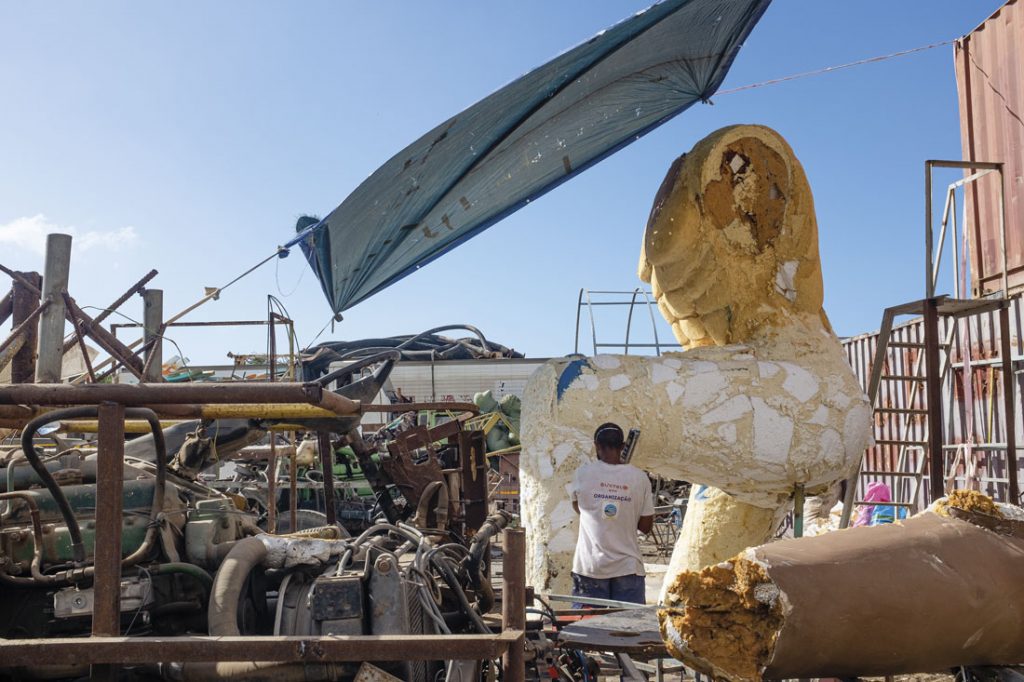
A visit to your estaleiro Weeks before the carnival do not allow us to guess what the theme of the year will be. In a container converted into an office and warehouse, Sequeira Duarte, Patcha, as he has been called since he was a child, reveals it with the commitment to publish it after the carnival event. The 2025 proposal has had to do with the origins of the neighborhood. covered in vermelha terra, Red land, Monte Sossego was known as “Indian land” because its inhabitants had their feet covered in the dust of the streets. This proposal fits with what Mami Estrela says: «The communities and neighborhoods are very active during the preparations. There is a lot of volunteer work. “It has a strong cultural identity that people identify with.” One of those details pointed out by Estrela, volunteering, becomes more nuanced with the passage of time. Now, most of the workers who make the floats are hired.
Patcha explains it:
–We have 12 people. Next week 25. Towards the end we will reach 34. It is less than a month away, but we will get there.
–Are you optimistic?
–Of course, always. The dynamic is always this. We are always behind.
As in the making of fantasies – work that is also paid – the lack of materials forces an exercise in imagination and readaptation of pieces from other editions. Remove from here. Put there. It’s an organized mess. Patcha lets herself go. Trust. The times of the creators, like those of the Church, are different.
–They accelerate. They brake. They contain. They accelerate again. They have the calendar in their heads.
The floats are one of the most striking elements of the parade. Samba Tropical, Cape Verde’s largest carnival group, is also in it. In their estaleiros Two 6.5 meter cars are built. The person responsible for coordinating this work, Tania Oliveira, maintains the mystery: “Only the school management can see the project.”
First trials
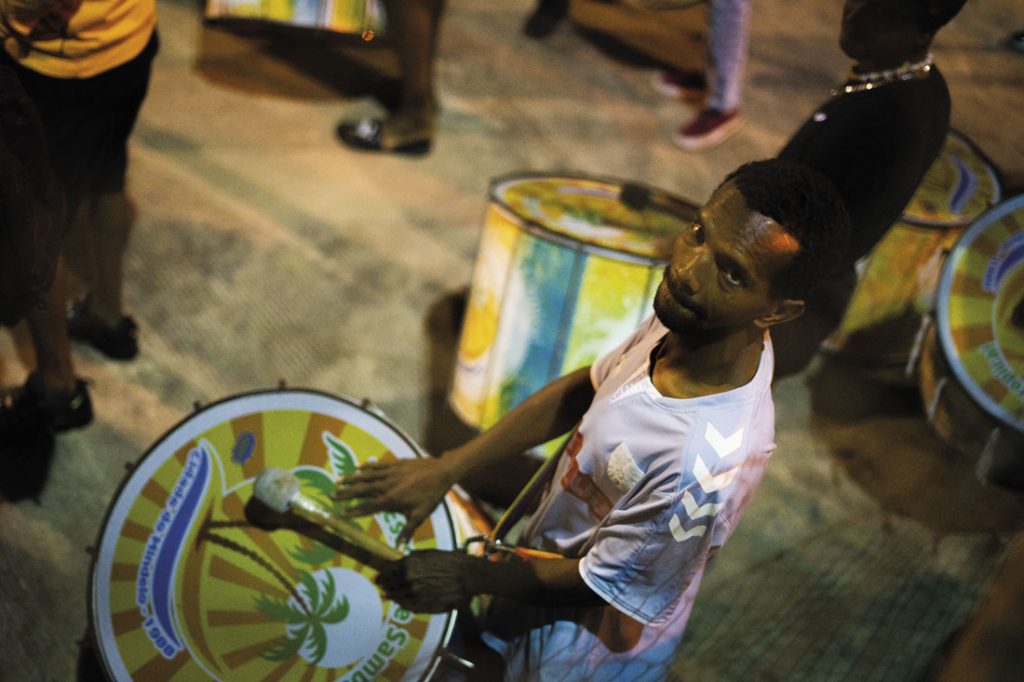
Carlos Alhinho, a Cape Verdean footballer and coach, gives his name to a football academy on 12 Septembro Avenue in Mindelo. With little discretion, due to the noise and the open doors, the first rehearsal of Samba Tropical begins. It’s January 31st and March 3rd is their turn to parade. Its president, David Jorge Silva Leite, comes and goes. Talk to musicians, dancers, percussionists: «It’s the first day, but the work starts six months before. “The team of artists designs the costumes according to the theme proposed by the school.” In 2025 they dealt with the history and trajectory of the city’s carnival.
The origins of the Mindelo Carnival date back to the colonial period, around the 1920s, when a group of Portuguese from Madeira began to celebrate the Entrudo festivities on the island of São Vicente, which precede Lent. “They were – explains Estrela – very discreet parties, with few celebrations in the street.”
Currently, with an aesthetic similar to the Rio de Janeiro Carnival, the teacher emphasizes that Mindelo is not the “son” of the Brazilian. The Madeirans who brought the Entrudo to São Vicente did the same with Brazil: “We have found documents that prove that the Rio Carnival started from here.” Of course, the Brazilian grew and grew. «The level of development of these traditions followed opposite paths. Río became an international influence, also for Mindelo. “We began to lose a little of our history to imitate them,” says Estrela with some nostalgia. Silva Leite points out that «we have nothing to do with Rio. “We want it to be something like that, but without losing our essence.”
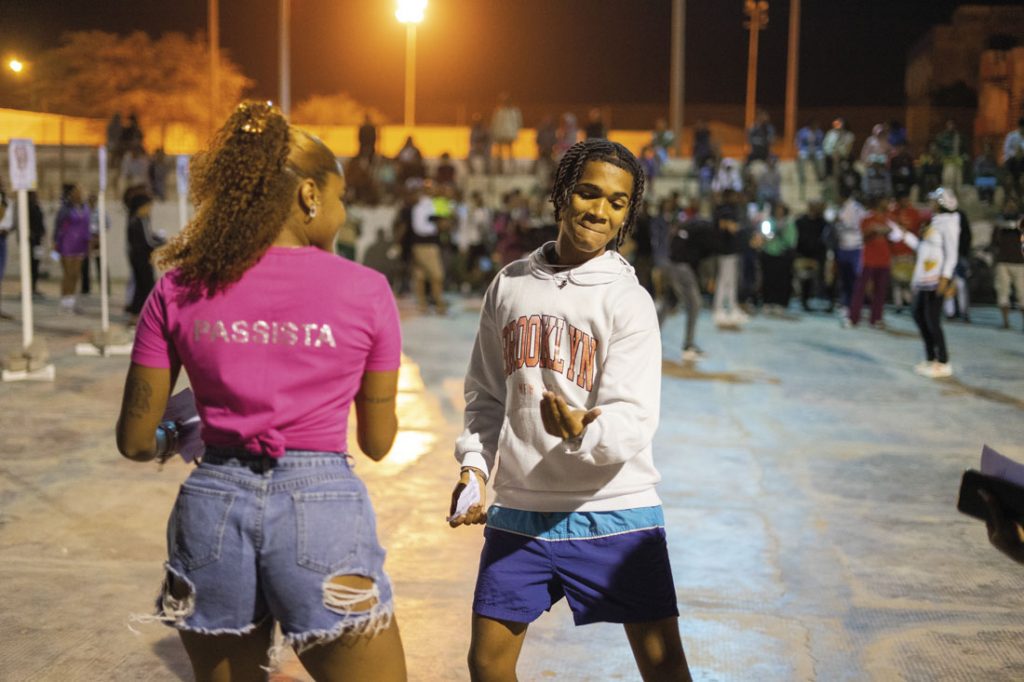
There is no hint of homesickness for other times at the Carlos Alhinho Academy. The temperatures move little, above or below, 20 degrees while the mountains move with impetus.passistas. Under the direction of the choreographer and with the roar of the batucada in the background, they begin to outline the steps.
Each carnival group is divided into wings made up of a variable number of people –Samba Tropical has 20 wings with a maximum of 80 participants in each one. Each wing has its costumes, the sketch of which is displayed, in a row, next to the Carlos Alhinho floor where dancers and percussionists rehearse. Two of the wings are dedicated to the tourist and economic importance of the carnival. His fantasies cost 20,000 Cape Verdean escudos, just over 180 euros, a considerable amount for a country with a GDP per capita of just over 4,200 euros. The person in charge of each wing must collect the money, pay the dressmakers and be in charge of delivering each fantasy to its bearer.
Information about costumes and rehearsal dates moves from phone to phone, making it easier for Cape Verdeans, including the diaspora, to participate. He Carnival Strategic Plan notes that between 2013 and 2014, international flights at São Vicente airport increased by 25% and the number of passengers from outside the country increased by 18.5% during this time.
Very close to the Alhinho Academy, the Vindos do Oriente group’s rehearsal space opens. It’s not time to work today. They celebrate a party, sponsored by a mobile phone company, which they accompany with the sale of t-shirts and bags to raise funds with which to undertake the thousand and one expenses that a company like this generates. After four years without competing due to the pandemic and the death in 2022 of its president, Lili Chala, and her daughter, who was only 57 years old, a few months later, Vindos do Oriente has returned to the Mindelense parade in 2025.
The impact and pride
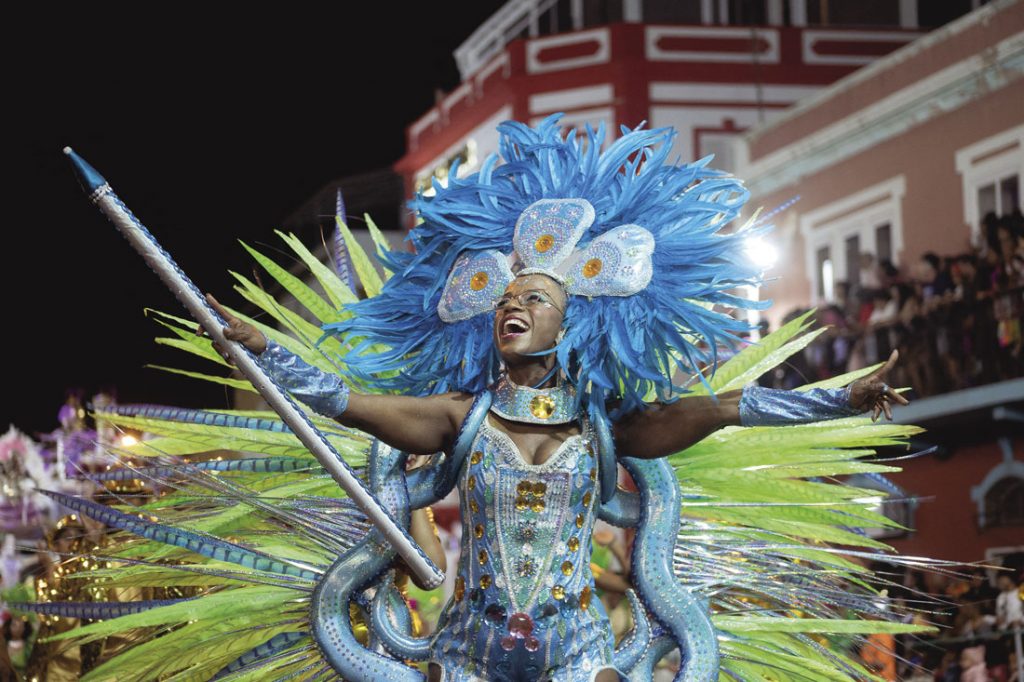
According to the Strategic Planthe cost of carnival decorations in 2014 amounted to 18.5 million escudos, more than 167,000 euros. That year five groups took to the streets in which 6,400 extras participated, 22 floats were built and 74 people worked on the estaleiros. They were joined by, among others, eight designers, 41 seamstresses, 60 musicians, 12 choreographers or six composers, because music is another of the legs on which the Mindelo Carnival is supported. Each group presents an original composition every year.
All of this – sewing, dancing, music and floats – is cooked in the back room of the carnival with the aim of marking territory in the history of the festival.
The fight for the title is fierce. The winner maintains, like a badge tattooed on the skin, the itch of victory for a year. Patcha recognizes, without hesitation, that “we work to win. “It makes no sense to participate not to win.” That’s why it hurt them to lose this year by a few tenths. After Cruzeiros do Norte and Monte Sossego were Vindos do Oriente, Estrela do Mar and Flores do Mindelo. Six groups, but five awards. Samba Tropical is missing. Because? Silva Leite responds:
–We have never competed. In 1988 some friends decided to create this group so that there would be a parade on Monday. The carnival takes place from Saturday to Tuesday, and before on Monday there was nothing.
It is another way to strive for the community, for fun, for revelry. Mami Estrela points out that “carnival is a liberation. It’s about giving energy to people, about forgetting sadness, about forgetting that we don’t have food to give to our children every day, about forgetting that we don’t have work. It is a party that allows you to live with joy for a few days, without thinking about what you have at home, because everyday life is very hard. As Dirce Vera-Cruz highlights, “carnival is heart, it is life, and only those who live here know it.”
Even Dina. Although not a parade. Although he sleeps while his fantasies travel along Libertad d’Africa Street, the old Lisbon Street.
