
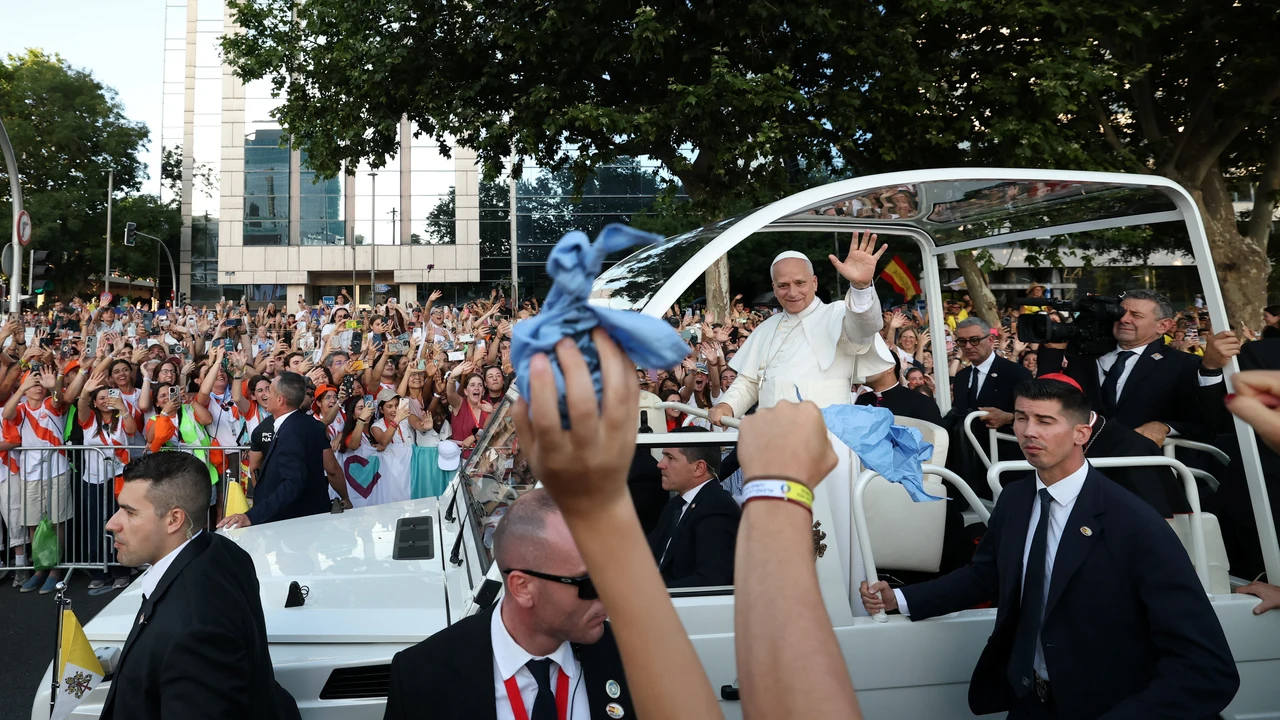
Pope Leo XIV arrived in Spain on Saturday in what is his first international trip to a country in the European Union. Beyond the agenda that awaits you in Madrid, Barcelona and the Canary Islands, your trip has an intention that goes beyond the spiritual. Now that there is so much talk about national priority, we find a Pope whose priority is humanity.
How will this trip define the Papacy of the first North American Pontiff? Fernando Arancón and Eduardo Saldaña analyze in The World Order of Julia in the wave the priorities of Leo XIV’s trip, focused on migration, his vision of Europe and counteracting the rise of the Evangelical Churches.
The symbolism of Leo XIV’s visit to Spain
It is the first official trip to a European Union country. It could have been anyone else, but it was Spain and that has quite interesting symbolism. For example, he is aware of the fight that exists within Christianity between the Catholic Church and the praise of the evangelical churches.
It also has a very clear position on the issue of polarization, the rise of the radical right in Europe and how the Catholic Church is trying to contrast values with that type of rise. Let us remember that he has confronted Trump and other “quite questionable” leaders.
Migration and his visit to the Canary Islands, Francisco’s heritage
There is another interesting variable and that is why it goes to the Canary Islands. The visit to the Canary Islands is an inheritance that Francisco left him because he wanted to go. Leo XIV has collected that legacy to honor his predecessor. The Canary Islands are one of the main entry points for irregular immigration to enter the European Union. It is interesting how Leo
The evangelical rise in Spain
Another key element is the evangelical boom in Spain. In this last month, we have seen massive events in Madrid. Does the Catholic Church perceive this as a threat? Yes, because without going any further, last week the Festival of Hope was celebrated in Madrid, an evangelical macro event promoted by the evangelist Franklin Graham, son of the famous evangelical preacher Billy Graham. There, Graham left moments like this: “I am here to tell you that God loves you and that he will forgive you tonight if you come to him through faith in his son Jesus Christ.”
Today there are one and a half million evangelical Christians in Spain and it is estimated that they will reach two million in 2027. Today, the place with the most evangelical temples is Catalonia, but where it is growing the most is Madrid, and that also has important symbolism in the fact that the Pope came to the capital first. It is estimated that the Evangelical Churches in the Community of Madrid have gone from 662 to 855 in just a decade and this directly affects the ability of the Catholic Church to recruit new faithful, not only in Spain, but also in Latin America, Asia or sub-Saharan Africa.
Rise of the radical right
This growth of evangelical postulates coincides with the rise of the radical right due to neoliberal economic and ultra-conservative social positions.
Leo XIV’s visit to Spain is marked by tensions between the Catholic Church and the extreme right. Not only because of the exchange of statements between the Pope and Donald Trump, but also because of the verbal attacks that Abascal has made to the Spanish Episcopal Conference. What is behind this confrontation? Are we really facing a Catholic Church that has turned to the left or simply a Church that follows the teachings of Christ?
According to The World Order, “it is a more coherent Church, I would not say that it is pivoting towards the left because Leo XIV spoke about homosexual couples or abortion or euthanasia and there it is clear that it is not left-wing.” But the Catholic Church is maintaining a “humanist discourse” that is not what the radical right maintains, which is social Darwinism, nativism, of what is inside against what is outside. “If the Catholic Church aspires to that universal church you cannot make distinctions between the Catholic of Spain and the Catholic of Cameroon. We are all children of God,” they explain.
“A figure like the Pope represents a first-level challenge”
For this reason, the speeches of the radical right do not go there. “This is a threat, he cannot enter, what is here is superior to what is outside and that speech is not Christian,” they say. Because “let’s think that a good part of the discourse of the radical right is fueled by a very Protestant discourse, which is the idea of social Darwinism, that if you do well in life it is because you deserve it. And that has nothing to do with the culture of Catholicism.”
The fact is that there is a “clash of world visions”, “first level ideology”, that is why Trump has made memes of himself caricatured as Jesus Christ because for these radical right leaders, who in a certain way, try to develop a certain authoritarianism and personalism as figures, “a figure of political and moral authority, such as the Pope, represents a first level challenge.”
