
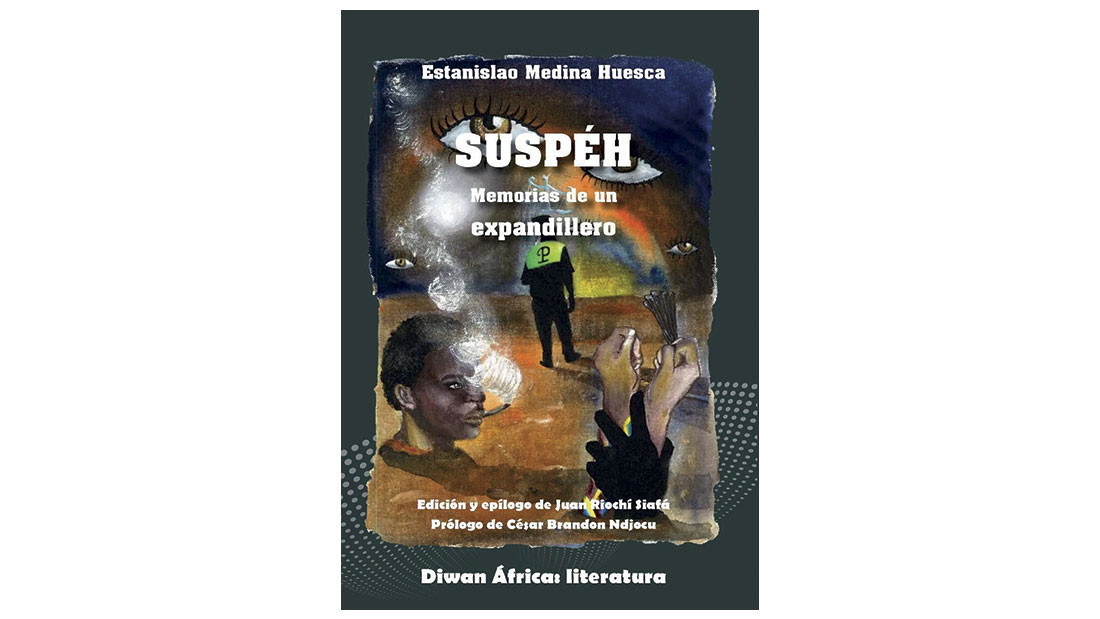
The Equatorial Guinean writer Estanislao Medina Huesca published his third novel in 2020: Suspéh. Memoirs of an gang member. According to the author, reading this work can be useful to understand both the recent visit of Pope Leo XIV to the Central African country and the foreign policy of the United States in the country, marked by the exploitation of its natural resources, especially oil and gas, both fundamental for the Equatoguinean economy.
I want to be like Donald Trump. Or better. I want to be like Pope Leo XIV. And if so, it would have the power to place Equatorial Guinea on the agenda of international society. The fact is that I am not the head of an earthly (USA) or spiritual (Vatican City) empire. I commune with Suspéh. Memories of an gang member (Diwan África, 2020), a novel by Estanislao Medina Huesca (Malabo, 1990) whose plot uses oil, the singularities of Spanish from Equatorial Guinea and gang activity, to tell a story that does place the former Spanish colony on the international geopolitical agenda. Reading this novel – which I recommend is mandatory – helps to interpret two recent phenomena: the visit of Leo
If the wars declared by Trump since he came to power for the second time have oil and gas as their Achilles heel, Medina goes back in time with Suspéh. Memories of an gang member until the 1990s, when North American oil companies began to exploit both resources in Equatorial Guinea or much earlier, after the coup d’état of 1979. The period after this year projects a country that signs agreements with member countries of the EU and with Washington, breaks away from the former USSR, and Pope John Paul II, head of State of the Vatican City, visits it. The protagonist of Medina’s novel is an adult man who, motivated to achieve a better future, leaves the island of Annobón at this time, settles in Malabo with his family and gets a job in an American oil company. However, it encounters a country divided into two social strata: a small group, made up of people enriched thanks to nepotism, and a citizenry abandoned by the inaction of public institutions. The result mainly hits the protagonist’s home. His wife dies, his daughter becomes pregnant as a teenager and his grandson joins the Malabo gangs – his daily life is robberies, drug consumption, murders.
The oil and gas industry, despite social inequality, not only enriches a minority, but also the oil companies and a conservative and corrupt local Catholic Church, far removed in form and substance from the repeated recommendations of Vatican City.
Suspéh It is the third novel by Medina Huesca. It adds to The albino Micó (Letrame, 2019), and Barlock: Children of the Great Owl (self-publishing, 2016). The three novels are written with marked stubbornness because Medina does not give up.
He uses the Spanish of Equatorial Guinea to write, a language variety that integrates specific words and phrases from the five – six – ethnic languages of the country, and that would function autonomously if it were not trapped by multiple erasure. In relation to deletion, on one side are the Spanish publishers, who with the excuse that they are companies eliminate content from works that do not adapt to “Spanish Spanish.” On the other side, a group of intellectuals from Equatoguinean exile positions themselves, composed, for the most part, of men integrated into ethnic nationalist political parties. This group, even when the works they write – themselves – are in Spanish, use the privileged access they have to the publishing world to avoid the publication of works narrated in Spanish “not from Spain”, because the Spanish of Equatorial Guinea hinders their nationalist agendas and “degenerates” the ethnic languages they wish to recover. The political regime of the country is also situated in this enterprise of erasure, whose leaders do not promote the Spanish of Equatorial Guinea or a State identity capable of uniting the human diversity that underpins it.
AND Suspéh. Memories of an gang member turns six years old now, in 2026.
And Donald Trump no longer has oil to exploit: he uses the prisons of Equatorial Guinea to throw away migrants.
And it will be known in the future why Leo XIV visited the country of Suspéh.
