
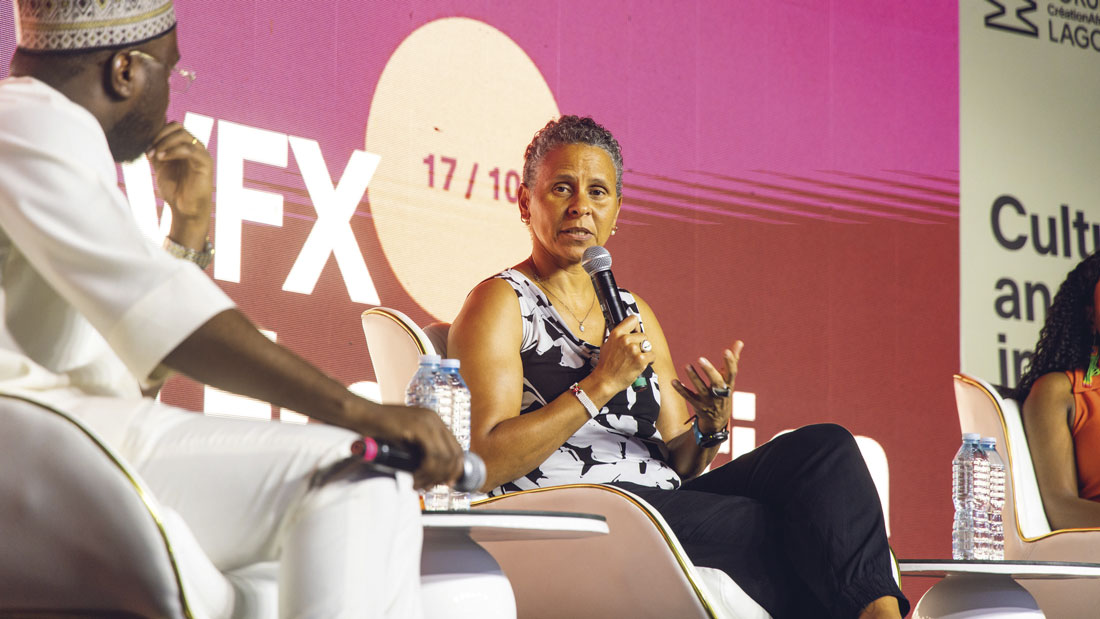
Yvonne Muinde, plastic artist.
By Analia Iglesias
This Kenyan special effects expert, responsible for creating the fantasy worlds of hits like Avatar, The Hobbit, Black Panther either Guardians of the Galaxyhas chosen to return to his continent to set up his own company with a Swahili name, Ikweta Arts, and work from there for international cinema.
Perhaps what draws most attention in her presentations as a prominent special effects artist in the great Hollywood industry is her status as a high-performance athlete. And with more than 50 years of age. Yvonne Muinde, Kenyan visual artist and filmmaker, who has earned awards and reputation creating immersive atmospheres and landscapes in films such as The Hobbit, Black Panther, Guardians of the Galaxy either Avatarcan seamlessly unite the world of triathlon and the African desire for talented people to shine in the field of international cinema, art and entertainment, wherever they come from.
“When I say ‘Kenya’, you think of athletics, animals, stereotypes, even though this country and the continent are very complex and diverse,” says Muinde. In this sense, she explains that she challenges those beaten places, since she has come to stand out in a specialty of cinema “dominated by white men.” And, if that were not enough, the triathlon “is a symbol” of their “own journey and, in essence, a bit of that same story, that of Africans who do not practice triathlon because they do not swim or cycle.”
To this renowned Kenyan artist specialized in matte painting (digital painting for cinema), a recognized figure in the field of visual effects worldwide, we found her in Lagos (Nigeria), in the framework of some inspiring talks that brought together renowned professionals from the continent with their disciples from all shores, both North African and those from East or West Africa, promoted at the Forum Création Africa.
There he spoke about his life itinerary: his time of more than two decades in the United States; of the reconversion that he needed to do “to pay the bills”, from his profession in fine arts to design for the film industry; of his desire to return to his homeland and that of his parents; of the creation of his own production company –Ikweta Arts– and his love for hard training and sports competition. In a subsequent dialogue with News Now Nigeria we were able to reconstruct the highlights of that trajectory and ask questions. What follows is part of the talk held in one of the rooms of the emblematic Federal Palace hotel, on Victoria Island (Lagos), where the Nigerian nation signed and celebrated its independence from the British Empire in 1960.
Are you the triathlon and Iron Man woman?
I did half Iron Man (laughs) in Rwanda, in Finland, in Durban (South Africa)… I started preparing three years ago, at 47, because I wanted to compete on my 50th birthday. At my age I have to organize myself well. Before, I ran, swam and played field hockey. I’ve always done something. To be honest, the reason I do all this is because I sit in front of the computer for 10 to 12 hours a day and my body and mind deteriorate. I started traveling because of the need to be with human beings, to ride a bicycle or simply to visit beautiful places.
He left Kenya when he was 18 to go study in the United States.
I was in Georgia (USA). There I went to Savannah College of Art and Design. Then I transferred to the Academy of Art College in San Francisco.
Was it from that moment on that, as you say, you began to paint pictures for the casinos in Las Vegas in order to pay the rent for your home?
Yes. And then I learned that knowing what the client wants is very important. And you find a collector who buys your work and everything goes this way.
Without losing the dream of being in a museum…
I still want to be in a museum.
In the talk with the young artists, she mentioned how much a photo with her father moved her.
It is important to me because, growing up on the continent, and specifically in Kenya, at that time, everything indicates that you have to be a lawyer, a doctor or an accountant to be among the professionals who can make a living. My father and mother always supported me, convinced that I could make a living from art… That was something historic, really significant. I wanted to make him proud and assure him that he had not wasted his money, because he paid for my studies and defended my dreams.
How was the transition from fine arts to the visual effects industry?
Awful. It took me another three years of training. My husband worked in visual effects and encouraged me to go into the field. matte painting. Traditionally, in the beginning, this technique consisted of painting on glass. In Los Angeles it was run by a small, closed group of men and you could only access it if you were accepted into that community. You learned from them. When we went digital, the space opened up a little and more people had access to this work. Then we project in 3D on the computer. So I got fully into this and discovered that I liked the fact that I was working in a studio, with people, because fine arts are very lonely. Furthermore, it allowed me to travel the world because in the visual effects industry they make it easy for you to go from one place to another. That’s how I ended up in New Zealand, where my daughter was born.
How did you plan to return with your family to your continent, to your country, to your city?
Mainly for my parents and my daughter, so that she understood her grandparents. I missed them a lot, although I always knew that I would return to Kenya or, at least, if I missed the opportunity to attempt a return, I would regret every minute. It was hard to get used to, but I’m home. We moved when my daughter was six years old and, after a few years, Nairobi is now home. I feel like I have a place, like my shoes have a place to rest. I still go to Los Angeles for a few weeks and come back.
She had to get used to a country to which perhaps she had only gone on vacation, or where she had only resided as a child…
I spent 28 years abroad and, you know, the experience is very different. Also, as an adult who had never worked in Kenya, I had to slow down, because this country has its own speed. We are enjoying it; Although this capital is surprisingly expensive, it is incredibly beautiful. I love it, too, because of how international it is: everyone is in Nairobi.
In Nairobi he founded something very important such as Ikweta Arts, which means…
‘The equator line’, in Swahili. This way we always know that we are in the center. I’ll be honest, I still have to do most of my work outside of Kenya, remotely, because there is no VFX infrastructure in my country yet. But what that taught me was that the way I was thinking when we arrived several years ago was too ambitious. We reduced expectations and thought about raising awareness and, to do so, we must talk about study and training.
Are you a visual effects company that operates internationally?
Yes, and that’s the difference, in that the industry knows that they can send part of the work for a film to Nairobi and there won’t be any difference with what is done in Paris or Los Angeles. Little by little we are getting there, we are still putting the pieces together. I work with studios in Australia, I’m starting a project for China… I want people to appreciate what great work can be done on the African continent. At least I am the same person, the same professional. I’ve just moved to a sunny place. My challenge remains how to make the transition to bring more people on board, because the difficulty with visual effects is the infrastructure. They can’t be done on a laptop or iPad; You need a suitable machine to aspire to an international level.
You have said that “the canvas changes, but the artist remains.”
I want to say that my canvas used to be a canvas for oil painting, then it changed to murals on the wall, and then it changed to the inside of the computer. I may be in the DaVinci Resolve program, but I am still me, with my own sensitivity, regardless of the material I use.
Is this also possible when it comes to industrial work, such as Hollywood cinema?
The beauty of matte painting In this entire industry is that we are given a blank canvas. In reality, the name of the technique can lead to confusion. We do not paint: we handle a collage incredible photography, because everything has to be very sharp and then in 3D.
Do you think that the work on African cosmogony is at a stage of development conducive to expanding and being understood in other countries?
Our history is as global as that of any other place. I still think that the plots and aesthetics have to return to our origins and our particularities, and perhaps not take as much as a model those of Star Wars. We still have to work on finding our own voice. How do you get there? We have to keep trying, exercising. If we don’t produce, we don’t progress. So we are ready. We have been ready for a while. Are the others ready? Because seeing what’s out there, in the world, everything looks very similar, since the same five images are generated over and over again in all the films. After a certain point, originality also stagnates.
Do you feel that, sometimes, big studios hire you to do international projects that are very neutral in terms of their aesthetics?
Yes and no. I took the time necessary to learn the trade, the technique, and I am very quick with orders. That is my own power and what makes me valuable. I understand what they want, I can take subjective things and say, “I can apply them and make them happen.”
Is this leaving you time for your own projects?
Yes, because, at the end of the day, we all want to sign the canvas, right?
Tell us about your next step, The African Project.
It is a documentary about triathletes, because for me, as a director, they are everything. It’s about six of us. The triathlon is also a symbol of my own journey as the only black woman in a men’s profession. In this case, we are talking about Africans who do not practice triathlon because they do not swim. But Kenya would be an incredible country for triathlon because of its endurance, although swimming is simply that obstacle. In addition, triathlon is also excessively expensive. This is another barrier you run into: when you go to Finland or Hamburg (Germany), you see people with $8,000 or $12,000 bikes, while you have a $1,000 bike. However, we are here and we want to do it, we are going to compete as best we can, we love doing it and we can improve. The community is growing and interest in the discipline, too. So, in this project I say to myself: “I shouldn’t be here, but I am,” and I show it.
