
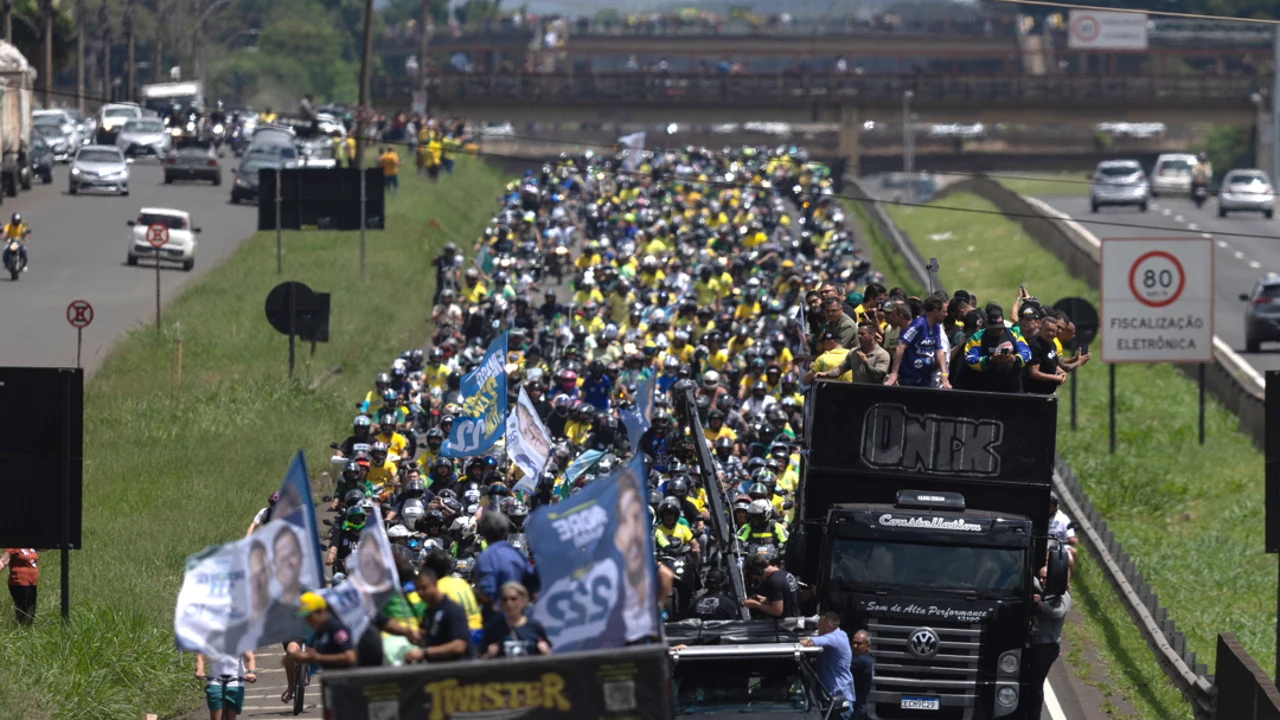
Brazil’s presidential elections face a first round marked by equality between Lula da Silva and Flávio Bolsonaro, son of former president Jair Bolsonaro. As explained by Blas Moreno in The World Order of Julia in the waveeverything indicates that neither will achieve an absolute majority and both will face each other in a second round on October 25.
A deeply divided country
The scenario drawn by the surveys is that of a deeply divided country. Lula would start with a slight advantage in the first round, while Flávio Bolsonaro would be ahead by just a few tenths in the second: 50.1% compared to 49.9% for the current president, according to the polls cited during the conversation. In this context, the vote of the undecided, estimated at around 3%, can be decisive.
“The country is divided in two and, basically, there is a key, which are the undecided, who are estimated at 3%, nothing more. They are the people who have not yet decided who they want to vote for, which is quite significant because, either you hate Lula or you love him. And with Flávio it is the same: you are either against him or in favor of him,” he assured.
Points for and against each candidate
Lula’s candidacy is marked by his extensive political experience, after having governed Brazil for twelve years in two stages, but also by his age: he is about to turn 81 years old: “He has governed 12 non-consecutive years, but he is about to turn 81 years old.”
Moreno has pointed out that in the country there is a feeling similar to the one that existed with Joe Biden, of “end of cycle” and “very fed up” with the president: “Because the economy, it is not that it is going bad, but it seems that way to many people. There have been issues of corruption involved and the feeling that we have to move on. I believe that if Lula wins, above all it will be because he has someone in front of him who is not very good and who is considered daddy’s son.”
Flávio Bolsonaro does not have the political experience of Lula nor, in Blas Moreno’s opinion, the charisma of his father, Jair Bolsonaro. Therefore, his possible victory would be explained by the wear and tear of the current president and by the desire of a part of the electorate to put an end to an era.
