
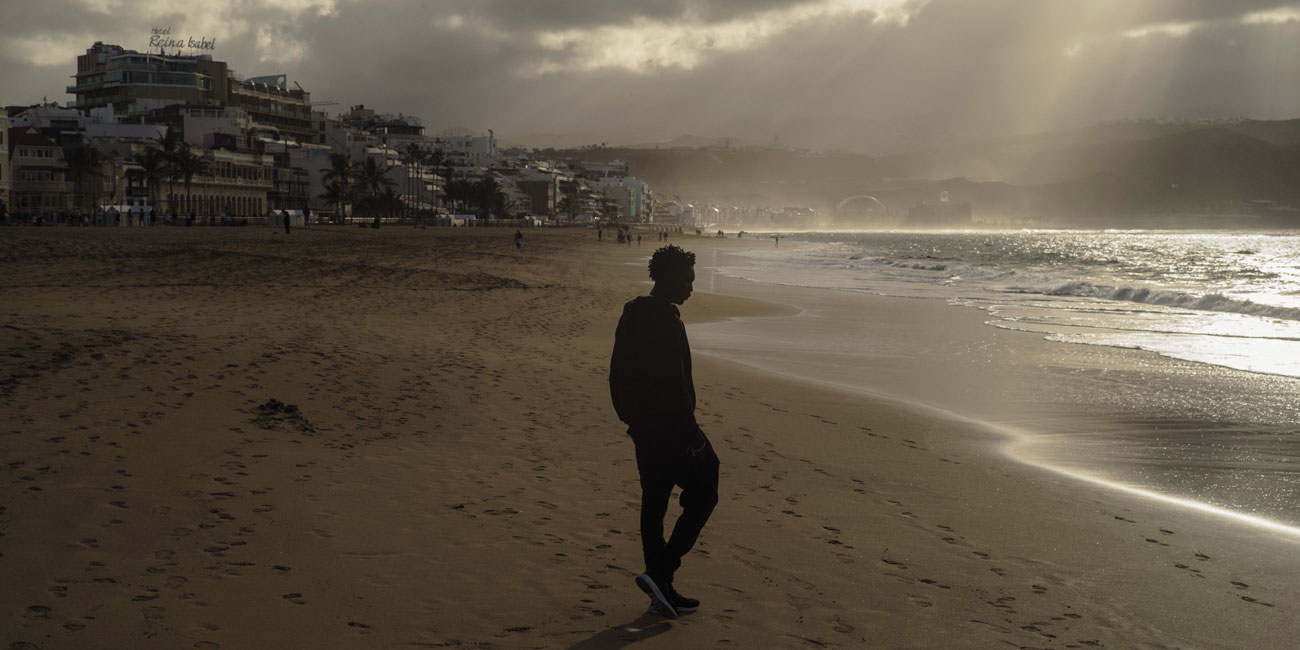
The Church in the Canary Islands welcomes, protects and integrates migrants who arrive to the archipelago.
By María Ángeles Fernández, from the Canary Islands.
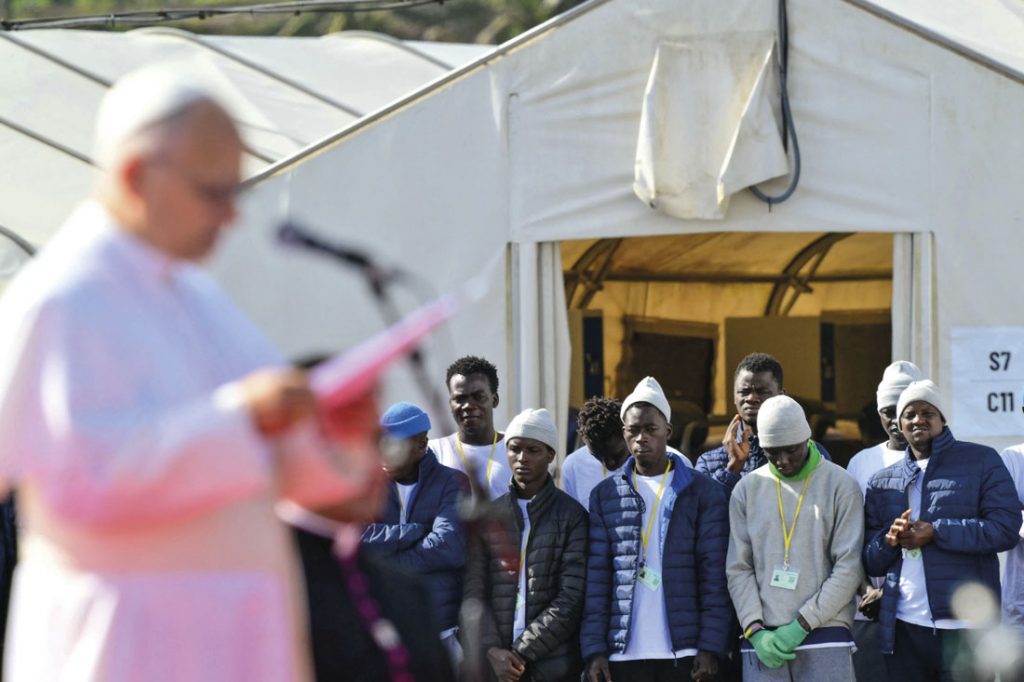
The third stage of Leo XIV’s journey to Spain was to the Canary Islands. With this presence, in addition to fulfilling the wish expressed on numerous occasions by his predecessor, Pope Francis, the Pontiff has experienced the migratory reality of the archipelago, the destination of thousands of migrants who leave in precarious boats from the western African coasts. These days, he has also learned how the Catholic Church works in this context.
The visit of Leo
Leo XIV arrived at one of the main gateways to Europe, a border where each canoe that reaches the coast contains a story of suffering, bravery and hope. The Canary Islands have become a place where thousands of people see an uncertain journey end and another full of questions begin. But it is also a land that, in the words of Bishop José Mazuelos, bishop of the Canary Islands, “has proven to have a wide waist to welcome.”
In the two days that his visit lasted, the Pope found a Church that has been working alongside migrants for years. A Church that does not usually make headlines, but that accompanies, listens, feeds, guides and supports those who arrive with what they have after having left poverty, violence or lack of opportunities behind.
Understanding the migration that arrives in the Canary Islands requires looking towards Africa. Towards Senegal, Mauritania, Gambia, Mali…, towards regions punished by poverty, political instability, violence or the absence of horizons for the youngest. Caya Suárez, General Secretary of Cáritas Canarias, describes African migration as a forced and involuntary decision. He points out, with regret, what he has heard so many times from immigrants themselves: either they risk dying on the journey or they die in their country. The head of Cáritas also insists on another little visible aspect: the “migratory mourning.” Because migrating does not just mean physically moving. It means breaking with the family, with the language, with the roots and with everything that makes up the identity of the person.
Often, when the boats reach the Canary coast, the journey is not over. Another, quieter journey then begins: that of adapting to a different culture, learning a new language and rebuilding a life away from those left behind.
Welcome, protect, integrate
Faced with this reality, the Church, both in the Diocese of the Canary Islands and in Tenerife, has developed a wide network of projects that attempt to respond not only to the immediate emergency, but also to subsequent integration processes. It is about helping people build an autonomous life. Thus, the work ranges from attention to basic needs to legal support, administrative regularization or access to employment, in addition to accompanying women, minors and the incarcerated population.
In the case of those who enter prison, many of them accused of being masters of the boats that arrive in the Canary Islands, they also do not have family networks or social support. The penitentiary ministry, coordinated in the Diocese of the Canary Islands by the Claretian missionary Fr. Dionisio Rodado, and in which a good number of professionals and volunteers participate, tries to cover needs such as facilitating communication with families through something as simple, but for them sometimes unattainable, as a telephone call. Also, through the Rehoyadas Association, they accompany them in the reintegration processes once they obtain one of the prison permits or are released. Getting out of prison and returning to society is not easy. Having to do it without a family to welcome you, in a foreign country where you may not even know the language, seems like a more than complicated task.
The linguistic issue is one of the main difficulties faced by migrants arriving from Africa. It is essential that they can communicate. To achieve this, projects such as Sansofé have been launched, in which a large group of volunteers teaches Spanish classes at the Tenerife Seminar, located in the town of La Laguna. We visited them on a Saturday morning. The names of all the students are written on the blackboards in the classrooms. Nobody is anonymous here. Samba is one of the oldest and you can see that he moves around the building with ease. He tells us that his immediate goal is to learn Spanish well, get a job and be able to send financial aid home. “I am a family man and I have to help my family.” But he also expresses something significant: after receiving support, he himself now wants to help other young migrants. We do not know if he knows the meaning of the word “referent”, but we are convinced, by his attitude and his desire, that he knows that he is one for the boys who have just arrived. As he recognizes, if he was able to learn Spanish, everyone else can and should do it. Maybe your future depends on that. With his firm and confident gaze he seems to say that he who has come this far risking his life cannot take half measures, he has come to give his all.
The immigrants fill three classrooms dedicated during the week to training future priests. Not only are grammar classes taught there, but it is a space for emotional and cultural welcome. Teachers are clear: their students need something deeper than learning vocabulary. They need to feel seen, heard and accompanied. The classroom thus becomes a place to regain confidence and begin to understand the society in which they try to integrate.
The coming of age
One of the most complex aspects of the migration phenomenon appears when warded minors reach the age of majority. Suso González, Migration delegate of Tenerife, regretfully recounts how the majority arrive on the Canary Islands coasts “absolutely disoriented.” They are often transferred from one island to another without knowing their rights or legal status. Up to 18 years of age they have institutional coverage, accommodation and maintenance. But when they reach adulthood, they are left out of the protection system and move into a situation of extreme vulnerability. It is at this time that many run the risk of becoming trapped in social exclusion.
To respond to this reality, the so-called “hospitality corridors” emerged. The objective is to connect these young people with dioceses and communities on the peninsula that can offer them welcome, personal accompaniment, training, job opportunities and, above all, the possibility of belonging to a community. Those who work in the field of migration insist that integration is not achieved with economic resources alone. It takes closeness, time and stable human relationships. Thus, there are many young people who find the first place where they feel expected by someone again in a parish, a host family or a group of volunteers.
But the Church also puts resources in place so that young people can stay on the island. In all likelihood, one of the most innovative initiatives is the Ben Project, promoted by the Migration Delegation of the Nivarian diocese. The name of the project has a strong symbolic load. As Arancha Méndez, responsible for the Human Mobility Program of the Diocese of Tenerife, tells us, the word “ben”comes from terms linked to ancient Canarian aboriginal languages; It also has Arabic and Hebrew roots in which it means ‘son of’. The message is clear, we are all someone’s children and we are all children of God.
Among the narrow and steep streets of Santa Cruz de Tenerife is this home that houses four young people. Because it is not just a conventional healthcare resource. It is, above all, a home. The volunteers prepared the home “as if it were for their own children.” And so they welcome us, into their house, with the table ready to have a snack and introduce us to the family. Bacar, one of those who has lived here for a few months, arrived by boat in 2023. In Spanish still in mantillas, he tells us that he wants to study something related to human rights and describes the project as “a great opportunity.” At his side is Mohamed. He just celebrated his 19th birthday. Just a few months ago, after coming of age and leaving the juvenile center, he spent some time living on the street. Now he wants to study ESO, work and help his family financially, while trying to build a quiet life in the Canary Islands. It’s his turn to prepare the food and you can see some anxiety, because we journalists are taking too long and he doesn’t want to neglect the responsibility he has at home that day. Before saying goodbye and getting into the kitchen, he stops for a while to talk to one of the home volunteers who later tells us that Mohamed has asked him if recording with a camera is also studied. Perhaps on that Saturday morning a new path began to open up for this young man to explore.
The heart of welcome
And behind all these projects the role of volunteering always appears. Older people, young people, consecrated people, professionals and even entire families who dedicate a good part of their time to preparing meals and clean clothes, accompanying them to a medical appointment or a job interview. But, above all, to listen and be present. It is difficult to find a welcoming initiative in the Canary Islands where they do not appear. They are the least visible face of this work and, however, they constitute its true heart. While institutions design programs and administrations manage resources, it is the volunteers who put a name and face to each story.
Stories of pain and hope that during these days the Pope has been able to learn first-hand, thus also fulfilling the wish of his predecessor, Francis. With his presence, Leo XIV has put the spotlight on a reality that usually remains on the borders of our most immediate concerns, but that has thousands of unique and unrepeatable faces and names. The one with Samba trying hard to learn Spanish to help his family. That of Mohamed imagining a future that just a few months ago seemed impossible. That of foreign inmates who try to rebuild their lives after leaving prison. That of the volunteers who return to classrooms, shelters or prisons every week without expecting any recognition. And that of a Church that, in the middle of the Atlantic border, continues to remember that no one should feel like a foreigner when what they are looking for is simply a place to live with hope.
