
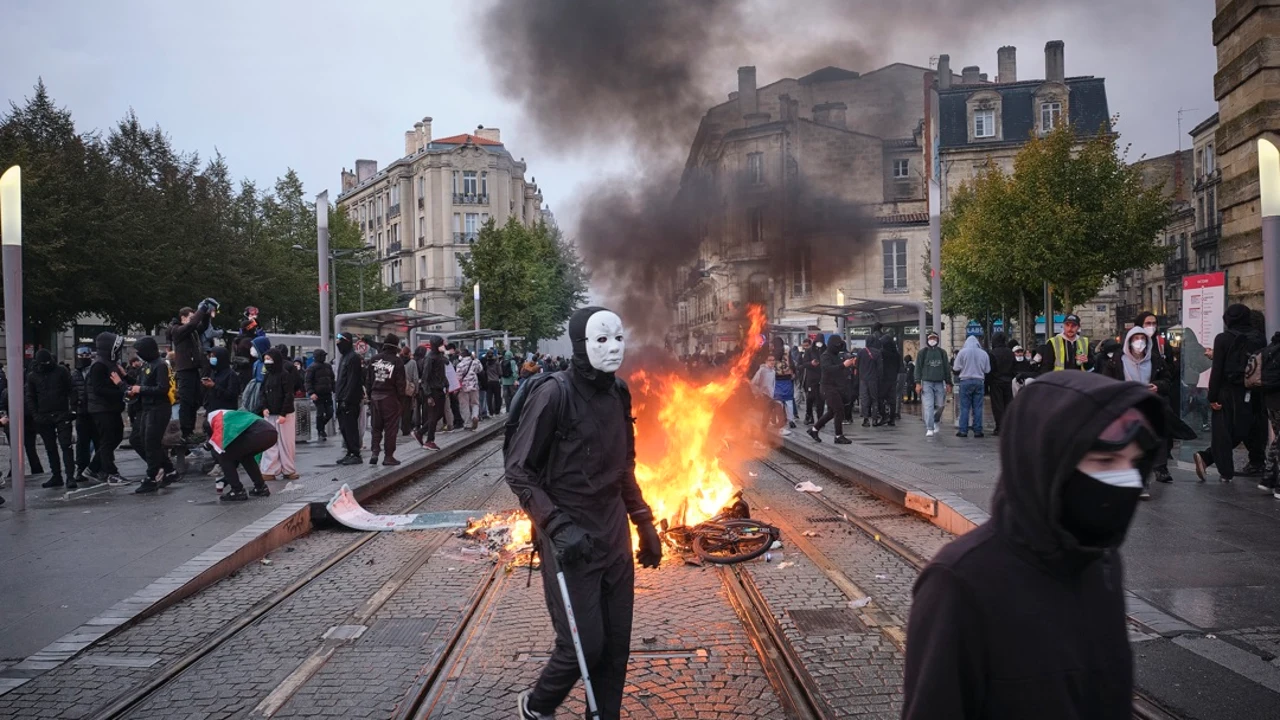
Europe has been experiencing a wave of protests for a few weeks. The continent is in the streets with mobilizations of all kinds and objectives. Hundreds of thousands in France, Spain, Italy, Albania, Portugal, Belgium and Greece, to which are added the altercations that occurred this Saturday night in Barcelona and which left more than one hundred arrested, including more than 70 minors.
Eduardo Saldaña explains in The World Order of Julia in the wave that it is not a single movement or a joint call, but rather each country has its own problems and these have converged over time. Despite this, there are social movements that are trying to coordinate because there are transversal problems that affect Spain, France, Portugal, Greece or Italy, where there are structural crises: “We can say that the common denominator is the cost of living, housing and education problems.”
What happens in France or Italy?
In France, we have seen that many of these protests have led to violence in the streets and looting. In fact, this weekend curfews have been established in several cities, some unauthorized demonstrations have been banned or have even changed their route to avoid police clashes.
In Italy, for example, riots have been seen in Milan or Rome. And then in Albania or Belgrade there have been strong clashes against the Police, but those, despite having that background of the crisis of life, are much more directed against the corruption of governments, an approach that has not yet been seen in Western Europe.
The interest behind these protests and their vandalism
Saldaña asks to be careful and analyze who can benefit from this whole situation. As an example, he gives what was experienced in the streets of Barcelona this weekend because what happened in Barcelona is “different” from what has been seen in France: “In France, there were massive protests and, within them, as usually happens, different groups tried to generate chaos. But in Barcelona, on the contrary, we have seen that Internet groups were organized throughout the week to carry out this violence and chaos to the streets.”
He explains that “there are people who are dedicated to networks and digital analysis who are warning that there are those who are trying to instrumentalize these mobilizations and this chaos that is perceived. We have to keep in mind who may have an interest, in such a large electoral cycle that we have, in generating instability. Profiles that are inside or outside of Europe.”
The underlying problem of the protests: a crisis from ten years ago
The expert assures that there are no very specific and recognizable demands, but that they are trying to unite a little. For example, in the north of Italy (Milan), there are protests more aligned with the demands of France and Spain, while in the south, there is a very strong truckers’ strike that is leaving supermarkets without supplies.
Therefore, the underlying problem is that it is “very difficult” to meet the demands in the short term because it is not a “sporadic crisis”, but a “structural crisis in a very complicated regional and global moment”: “We are not experiencing the consequences of a crisis from two years ago, but rather we are experiencing the consequences of a crisis from a decade ago, of the problems that were not solved and the system is tightening, the seams cannot hold.”
An “amendment to the entire system”, but not for something that happened one or two years ago, but for problems that were not solved when they had to be and with a more turbulent world like the one we live in today.
Foreign governments are “rubbing their hands”
The radical right is on the rise throughout Europe, there is a feeling of general instability and we are in the middle of the electoral cycle, with several countries voting or about to do so. To what extent can this be taken advantage of by third parties to further destabilize or obtain political gain?
“Putin is rubbing his hands, without a doubt,” explains Saldaña, who adds that “we have no doubt that these legitimate social mobilizations and the tension that we find in Europe are going to try to be taken advantage of by countries and governments that have a clear interest in generating instability in Europe.” That is, “take advantage of the crisis of liberal democracy itself to go against it.”
In fact, he explains that there are Russian disinformers promoting stories and narratives and spreading images of violence and chaos. But not only Russians. He asks to remember the US national security strategy from a year ago, which focused on “supporting the nationalist right.” “The United States and Israel have a clear interest, in an electoral macrocycle like the one we find ourselves in and with radical rights on the rise, to project an image that Europe needs a strong hand and security. And there may be a need for that, but not the chaos that is being projected. We have to be aware that liberal democracy faces this wave of misinformation and that it tries to go to our viscerality.”
