
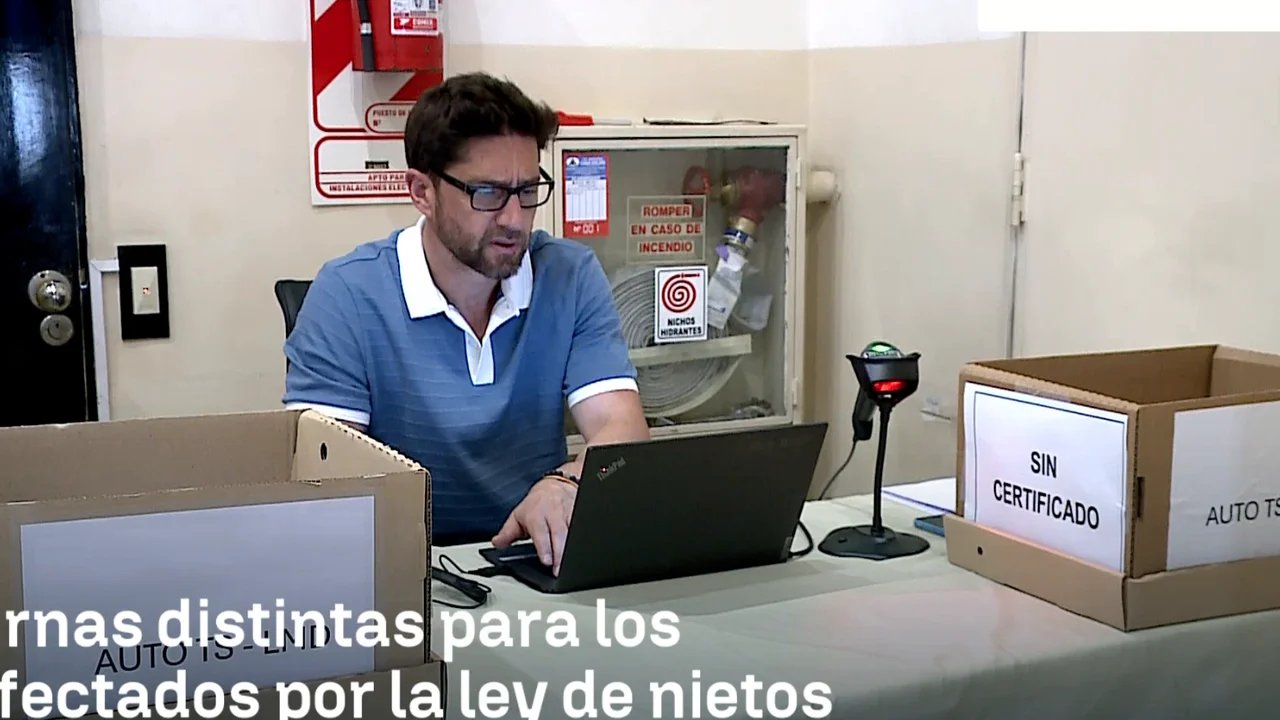
A few days before the general elections, images have come to light in which several people vote in the consulates of Buenos Aires (Argentina) and Caracas (Venezuela) in cardboard boxes. An image that has sparked controversy and has provoked criticism from the opposition.
Alberto Núñez Feijóo himself has pointed out in his interview in More than One that it causes him “concern” that “possible citizens” who do not comply with the law in terms of nationality vote in “cardboard ballot boxes”, although he trusts in the consuls and that the system adequately supervises these cardboard boxes.
Why are there cardboard ballot boxes in Spanish consulates?
The reality is that those affected by the grandchildren law, who now have their vote suspended by the Supreme Court’s precautionary order, can cast their vote, but not in the default ballot box in which people registered on the electoral roll vote.
This occurs precisely by order of the Supreme Court and not the Government. In an order dated October 23, the Supreme Court establishes precautionary measures for the deposit of the vote in the ballot box at the Consular Offices. If a person goes to the place and is not registered on the electoral roll list due to the ‘suspension’ of their vote by the courts, the consular officials will receive their electoral documentation, but they will not put it in the ballot box, but rather they will keep it “apart” for sending to the competent Provincial Electoral Board.
Thus, this vote must remain “duly differentiated”, as established by the Supreme Court itself, which is why it appears in the images marked in a separate section and in a cardboard box with this text: Auto TS – LMD (Auto Tribunal Supremo – Ley de Memorá Democratica, in reference to the ruling on the law on grandchildren). The regulations also ensure that it must be recorded in the consular record and that, once the general scrutiny carried out by the Provincial Electoral Boards takes place, only the envelopes of the voters registered in the census will be placed in the ballot box.
If they do not appear in the census at this time, all those of the people who do not appear in the census must continue to be kept separately, along with the rest of their electoral documentation, also being recorded in the minutes of the session. This is a kind of ‘limbo’ until the legal status of these votes is clarified, without it yet being known whether they will be counted or not.
In addition, a separate ballot box has been installed in the consulates for those who can prove they are the descendants of exiles and another for those who did not have time to do so, despite having a Spanish passport.
Large influx and long queues in the capitals
From last Saturday until Thursday, the 26th, Spaniards registered abroad can vote in person at the consulates, where a large influx has already been seen in these first days, with long lines in London, Paris, Buenos Aires or Mexico City.
Comparing with the previous general elections of July 23, 2023, in which CERA registered 2,328,261 voters, on 29N there would be almost 450,000 more voters if the Supreme Court had not decided to cancel the right to vote of those naturalized by the law on grandchildren. Another variable of the foreign vote is that the 2023 elections were held after the requested vote was eliminated, which facilitated the procedures and participation since voters residing in another country now receive electoral documentation without having to request it, as was the case before.
This change was noted in participation, which rose 3.5 points compared to the 2019 elections with the requested vote in force: 233,688 votes were cast (10.04% of the CERA record), which also changed the final count as the PP won a seat for Madrid to the detriment of the PSOE.
The grandchildren law and the confusion of the foreign vote
The so-called grandchildren law has focused on the foreign vote for 29N, which has led to an unprecedented controversy, in which for the first time the vote of Spaniards living abroad has been questioned in a general election.
In this sense, the Supreme Court provisionally suspended the vote of the 163,355 people who obtained nationality in this way and noted that the “rational indications” of an alleged irregularity in the preparation of the Electoral Census of Absent Residents (CERA) are increasing. Something that the high court maintains when comparing that figure with the 901 nationalized people who can finally vote by proving they are descendants of exiles, as determined by the provision of the Democratic Memory law, known as the grandchildren law, approved on October 5, 2022.
A few days later, the Government approved an instruction that presumed exile status for all those who emigrated between July 18, 1936 and December 31, 1955, which was what sparked all this controversy, although the instruction was not appealed by Vox and Iustitia European until this same year. As a result of this appeal, the high court ordered on September 8 the precautionary suspension of the right to vote of those naturalized by the grandchildren law.
The foreign census: 2,776,645 people with the ‘grandchildren’ and only 901 vote
In any case, the census of residents abroad for 29N, as recorded by the National Institute of Statistics (INE), amounts to 2,776,645 people, 7.17% of the total electoral census (38,730,187).
All those naturalized under the law on grandchildren are also included in the foreign registry, although only the 901 who were able to prove their status as exiles can vote. Of the rest (162,454), a list has been sent to the polling stations identifying them so that, either in the ballot box or by mail, their vote is not counted.
Where is the foreign vote: Argentina concentrates most of the census
For the 29N appointment, most of the foreign census is concentrated in Argentina (524,000 voters); followed by France (267,960); United States (213,683); Mexico (192,306); United Kingdom (155,954); Brazil (135,685); and Venezuela (130,985).
And by autonomous communities, the majority of voters are assigned to Galicia (517,063); Madrid (500,749); Catalonia (345,464); Andalusia (314,451); Canary Islands (191,542), Castilla y León (187,771); Valencian Community (152,539); and Asturias (143,728).
This assignment is normally made taking as reference the last place of residence of the voter or his or her ancestors, but there are those who choose, justifying it, for a certain constituency based on other criteria, for example, having a second residence in another place.
Precisely one of the demands of the General Council of Spanish Citizenship is the creation of an external constituency, as Portugal, France or Italy have with a certain number of deputies and senators, to avoid this procedure.
