
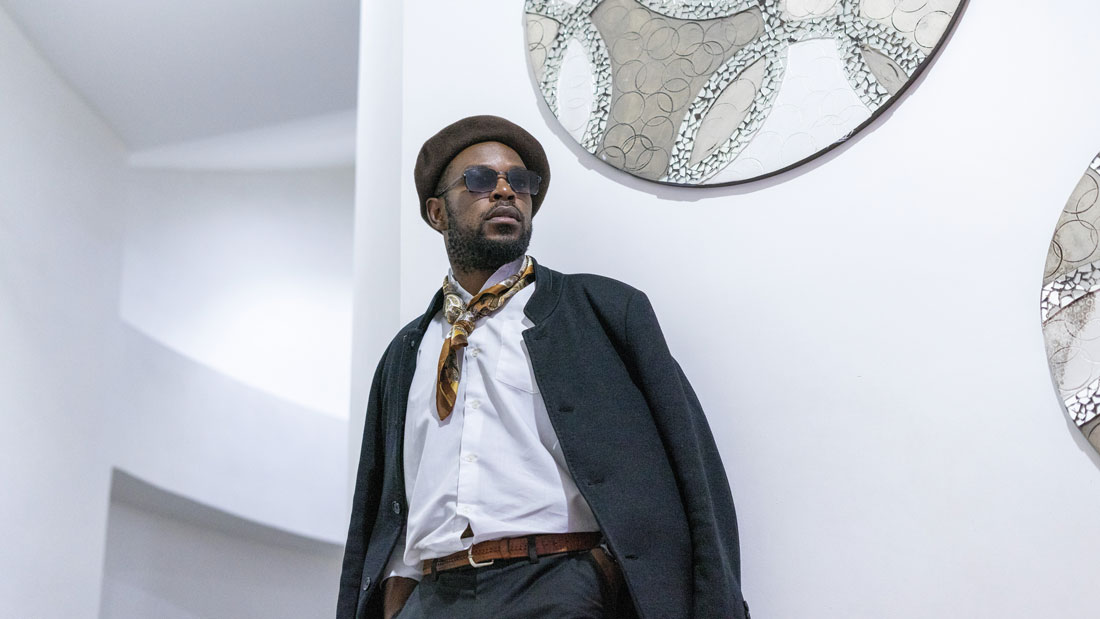
McLuther, musician.
Just over thirty, McLuther has just published K.U.N.O., his last job. Winner in 2014 of the Malawian edition of The Voicehis music moves between afrofunk and the afrojazzbut with many elements of Malawian folk music.
Where did you learn the fundamentals of music?
I didn’t go to university to study music, but I have attended many courses and workshops to improve myself, both in Malawi and in other countries, especially in music theory. I play acoustic guitar and a little keyboard, because I am also an arranger and producer. Furthermore, the church has played a fundamental role in this process, because it is where I started.
What gender defines you?
I call my music like afrofunk. I wanted to contribute something unique to the funk and I introduced the Afro side, integrating cultural sounds from my country. On a harmonic level, many people call me a musician of jazzsince I integrate my music with the jazzhe blues and a little of rhythm and blues. Additionally, I am an a cappella arranger. I’m proud of it, because I think that in this country you can’t talk about vocal arrangers without mentioning my name.
What are your main influences?
There are many, like my own culture, the Nguni. It is part of a series of peoples that share the same root, the Zulus in South Africa, the Ndebeles in Zimbabwe or the Tswanas in Botswana. My album has 24 songs and I have used all the traditional sounds and dances of the cultures of Malawi: Sena, Lomwe, Chewa, Yao, Tumbuka… I have taken advantage of all that, I have mixed it with the jazz and the funkand I have achieved a sound like the one on the album.
What does it mean K.U.N.O.?
It means ‘here’, ‘home’, but it is also an abbreviation of Knowing Untold Native Origin (‘Know the unknown native origin’). I wanted a name that would expand the stories on my album.
How was the recording process?
It has been a challenge, but also a beautiful process. My first project, Diversitywas lost when the record label he worked with, one of the biggest here, disappeared. The second, mizu -of Mizuya McLutherwhich means ‘McLuther’s roots’, was ruined in a studio when the files were damaged. I lost the third due to a political issue in 2023. The engineer I was working with was arrested by the Government, who was looking for someone who was against them, and they took everything that was in the studio where I was recording my album. After losing three albums, I launched myself into self-production in 2024. That’s how I started working on K.U.N.O. I was creating day and night, non-stop, until I had 24 songs. I have had the collaboration of really good artists like Fikisa, Lulu, Erik Paliani, Agorosso, Maggie Kadrum or Rebecca. Although I wanted to include others like Lawi, in the end it couldn’t be.
In 2014 he won the contest E-Wallet Sunbird Search for a Starsomething like The Voice from Malawi. How was the experience?
It was great. I come from the church, from humble origins, where I sang with my family, which has a great musical tradition. Coming from that environment did not imply any ease, because people also compare you with your family lineage. Here you will hear about a duo ofhiphopThe Daredevilz, who are my cousins. And from an amapiano star, Zeze Kingston, who is my nephew. I’m the youngest, so it hasn’t been easy. The competition taught me a lot to not let pride dominate me musically, but to always learn from everyone. About 500 people showed up at the auditions and 27 were selected, then 16, 12, eight, five and, finally, three. Afterwards, I was number one. At that time I was 18 years old and expectations were very high. At that time, social media in Malawi was not so important, thank God, because I think that helped me relax a little. Then my father told me I had to go to university. I could have bought a car with the prize, but I invested part of that money in my education, I wanted to be part of my own process. Being someone who has achieved something on his or her own. Having to continue with my studies, I entered a kind of lethargy and my name was not as well known as expected. Opt for the jazz It was also quite a challenge, because Malawi does not have a very large market, but now there is no talk of jazz without mentioning my name. At the end of the day, I am very happy to have become a professional artist and to have learned to be humble about my origins. Other artists usually come to light suddenly, they are famous as if nothing had happened…, but for me it was a process and it taught me a lot.
Would you say that being humble is the most important thing you have learned in all this time?
Of course. Do you know why? There is a lot of talent out there. So, if you are not humble, they put you in your place. I come from a contest in which I saw that this one is good and the other one too. There I learned that everyone can be good in their own way.
How does faith influence your music?
I grew up in church, where there are choirs without instruments. I was trained in that environment where we could sing and sound wonderful without a band. My music is full of harmonies on a vocal level. The church has taught us and helped us a lot, I learned to sing as a soprano and tenor thanks to it. For me it was easy, cheap and affordable. I also compose gospel songs. I write what inspires me, what I feel in each specific moment about the love of God, the love between people or stories from Africa so that everyone can learn something. Simply being a Christian has helped me understand that too.
Do you like singing or playing the guitar more?
I am a very powerful singer. In fact, it is impossible for people to mention four great Malawian performers – by the way, I remain humble – and not mention my name. Impossible. My strong point is my voice, I can do anything when it comes to singing and I find it easy to learn new things with my voice.
If you had to describe yourself with three of your songs, what would they be?
The Resolve It is a gospel song influenced by blues that reflects me on a vocal level. Gwada Pansi/Zapadziko is a song that the new generations think is mine, but it is by a legendary Malawian artist, Stonard Lungu, who passed away a long time ago, but I gave it my personal touch, taking it towards the afrojazz. AND Nkwanustyle afrosoulin which I collaborate with two Congolese, is a very dynamic song, with many transitions, in which you can appreciate the Congolese and Malawian touch.
After the release of the album, do you have any projects?
Once I solidify the album here, I want to tour everywhere so people hear the local stories. We Malawian musicians have not done justice to those who have come before us or those who are greater than us, especially in the field of pop. Most Malawian music sounds Nigerian and South African, and I’m not proud of it. It’s fine to represent Africa in general and borrow sounds from South Africa, Congo or Zimbabwe, but Malawians are very talented. When you hear something, you wonder who this South African artist is, but then you are surprised to discover that he is Malawian. My vision is not so much to fight for fame, but to find a way to make our culture and our music known to the world, to get out there.
What are your three biggest dreams for the next ten years?
The first is to have an arts academy. This year I have been teaching singing classes through the Praise Experience project, I am fully involved in vocal training in churches and larger projects. I want to start something where I can collaborate with different countries and musical spaces, where we can even offer courses where people can obtain diplomas and certificates. Secondly, making sure our sound is heard outside. Thirdly, I would like to see music or the arts become something that contributes to the country’s economy. I am always trying to find ways to collaborate with the Government. Our arts, in general, can contribute a lot to the economy and development of Malawi. There is only agriculture here and when we suffer in that sector, the entire country is affected… Then you only hear about us as the poorest country in the world. There are many talented people here, not only in music, but in sculpture, poetry, writing or cinema.
