
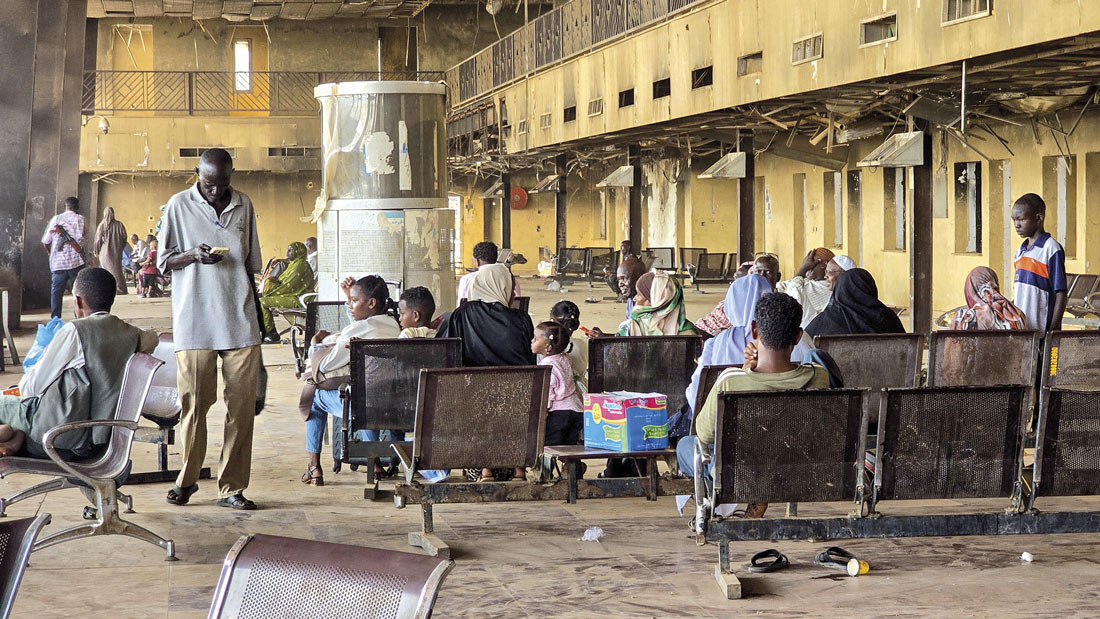
The dialogue and reconciliation processes in Sudan coexist with a conflict that is geographically distant from Khartoum.
By Mohamed Ahmed Al-Kasalawi
After three and a half years of conflict, the capital of Sudan is beginning to regain its momentum. Since the Sudanese Armed Forces (SAF) regained control of Khartoum in March 2025, the city has been trying to regain normality amid widespread destruction and a severe economic crisis. Last January, the ministries left their refuge in the coastal city of Port Sudan and occupied the two towers that the national mining company had built before the start of the war for their offices. The original offices of some of these ministries, located in the center of Khartoum, have been partially or completely destroyed by the fighting. Only the Ministry of Health has been able to quickly recondition its original headquarters.
The recovery of essential services is progressing slowly, electrical infrastructure remains very deteriorated and numerous buildings need rehabilitation. On February 1, Khartoum International Airport welcomed its first commercial passenger flight since the start of the war. A Sudan Airways plane from Port Sudan landed with about 160 passengers, in a symbolic event for a capital trying to reestablish its connections with the rest of the country.
The recovery of university activity has also become a priority. On June 3, the Minister of Higher Education and Scientific Research, Ahmed Madawi Musa, issued Decision No. 83 of 2026, which required universities and higher education entities to return to their authorized locations by August 1. The measure aims to restore academic activity, although many institutions still need to repair their facilities and recover destroyed or looted equipment.
The health challenge
The challenges are enormous. The World Health Organization (WHO) has warned that a substantial part of the health facilities in the regions most affected by the conflict remain closed or barely functional (70% of the country’s health facilities have been damaged). In Khartoum State, hospitals and medical centers have been bombed, looted and lost essential equipment. The lack of medicines and a stable supply of electricity limits the ability to care for a population that urgently needs assistance. Added to this is the shortage of qualified personnel. 80% of the nurses who worked in Khartoum state have not returned. Some have lost their lives and others have emigrated. The same happens with 60% of doctors.
The International Organization for Migration (IOM) estimates that the number of people who have returned to Khartoum reaches 2.5 million. Many return to damaged or uninhabitable homes and find themselves with insufficient basic services. Furthermore, the economic recovery does not offer enough opportunities: the war has hit industry, commerce and small businesses, while inflation and loss of income aggravate the vulnerability of families.
The map of conflicts
Meanwhile, El Obeid, capital of North Kordofan, is trying to consolidate its position after months of military pressure. On March 5, the SAF and its allies recovered the strategic city of Bara, on an important supply route for the region. However, the fight to secure the roads and surrounding towns continued over the following months. The recovery of a military position does not necessarily mean that the civilian population can return safely.
The fighting has not ended, but has moved to other regions. One of the flashpoints is Blue Nile state, near the borders with Ethiopia and South Sudan. In early October, the SAF announced that it had repelled attacks by the Rapid Support Forces (RSF) and accused Ethiopia of supporting the latter. The insurgent coalition, for its part, claimed to have conquered strategic positions and threatened to advance towards Damazin, the regional capital.
Another decisive front is in South Kordofan, where the RSF and the Sudan People’s Liberation Movement-North (SPLM-N), led by Abdel Aziz al-Hilu, maintain pressure on towns such as Dilling and Kaduqli. The complexity of local alliances and disputes over territory and natural resources make any military solution difficult. In this region, as in other parts of the country, control of the gold mines – of which there are numerous deposits – and trade routes constitutes an important factor of power. Dilling and Kaduqli seemed poised to fall, but infighting between members of the SPLM-N’s Otoro community and soldiers loyal to Al-Hilu is weakening their capabilities. The Otoros are one of the large peoples that populate the region, which has Kauda as its capital. They feel mistreated by the Tiras, who occupy the highest positions in the hierarchy within the SPLM-N and who occupy territories that the Otoros consider their own.
As for gold, it has become one of the resources that feed the war economy. The income from its extraction and commercialization benefits networks linked to different armed actors. The United Arab Emirates is the main destination for Sudanese gold and, at the same time, the main support of the RSF. Although trade data show that official trade has partially shifted to other destinations, including Egypt, this reality does not put an end to smuggling networks. The relationship between gold, finance and arms supplies means that the Sudanese conflict has important international dimensions.
In Darfur, the RSF maintains a dominant position in large areas, while forces allied with the SAF try to recover territories. Violence, displacement and difficulties in accessing humanitarian aid continue to seriously affect the population.
At the political level, General Abdelfatah al-Burhan, president of the Sovereign Transitional Council, has promoted reconciliation and dialogue initiatives with armed groups. However, sectors linked to the parallel government established in Nyala and the civil platform SUMUD question the inclusiveness of these processes and their ability to lead to a lasting solution.
