
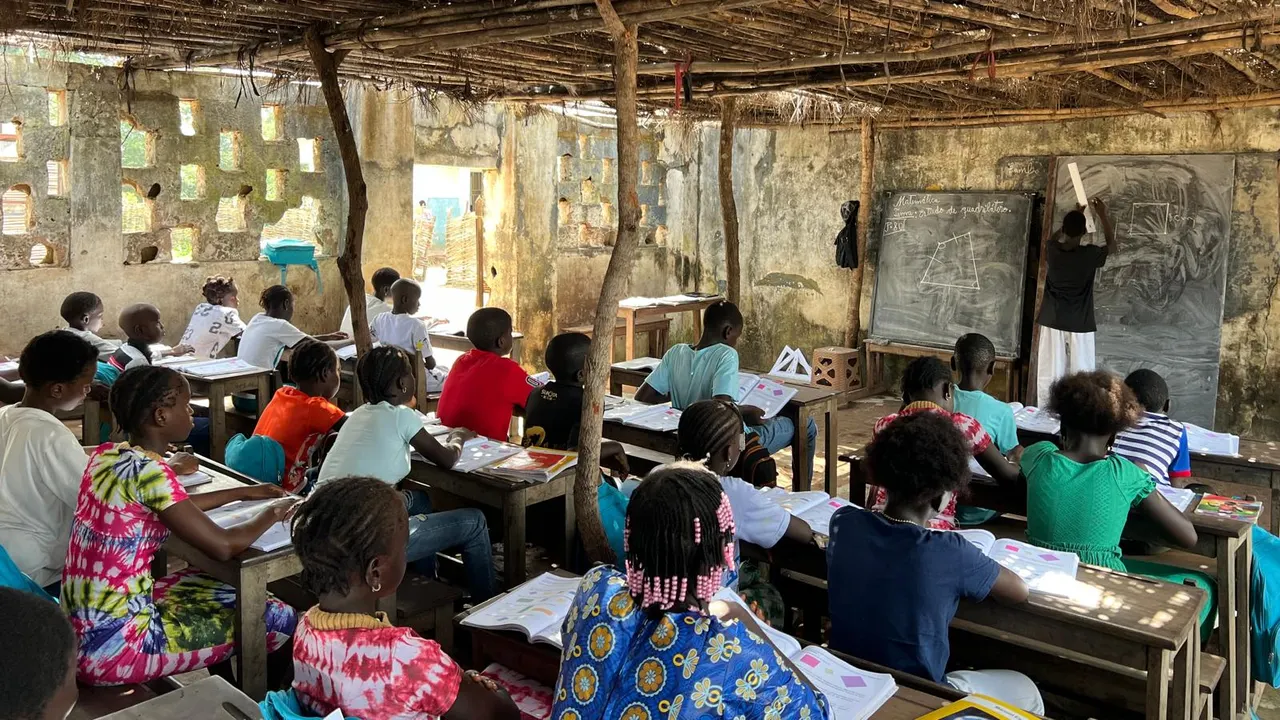
In Guinea-Bissau, boys and girls attend school from the age of 10 on average. And only 3 out of 10 Bisauguinean minors finish primary education, the rest fall by the wayside.
It is one of the lowest rates in West Africa
Unicef teams on the ground report that the high school dropout rates in the African country do not have a single cause. Many boys and girls have to travel long distances to get to school. Others are forced to marry while they are still minors. And many more start working too early because child labor affects 17% of minors between 5 and 17 years old in Guinea-Bissau.
The cashew harvest keeps thousands of boys and girls away from the classrooms
As the cashew harvest approaches – the basis of Guinea-Bissau’s economy – the problem worsens. Many minors leave classes to go work in the fields and never return to school.
Adama Saidí, education inspector of the Bafatá region, explains it to us on the spot. “The abandonment rate is a challenge for us, because when the cashew harvest season arrives, many of the children are taken as labor and some return after several months and others do not,” warns Adama Saidí.
Schooling is very late in Guinea-Bissau
Since boys and girls are not enrolled in school in Guinea-Bissau until they are on average 10 years old, they need intensive courses to stay on track. And when they get to the classroom, students find schools without enough desks, without school supplies and, in many cases, without water or toilets. Mariama is 14 years old and studies an accelerated course in Bambadinca, a remote neighborhood of Bafatá. “We lack pens, pencils, erasers and notebooks to continue studying,” says the young woman who wants to be a mathematics teacher when she grows up.
For this reason, Unicef works in the poorest regions of Guinea-Bissau, supporting schools with school supplies and training teachers, aware that education is key to the future of children.
