
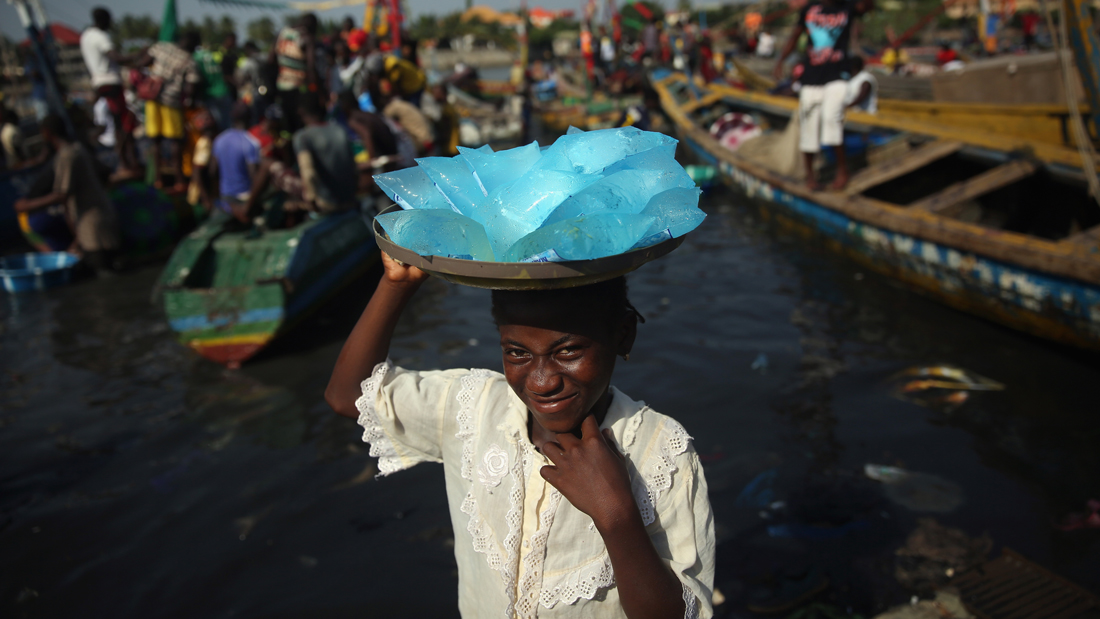
Something that until a few weeks ago was part of the everyday landscape has disappeared from the streets of Conakry. You no longer see the small transparent plastic bags full of water that were sold everywhere: in the markets, to passengers stuck in one of the city’s endless traffic jams, at the doors of schools, next to construction sites, in restaurants, bazaars or bars. Water was cheap, accessible to everyone, it was everywhere and, for many of the inhabitants of the Guinean capital, it was one of the easiest ways to access water to drink. Something that Conakry shared with many other cities in Africa.
A 2024 law, which came into effect on September 20 of this year, prohibits the manufacture, import, sale or use of this type of single-use plastic packaging. The veto is part of a set of political measures to fight against disposable plastics that includes shopping bags, cups, plates, straws and other products. Guinea is no exception in Africa. Countries such as Rwanda, Kenya, Tanzania, Ivory Coast and Morocco have approved different bans and restrictions on single-use plastics in recent years. All of them, and the Guinean Government as well, defend these measures for environmental and health reasons. But the Guinean case presents the particularity that the prohibition directly affects one of the mechanisms used by the population to access a basic good such as water. The disappearance of those in Guinea does not have, for the moment, an alternative. The supply of packaged water has not been able to replace them, bottles have become more expensive and, in some neighborhoods of Conakry, they are scarce.
There is a paradox here since Guinea wants to get rid of one of the symbols of pollution in its cities and, at the same time, finds that this same polluting object fulfilled an essential function for a very important part of the population. Thanks to these bags, drinking water was accessible to those who cannot regularly obtain it from a tap.
It is not, however, correct to say that the ban created the water crisis in Conakry. The city has had a structural supply deficit for years. According to the World Bank, the capital’s drinking water production needs were estimated at the end of 2024 at about 250,000 cubic meters per day. If no new investments are made, the World Bank estimates that it could reach 600,000 cubic meters in 2040. The s were, to a large extent, a private and informal response to this insufficiency. They did not solve the water problem, but they allowed it to be partially overcome.
The decision of the Guinean Government tries to respond to a serious environmental problem. You only have to walk through Conakry or other cities and towns in the country to see why plastics have become a political issue. The bags appear in the streets, in the markets, next to landfills and, above all, in the canals through which rainwater should circulate. During the rainy season, the problem becomes especially visible. In May of this year, the first rains once again left Conakry’s drainage canals clogged with bags, bottles, water and other waste in neighborhoods such as Matoto, Dixinn, Sonfonia and Dabondy. The accumulation of garbage makes it difficult to evacuate water and contributes to the floods that periodically affect the capital.
An academic study published in 2024 on the composition of Conakry’s household waste estimated that plastics represented 18% of the municipal solid waste analyzed. Organic matter made up 46%, while glass accounted for 6%, paper and cardboard another 6%, and metals 7%. The study also highlights the difficulties that the rains cause in the collection and management of waste.
In September, the Ministry of the Environment launched the ‘Guinée sans plastique’ campaign, with the intention of turning the removal of single-use plastics into a national policy. The authorities assure that before reaching the ban, consultations were held with industrialists and importers and that an adaptation period was established. The problem is that two years of preparation do not seem to have been enough for a particularly delicate transition.
Before the ban, a bottle of water could be sold for around 500 Guinean francs (0.05 euros). In the days after his disappearance, some 1.5-liter bottles of water went from around 5,000 francs to 6,000 or 7,000. Even greater differences depending on the establishment and format have also been documented. Something that many families who have to buy water every day cannot afford.
And this is because running water does not reach all neighborhoods of the capital on a regular basis. The population that does not have a reliable supply resorted to different solutions: fountains, wells, boreholes, informal vendors and bottled or bottled water. The water bag was one of the most economical options. When water disappears without a public network capable of absorbing that demand, the consumer cannot simply stop drinking water. You have to pay more or find another source.
And there appears the health risk. Guinean media have collected testimonies from inhabitants who, faced with the scarcity and rising cost of bottled water, are turning to sources whose quality raises doubts. Doctors and specialists have warned of the risk of consuming uncontrolled water and the possible appearance of diseases related to contaminated water. Here another dimension of the problem appears since poverty and public health come into play.
Water producers had warned of difficulties before September 20 arrived. The Union of Mineral Water Producers of Guinea (UPEMGUI) did not necessarily reject the environmental objective of the measure, but warned that the production capacity of bottled water would not be enough to immediately replace the enormous amount of water that was sold in . Some producers even asked that the adaptation period be extended. Environmental groups, for their part, warned that replacing them with plastic bottles could simply mean moving the environmental problem from one container to another. The bottles, although they can be collected and recycled, are still made of plastic. And the streets and canals of Conakry are already full of them.
The problem of plastic waste is real and required action. But it is worth asking whether it is logical to ban a product that fulfills an essential function when there is still no alternative accessible to everyone. The question is whether they were banned before the system that was to replace them was created.
The Administration itself seems to recognize that the transition is not yet finished. On October 1, the Ministry of Industry and Commerce asked producers, distributors and merchants to maintain prices for bottled water and announced that it is working on bottle formats adapted to the needs of consumers. He also talked about promoting water in biodegradables.
The story of the Guineans raises a problem that goes far beyond Conakry. In rich countries, reducing single-use plastics may seem like a relatively simple matter. Bags are replaced with reusable bags, a water fountain is installed, a reusable bottle is purchased, waste collection is improved or a recycling system is established. But in a city where millions of people are not guaranteed a regular supply of drinking water, plastic can end up becoming the cheap infrastructure that allows the distribution of an essential good. Which shows that environmental problems cannot be separated from the economic and social conditions in which they occur.
A person who has running water at home can easily do without a . A person who has been without water for hours can see it differently. The ecological transition, therefore, also has a dimension of justice. It’s not about choosing between the environment and drinking water. The aim is to ensure that the protection of the first does not fall disproportionately on those who are least able to access the second.
Perhaps the lesson of Guinea is that the problem is not only in the country. It is in everything beneath it. It is in a city that does not properly collect all its waste. It is in drainage systems that become saturated during the rains. It is in a water supply network that still does not produce enough to meet the needs of the population. It lies in the lack of recycling systems capable of transforming waste into resources. And it is also in an urban economy where thousands of people live from informal activities related to the sale and distribution of water.
The ecological transition therefore has winners and losers. And for it to be sustainable it needs to foresee what happens to the latter. Because perhaps the image that best summarizes what is happening in Conakry is not that of a plastic bag floating in a canal. It is that of a citizen who looks at an empty shelf of bottles and calculates how much it will cost him to drink water that day.
