
On August 4, a drone loaded with explosives and a detonator was found at Leipzig airport, one of the main freight transport centers in Germany and also used by Ukrainian cargo planes, near a Ukrainian Antonov; The device hit the aircraft, but did not detonate.
A second drone would have been involved in the incident and a third was located days later, on August 14, in a field near the airport, where about 50 grams of a military-use explosive were also found.
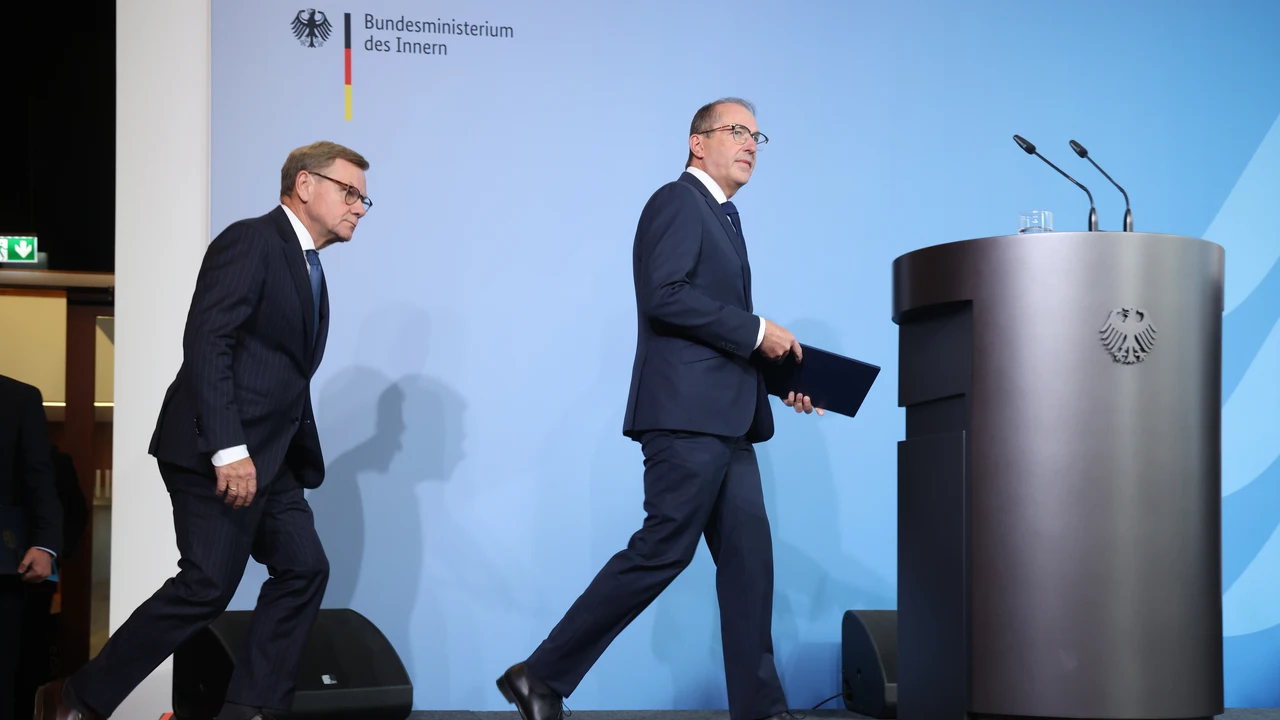
All this has caused the German Interior Minister, Alexander Dobrindt, to point to Russia as responsible for the failed attack carried out last month with drones loaded with explosives. Dobrindt explained in a joint press conference with the head of Foreign Affairs, Johann Wadephul, that the investigations carried out by the authorities have revealed that the pattern of the attack, also including the components of the devices and the technology used in their detonation, is conclusive with the methods used by Moscow to carry out attacks within the framework of the war in Ukraine.
“We do not consider Leipzig an isolated incident, but rather we see it in conjunction with other hybrid actions,” explained Dobrindt, adding that “Germany is not at war,” although it is a “daily target” of these “hybrid” attacks by Moscow.
For his part, Wadephul has announced that the Government will close the Russian consulate general in Bonn as of September 18, terminate its contract with the House of Russia in the capital, Berlin, and summon the Russian ambassador in protest.
Likewise, the Foreign Minister explained that they will propose to the European Union a new ‘black list’ of people of Russian origin linked to hybrid attacks and has announced that the Government will strengthen entry controls for Russian citizens.
The support of Sánchez and Feijóo
The President of the Government, Pedro Sánchez, has described as “unacceptable” the failed attack perpetrated at the beginning of August against the Leipzig airport, ensuring that “Spain supports Germany unequivocally.” This was communicated through the social network ‘X’.
Given the event experienced in Germany, the leader of the Executive has vindicated Spain’s “unbreakable” commitment to Ukraine. “We will not be deterred by hybrid threats; our commitment to Ukraine is unwavering,” he warned.
Along the same lines, the Minister of Foreign Affairs, European Union and Cooperation, José Manuel Albares, has shown, also through a message in ‘X’, his support for Germany “in the face of the Russian hybrid threat”, warning that “hybrid aggressions are a permanent challenge for Europe.”
“The unity and solidarity of Europe are vital to protect our citizens and borders. From south to north, from east to west. United we are stronger,” defended Albares.
For his part, the president of the Popular Party, Alberto Núñez Feijóo, has conveyed his “support” and “solidarity” to the German Chancellor, Friedrich Merz, to adopt the “opportune” measures in the face of the failed attack perpetrated at the beginning of August against the Leipzig airport; after Germany pointed out this Tuesday that Russia was responsible for said offensive.
“All our support and solidarity, Friedrich Merz, to adopt the measures he deems appropriate in the face of the Russian hybrid attack that they have suffered in Leipzig,” said the ‘popular’ leader through a message on the social network ‘X’.
