
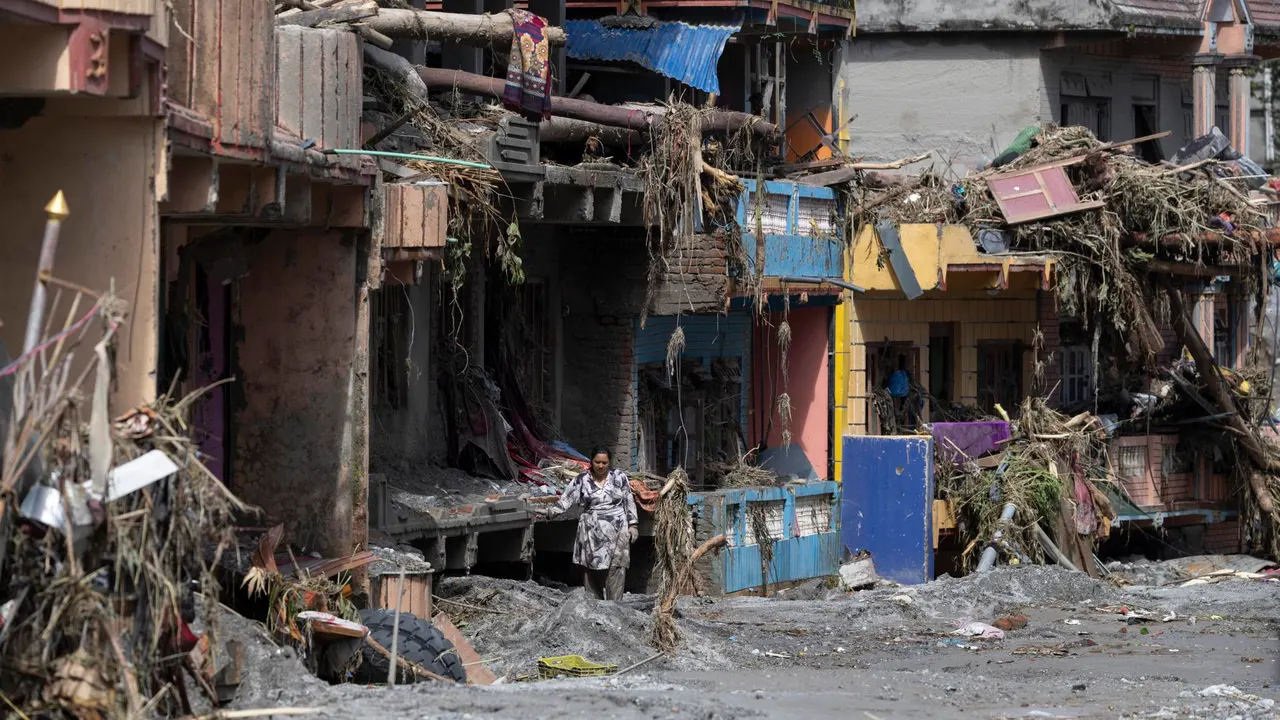
The floods and avalanches that have hit the border area between Nepal and China in recent days have left hundreds dead and thousands missing and have caused serious damage to infrastructure. While efforts continue to locate the more than 1,900 people who remain missing, Chinese authorities have now detected a new danger that could further aggravate the situation.
The new alert occurs when emergency teams were trying to advance towards the areas most affected by the flood. The barrier lake, located upstream and with a capacity of approximately two million cubic meters of water, began to overflow when the rescuers were about three kilometers from the port of Gyirong, on the border with Nepal.
The Chinese authorities have considered the situation to be high risk due to possible flooding or mud and rock slides, which is why they have ordered the rescue teams to move to another area considered safe while awaiting orders from the command center that is coordinating the work, with the aim of trying to avoid further victims.
Thousands of people evicted and missing
The floods and mudslides have especially affected Nepal, where authorities have raised the number of deaths to around 570 this Friday. In addition, hundreds of people remain missing after the flood devastated populated areas and infrastructure. In Chinese territory, the provisional toll is at least five dead and around 571 missing. Authorities have also relocated nearly 500 people affected by the floods and evacuated about 555 tourists who had been trapped in the border area.
The origin of the tragedy: an ice avalanche
An expert from China’s Ministry of Natural Resources said the disaster began with an ice avalanche from a high-altitude glacier. According to Guo Zhaocheng, director of the Geological Disaster Research and Monitoring Center of the Chinese Aerogeophysical Prospecting and Remote Sensing Center for Natural Resources, the ice mass descended the slope and was transformed into a high-speed debris flow.
The material ended up entering the Donglin Tsangpo River before continuing its journey towards Nepal. The expert thus rules out that the catastrophe had its origin in the overflow of a glacial lake.
In addition, the first investigations by the United States Geological Survey (USGS) point to the collapse of a glacier as the source of the flood. The agency has also ruled out that an earthquake occurred in the area that could be related to the catastrophe. The USGS also estimates that the collapse occurred in Langtang National Park in Nepal, near the border with China.
Benjamin Mirus, researcher at the Geological Hazard Science Center, explained to Europa Press that the Chinese expert’s conclusions are similar to those obtained so far by American scientists.
A flood that traveled almost 100 kilometers
Debris avalanches can move at speeds of tens and even more than one hundred kilometers per hour. The mudslide and flooding traveled almost 100 kilometers across the Trishuli and Bhotekoshi rivers, affecting several populated areas downstream, including the port of Gyirong in China.
The force of the flood destroyed numerous buildings and infrastructure, including a fundamental road for communications between China and Nepal. Now, the overflow of the new lake keeps emergency teams on alert for the risk of another flood.
