
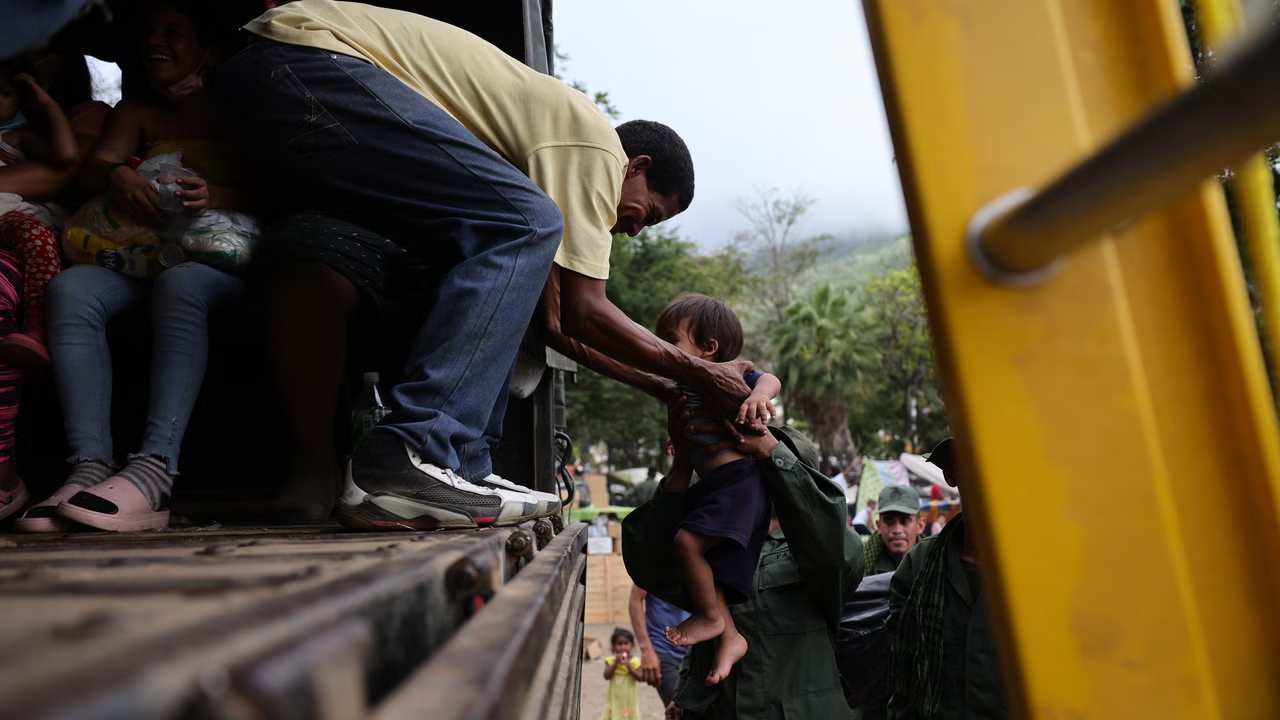
“Wait, Nieves, there is an earthquake in Venezuela.” Gabriela, a Venezuelan colleague, interrupted our telephone conversation when the first news arrived. She was in Berlin and, as a new mother, she had been sleeping at odd hours for several days. But the fatigue disappeared suddenly.
In a matter of minutes, the Venezuelan diaspora groups in Colombia that I work with began to be filled with messages of anguish and questions. Thousands of kilometers away, in Madrid, Aleja woke up and saw the first headlines on her phone. He thought it would be just another tremor: “It shakes all the time there.” But he soon understood the true dimension of the tragedy.
With eyes on the country
Like them, nearly eight million Venezuelans observe from outside their country the devastation caused by the two earthquakes last week, of magnitudes 7.2 and 7.5, which have hit the state of La Guaira especially hard, as well as other areas in the north of the country and Caracas itself. For many Venezuelans like Gabriela, this new tragedy in the state of La Guaira (which until 2019 was called Vargas) evokes the memory of the Vargas landslide of 1999. Their relatives, who had survived then, are again faced with loss and reconstruction today.
Friends and acquaintances held their breath as they desperately tried to contact relatives to make sure they were safe. For some, like Gabriela, uncertainty gave way to even more painful news: loved ones dead and seriously injured. Others, like María, watch helplessly as a country that they left – in many cases against their will – and that they miss, once again faces a tragedy.
“The chest hurts. And I know that millions of us are out there with the same feeling,” explains María.
Photograph of a disaster
Since Wednesday, the number of fatalities has not stopped increasing: between Saturday and Sunday it went from 920 to 1,450, according to Venezuelan government sources, while thousands of people remain missing, so it is foreseeable that the number will continue to grow.
This happens in a country whose institutions and public services have been in a deep crisis for years: hospitals with limited resources and vulnerable infrastructure in a territory located between the two most active tectonic plates in South America.
The actions of the State, now supervised by the United States government, have been the subject of harsh criticism, while civil society organizations, neighborhood networks and volunteers have assumed a central role in the rescue and assistance efforts.
“How difficult it is to be Venezuelan” is, according to María, one of the phrases that is most repeated in the diaspora. And yet, the resilience of the population has become one of its main resources in the face of adversity.
The tireless Venezuelan diaspora
The diaspora has also mobilized tirelessly. In just a few hours, hundreds of initiatives have emerged. The Hacha y Machete collective has created an application to determine if buildings and homes can continue to be habitable and which ones represent a risk to the population. Transparency Venezuela has disseminated concrete recommendations to guarantee that donations reach those who need them most and avoid corrupt practices or the diversion of resources. And media outlets like Soy Arepita have become an essential source to combat misinformation and keep the diaspora updated on what is happening on the ground.
Added to this is the personal commitment of many exiles. Lorent Saleh, activist and former political prisoner, or María Corina Machado herself, opposition leader, have announced that they will return to Venezuela to participate in humanitarian work despite the uncertainty and lack of guarantees. Venezuelan restaurants in Bogotá, Madrid and Miami function as collection centers; Migrant associations coordinate solidarity campaigns and thousands of people contribute from a distance with resources, contacts or volunteer work.
This is a wave of transnational solidarity that reveals the extent to which ties with the country of origin remain alive after years of exile and forced migration, as research on diasporas has amply shown.
Politics vs. natural forces
All of this contrasts with the progressive weakening of international attention towards Venezuela after the capture of Nicolás Maduro on January 3 of this year and the collaboration of the US government with current President Delcy Rodríguez.
In Spain, on June 12, the extraordinary route of residence for humanitarian reasons for Venezuelans was eliminated due to the entry into force of the European Union Migration and Asylum Pact. However, the current tragedy demonstrates the extent to which these pathways are still necessary.
Despite some progress, such as the release of hundreds of political prisoners (389 remain imprisoned), new arrests have occurred and free elections have still not taken place. Nor has economic recovery resolved the social crisis: the IMF forecasts growth of 4% in 2026, but inflation continues above 380%.
For this reason, the response to this catastrophe requires not only immediate humanitarian aid, but also a renewed international commitment to the institutional and economic reconstruction of the country.
Far away but supportive
Meanwhile, Venezuelans continue to support each other. A few days ago, María passed a woman on the street who was listening to news about the earthquake on a loudspeaker and asked her: “Madam, are you Venezuelan?” He didn’t have to answer: the lady burst into tears and they hugged.
In times like this, when distance and helplessness weigh heavily, the diaspora remembers that exile not only means absence, but also community, solidarity and the certainty that, even far from home, no one is completely alone.
Nieves Fernández Rodríguez, Professor and coordinator of the Chair of Migration and Human Rights, Nebrija University
This article was originally published on The Conversation. Read the original.
