
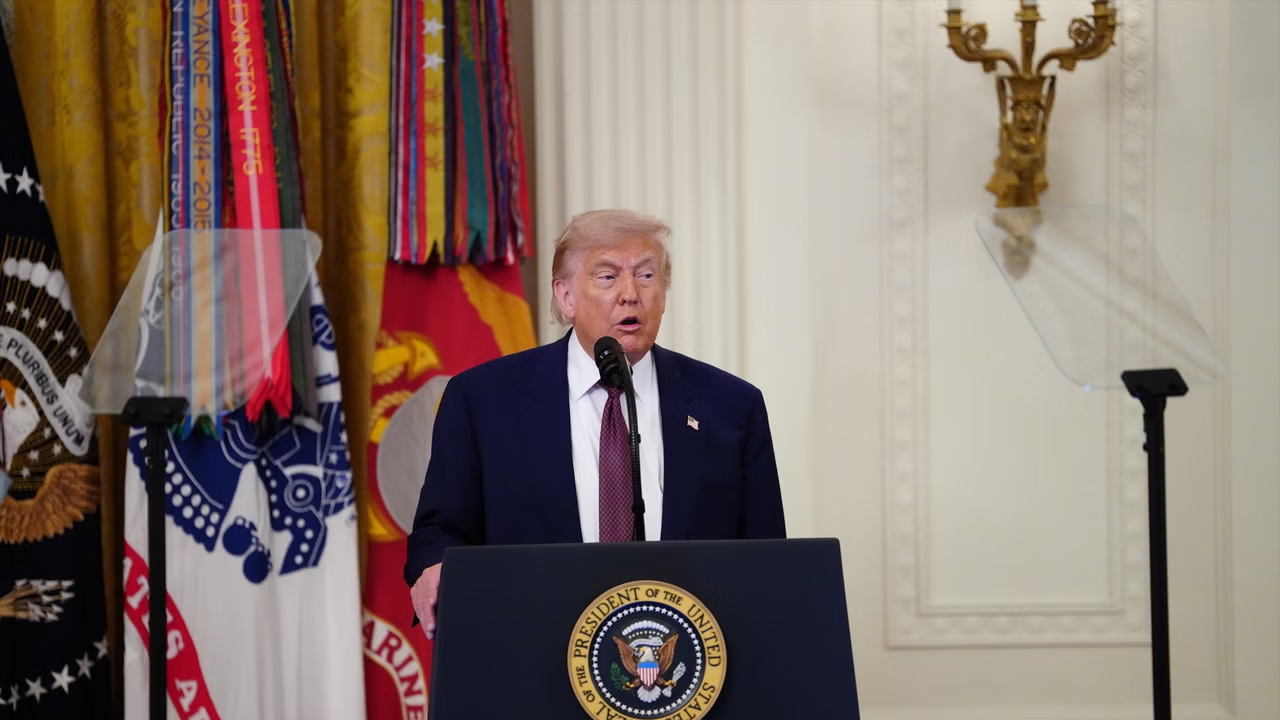
The topic of the week is the peace memorandum that the United States and Iran reached a few days ago and which quickly became frustrated. Just one day later, the signing of the agreement between the two countries was canceled in Switzerland due to Israel’s attacks in Lebanon. The Israeli Minister of National Security, Ben Gvir, said a few days ago:
“We cannot stop destroying houses in southern Lebanon. We cannot. Period. We cannot allow the population of southern Lebanon to return. We must continue to control the territory even if Trump does not agree. We are an independent state.”
That the agreement was blown up in such a short time was something that the United States could imagine, since, as explained by Eduardo Saldaña and Alba Leiva in The World Order of Julia in the waveTwo days ago, United States intelligence warned the White House that the Israelis were going to sabotage the agreement, which is why currently “we are seeing a very clear clash between Israeli nationalism, which is unleashed, and the interests of its historical ally.”
Israel is not a signatory, but the US pressures it
The clash between both allies was “predictable” since the 14 points of the memorandum were presented because they included the cessation of hostilities in Lebanon, which is a “direct appeal to Israel.” In fact, the first point of the agreement says “The United States and the Islamic Republic of Iran, together with their allies in the current war, sign this memorandum of understanding (MoU) to declare the immediate and permanent cessation of military operations on all fronts, including Lebanon.” That is to say, although Israel is not a signatory, the United States makes it a “clear participant in the agreement”: “It is a way to put pressure on Tel Aviv to sign the memorandum.”
And that pressure is not only seen in the peace agreement, but in statements by Donald Trump himself: “I think they could do better. I’m not saying they shouldn’t protect themselves. I’m saying that when two drones are shot down in the desert without any damage, you don’t have to take down buildings in Beirut. They could behave better.” Also, Vice President Vance himself assured a few days ago that it was not “intelligent” for Israel to fight with the only ally it has in the area.
Why does the US so openly criticize Israel? Eduardo and Alba assure that it is because they know that they are the ones who are going to torpedo any type of rapprochement or understanding with Iran. Therefore, “the great challenge that the Trump Administration has right now is to get Netanyahu to give in and allow” that agreement to be established.
“It does not imply that the US and Iran are going to resume attacks against each other”
It is true that the part of the commitment to pacify the Lebanese front has failed before it began, but that does not necessarily mean that the United States and Iran will resume attacks on each other or that they will not be able to sit down to negotiate at some point. In fact, because of how diplomacy works, it is possible that these conversations are already taking place: “The will has already been expressed. Now it depends on whether Trump manages to keep Israel calm so that he can sit at the table. It remains to be seen, but the outlook is not good.”
What does the memorandum include?
The World Order explains that it must be understood that the memorandum is not “exactly” a peace agreement, but rather an “agreement of understanding and commitment to peace.” In it, Iran and the US commit to ceasing hostilities and working to achieve a definitive peace agreement within an extendable period of 60 days. That is, the next key date would be August 16, “but we highly doubt that they will arrive with a definitive document closed on that day, especially if we take into account that only one day later they are having a hard time resuming negotiations.”
What the memorandum also does is “define the key lines of that peace agreement”: the blockades on Hormuz, the Iranian nuclear program and the United States sanctions on Iran.
Hormuz blockade
The two countries undertake, as a priority, to lift the double blockade on Hormuz, that is, the one that exists in the strait by Iran and in the Sea of Oman by the United States to the flow of Iranian oil. This continues to be the priority for both: “it is what allows us to end the hydrocarbon and inflation crisis that we are experiencing.”
Iranian nuclear program
Regarding the nuclear program, Iran undertakes not to develop or acquire nuclear weapons. This is perhaps one of the weakest points, because it talks about “reaffirming” its commitment. Something it already did in 2015 with the nuclear agreement.
Sanctions on Iran
And hand in hand with this, one of the most interesting points is that the United States is committed to progressively lifting all sanctions on Iran and contributing to the reconstruction of the country with 300 billion dollars. That is, “we would be talking about reintegrating Iran into the international system, lifting the trade blockade and access to the SWIFT system, giving them access to frozen funds.”
Not only is it a very broad commitment, but it is much more ambitious than previous agreements such as that of 2015. But this does not mean that they will comply with it or that they will reach a final agreement on all these points: “But it is striking that they are on the table to be discussed.”
What is clear is that this agreement is the “confirmation of the mistake and the monumental mistake that Trump made in March by getting into the conflict with Iran because, yes, he has destroyed the ayatollah and destabilized the country, but the ayatollah regime remains in power, things have not changed, he has his ally in the region very unleashed and cannot control him. Furthermore, internally, it has hit Trump’s credibility because he is signing an agreement to return to where they were. four months ago.”
“Understanding the 2015 agreement is important because none of this would have happened if Trump had remained in that agreement in 2018 because we would have monitoring of the Iranian nuclear program,” concludes Alba.
