
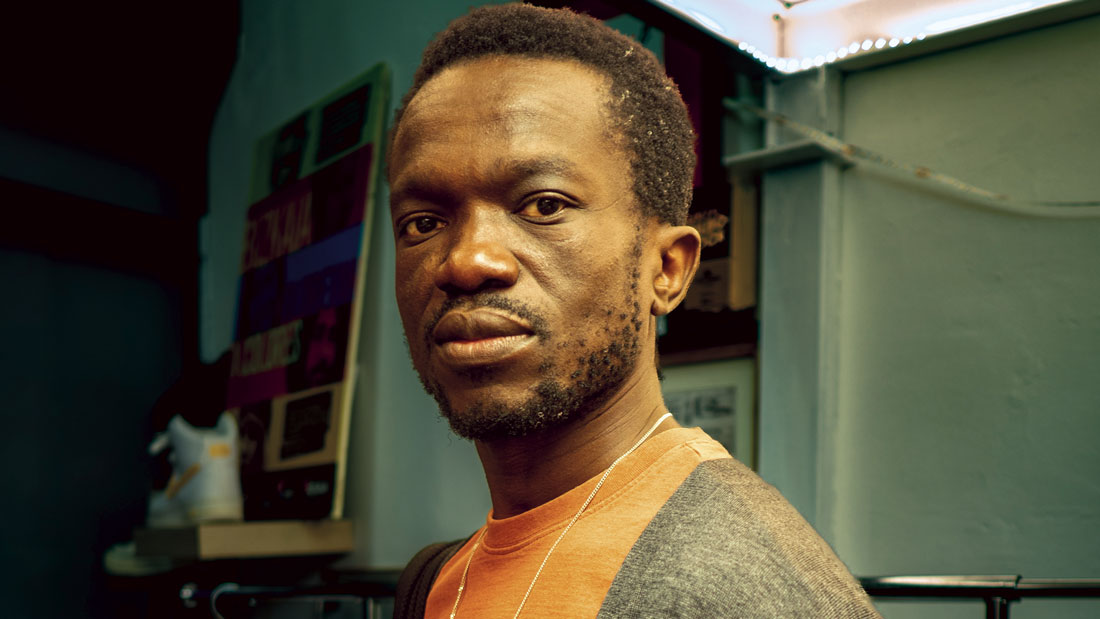
Blanchard Moussayou, textile artist
After studying industrial pattern making, he went from the business world to the art world. Blanchard Moussayou presented his third exhibition, “Therapy: migratory processes and mental health”, which closed at the end of last March in Bilbao, where he resides. There we talked with the creator.
How did you get into the textile world?
It goes a little bit in my story. My father was a tailor in Angola and my older brother is also dedicated to the world of fashion. I studied mechanics, but someone told me that I had a good profile for clothing stores and, by chance, I ended up in one. After several years, I decided to study a higher degree in industrial pattern making. As a result of that, I no longer only sold clothes or understood fashion, but I dedicated myself to making clothes, to being in the textile world.
What made you now dedicate yourself to artistic expression through textiles?
I think it’s something gradual. The seed is there supposedly inactive, but there comes a time when it begins to grow. I couldn’t tell you exactly when, but it’s like your being, which is there latent and comes out in some way. Each time it has become bigger, more present. It’s like a tree. In the clothes I project my person.
What is the difference between fashion and textiles?
Fashion is a part of textiles, because many people do not consume fashion, but they do consume textiles. Clothing, upholstery fabrics, etc. are included in textiles. It’s a broader world that encompasses all of that. In the projects I separate it because fashion has a limitation, a time and, after that time, it dies. The idea is that these creations do not have that limitation, that they transcend.
Many times we do not give importance to the meaning of what we carry. Are you looking to change that?
More than changing, it is perhaps about raising awareness from myself. For example, when we wear a garment that has letters in a language that we do not control, it would be interesting to know what it says. It’s basic, because we are like a walking billboard. It’s propaganda. Maybe we are going against our principles by carrying out certain things that we probably shouldn’t. It is very interesting that we take into account that what we wear means something in our favor, that it is not counterproductive with who we are. Each element of the garments has a meaning. In the textile world, as the saying goes, there is no stitch without thread.
What were you looking for and what did your first exhibition, “Tangible Thought” consist of?
I was looking to know that incredible part of knowing that I have ideas that I can carry out from scratch, take them outside and have people see the tangible part, that they can touch it. After finishing my studies I started researching and making clothes, thinking about what it would be like to make a sports garment with a fabric that was not predetermined for it. I showed it to my friends and some told me that I couldn’t limit myself to that, that I should open it to the general public. “Tangible thinking” came from curiosity and research.
The second was “Light of the Path”, around the figures of four African martyrs: Thomas Sankara, Patrice Lumumba, Nzinga Mbande and Steve Biko. Why did you choose them? What were you looking to convey with them?
Part of it was due to an inspiration from Black out, a song by Youssoupha, one of my favorite rappers. In it he talks about people who were silenced. The origin was seeing that within the black struggle Martin Luther King or Malcolm X are held in great consideration, but not African leaders. The idea was to use that structure to make them visible, so that something could be known about them. Each garment has a story, a specific design on the front and a phrase on the back. It is about bringing the martyrs to the present by dressing them in a current garment and having them speak through the phrase printed on the back. That is, they not only come, but they talk. It is as if he had invoked them, with his permission, to come and talk about what they said in their day. For example, that of black angel either Black Angel She is linked to Patrice Lumumba. If you think about the color of an angel, you already know what it is, and if you think about the color of a bad angel, you know it too. What this garment says is that you would have to look at the capacity that the angel has or its qualities. It is as if Lumumba had given the people wings to fly towards emancipation. Steve Biko’s sweatshirt is Sparklesa garment that speaks of feelings, of the importance of the left side of the body. Revolutionaries have to have a feeling of struggle, be very brave, but they must also have very strong feelings of love, otherwise they would not do anything for anyone. With something as simple as a piece of clothing, you are carrying a message that can reach the people you meet. I found it very interesting what you can contribute from the same street without having to go to the Internet or a book.
The third exhibition was “Therapy: migratory processes and mental health”, where did this project come from?
The need was brutal from day to day to listen to you, to ask you things and to be perceiving what surrounds you. It also comes from listening to people, who wonder, for example, about the issue of the cayucos, about the question of what these people are doing coming here. Or for growing up in a place where, in quotes, you don’t belong. The life that corresponded to me was to be raised and grow up in Angola near my family, enjoying that environment. When you arrive in the country you emigrate to, you have a lot of external things that affect you, some good and some bad. Everything that you collect over the years settles somewhere and becomes something more physical. “Therapy” was very necessary and I have noticed it over the course of the project. Releasing and presenting this initiative has been very important, especially on a therapeutic level. We all grow up with fractures and wounds that, if not healed, impact the person.
What type of pieces have you presented in this exhibition?
There are six textile items, although there are more elements. The exhibition was planned as if it were a journey in ten points. The first destination was reached at point nine, while the tenth and last was the final destination. That is, until point nine you couldn’t get off. The logic of this leads people to see the thermometer of where they are and say: “I’m doing well, I’m liking it” or “That’s it.” Point ten contained a warning: you had to know that you were going to see something that could affect your sensitivity. If you weren’t in the best moment, it still wasn’t good for you. What the last point said is that the person who leaves does not come back the same, that there are not always happy endings. The hard part, intrinsic to life, is there and we cannot escape.
Is the mental health of the migrant population made visible?
One of the logics of the project is that sometimes the mental health of migrants is not taken into account. Because of their hardness or because we believe they are resilient, it seems to us that difficulties or dehumanization do not permeate them. Since we are all human beings, why is this aspect of mental health accepted by some more than others? They are people who have the same needs as any human being. There comes a point where it weighs on me and makes me angry having to continue explaining things that we should already know. I have to explain them to my five-year-old son, but it seems like a delay to have to do it with an adult. If I have more rights than you, something is wrong. I don’t want to have more rights than anyone else. The topic of mental health is based a little on this. I see people around me with mental health problems and, be careful, if you don’t have a structure… I believe in the collective. The individual is fine, but the collective would have to gain value, because we move in a collective construct. Not only would it be enough for me to do well, but it is interesting that my neighbor does as well.
How would you like your child to see you in ten years?
It sounds strange, but I would like him to see me in the same place, to see me doing the same thing as now, because surely that will put me in a place close to where I want to be. I want my son to see me following my purpose, the key is there. It is such a heavy word, so powerful and with so much meaning for me, which is what I propose. Ten years ago, during an interview, I realized that I was achieving things that I didn’t value very much, because I am constantly in the future. When I reread that interview, I realized that at that moment I was projecting what I have subsequently done over the last eight years. What more do you want than to look back and have achieved what you were longing for! A sweatshirt I made to accompany the project has text that says: “Smile. Your future self says you made it. Obviously there will be things you don’t achieve, but there will be a lot of things you do. We’ll see what will be, but what is being is already important. The way is to be oriented towards that.
