
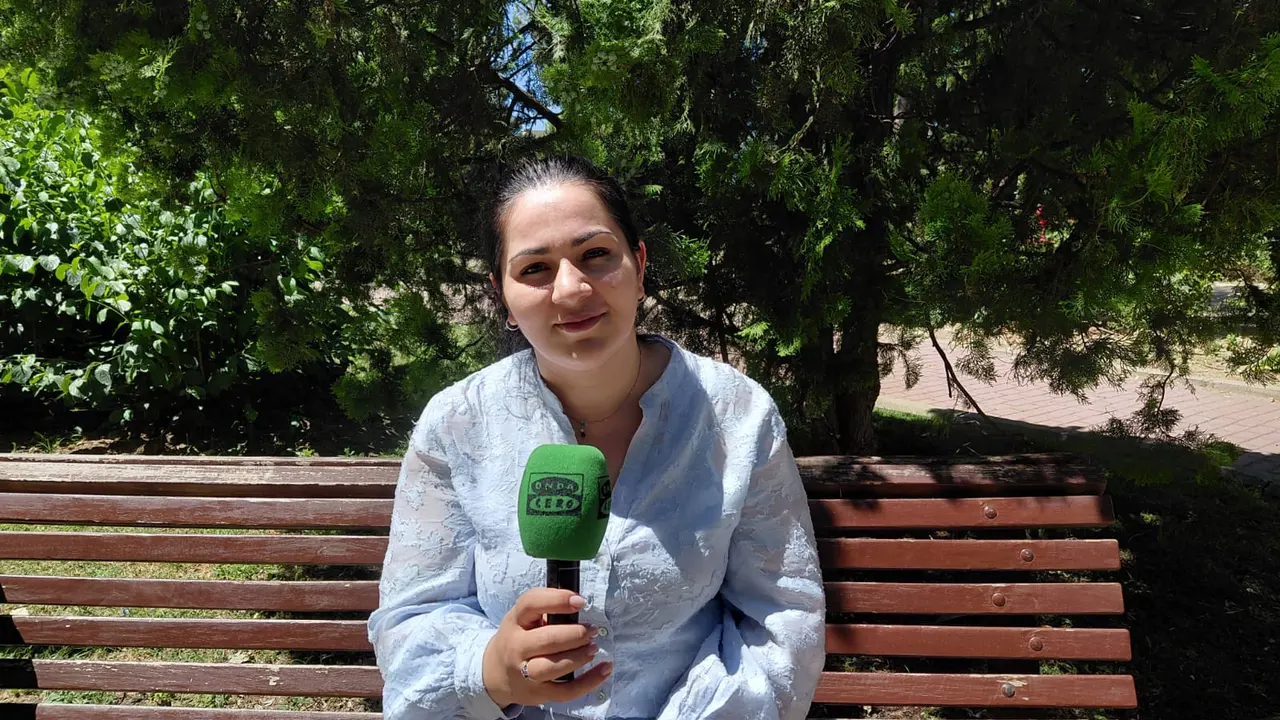
Khadija Amin is Afghan, she is 33 years old and has 3 children whom she has not seen since 2024. This summer she could face one of the most important moments of her life: the trial for the custody of her children. Although, after divorcing her husband and denouncing abuse, there is no indication anywhere in Afghanistan that Khadija Amin has children. It’s like they erased his name from all records. And not only that, but her ex-husband and the regime are manipulating them, turning them against him and turning them into “little Taliban.” The latest audios that the little ones have sent her say: “you are not Muslim, you have abandoned us, you don’t know what God says, you have no shame and we don’t love you. Don’t try to talk to us again,” she tells us very excitedly.
“I’m afraid they will become Taliban”
It pains him to say it, but it’s like this: he hasn’t hugged his children in 2 years. “These days I’m having a very bad time because the children don’t want to talk to me, their father is manipulating them, he tells them that I’ve abandoned them. Now I want him to go to the trial in Germany because, being in Afghanistan, we can’t do anything,” he explains.
Their fight goes much further. Her fight is also for the silenced women in Afghanistan. Those who have no voice or face, because men do not let them speak and because they hide them under a burqa.
The president of the Esperanza de Libertad Association of Afghan Women opens the doors of her house to us, a small apartment where she lives with other Afghan refugees who arrived in a similar situation: fleeing a regime that threatened them for the simple fact of being women.
When she was 19 years old, they forced her to marry an older man, an unknown man who had nothing to do with her and who did not let even a few months pass before he put a burqa on her and started mistreating her. And she admits that in her case she was lucky because, at least she, she was of legal age.
“Child marriage is like raping girls, a lifelong trauma”
He acknowledges that it hurts him to see how the Taliban have now decriminalized child marriage from the age of 6. And that silence means consent. “Child marriage is like raping girls. Older men who are already their father’s age and rape them are stealing the childhood of girls in Afghanistan. These girls will never recover because it is a trauma,” says Khadija.
The precarious situation of women in Afghanistan is leading them, in many cases, to a dead end. Khadija Amin denounces that “many Afghan women are committing suicide.” He assures that every day he receives news of dead women, although it is not clear if they commit suicide or have been murdered. “It is very worrying and we – as feminist women – have to support Afghan women so that they do not fall into oblivion,” she laments.
“I was talking to my colleagues that the day would come when we would present the news without a veil.”
Khadija Amin was a presenter on Afghanistan’s public television and confesses that on August 15, 2021 she had to make the most important decision of her life: flee her country – under death threats – on a Spanish plane and leave her three children there. His intention was to arrive in Spain, obtain asylum as soon as possible and request family reunification. Although none of that has been possible until now.
“The truth is that it has been very hard to see how we have lost our rights so quickly.”
Khadija describes her last day in Afghanistan as just another day and confesses that, by no means, she imagined that the Taliban would return to power that quickly. “Just this day, before going on the set and presenting the news, I was talking to my colleagues about the day when we would present the news without a veil. Without knowing that in 3 hours they will no longer let us enter the newsroom or the set.” “When I got to the newsroom I saw that there was no one there,” he says. “It was very hard for me when my boss insisted that I leave, he told me you’re crazy and we don’t want to risk it for you. I left crying.”
Some 4,800 Afghans have obtained a residence permit for international protection in Spain since the fall of Kabul into the hands of the Taliban on August 15, 2021.
Asked how she sees herself in 10 years, Khadija is clear: “the truth is that my dream has always been to first get my children back and then return to Afghanistan.” “I want to return to my country,” he says. In fact, in his book (Veilless) says – among other things – that she hopes that one day there will be a female president in Afghanistan and that, hopefully, it will be her.
