
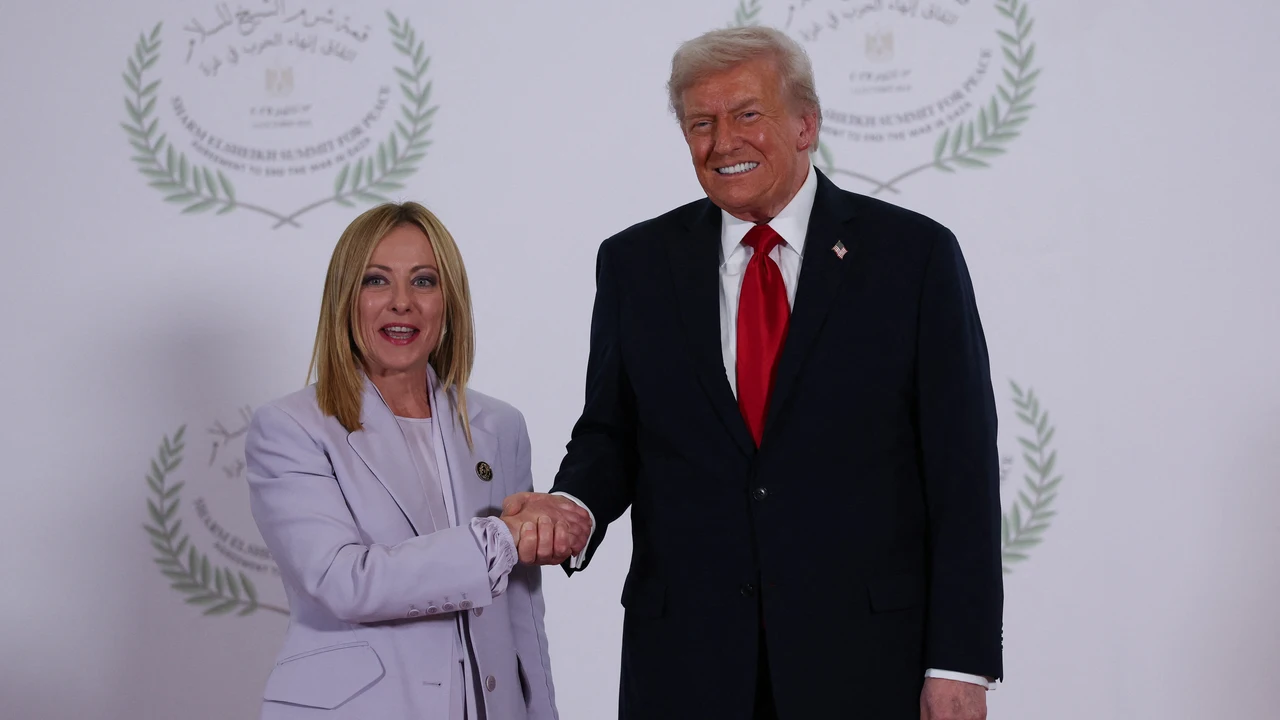
An apparently anecdotal comment has ended up sparking a diplomatic conflict between two key Western partners. The words of the American president, Donald Trump, about a photograph with the Italian prime minister, Giorgia Meloni, during the recent G7 summit in Évian (France), have provoked an immediate institutional reaction in Rome and have strained transatlantic relations at a particularly sensitive moment for international politics.
A comment that sparks controversy
Trump assured in an interview on Italian television that he agreed to be photographed with Meloni “out of pity,” insinuating that the Italian leader had insisted on that meeting. “She begged me to take a photo with her. I felt sorry for her,” said the American president, adding that Meloni “really wanted” that public gesture.
The statements, made in the program ‘L’Aria che tira’, did not take long to go viral and generate unrest in Italy, where they were interpreted as institutional contempt towards the head of the Government.
Meloni’s response: “Italy does not beg”
The Italian Prime Minister reacted quickly through a video on social networks, in which she flatly denied Trump’s version and showed her discomfort at the tone used. “I don’t know why the president of the United States behaves like this with his own allies,” he said.
Meloni called Trump’s words “completely invented” and sent a direct message: “But one thing must be remembered: Italy and I are not begging!” The Italian leader also questioned the attitude of the American president, reproaching him for being more harsh towards allies than towards international adversaries.
First consequence: cancellation of the visit to the US.
The tension has already had concrete effects on the diplomatic agenda. The Italian Minister of Foreign Affairs, Antonio Tajani, announced the cancellation of his official trip to the United States scheduled for June 21 and 22.
As he explained, the decision responds to the “serious and offensive words of President Trump towards Prime Minister Giorgia Meloni”, statements that, he stressed, “offend all of Italy.” The gesture represents a clear sign of institutional protest and shows the momentary deterioration of bilateral relations.
European support and Sánchez’s reaction
The incident has transcended the bilateral sphere and has found echo within the European Union. The President of the Spanish Government, Pedro Sánchez, publicly expressed his support for Meloni during the press conference after the European Council held in Brussels.
“All my solidarity,” said Sánchez, who described Trump’s words as an “attack” that is difficult to frame. “It is neither political nor personal. I really don’t know how to describe it either,” he added, pointing out the surprise generated among European leaders.
A new clash between Trump and some European leaders
The episode is part of a broader dynamic of complex relationships between Trump and some traditional partners of the United States. During his political career, the president has had various disagreements with European leaders, sometimes questioning the loyalty or role of historical allies within NATO and the G7.
The controversy also comes at a key moment for Western coordination on issues such as European security, the war in Ukraine or trade relations, where cohesion between allies is especially relevant.
In this context, the clash with Italy adds a new source of friction that could have implications beyond the symbolic field if it is not redirected in the coming days.
