
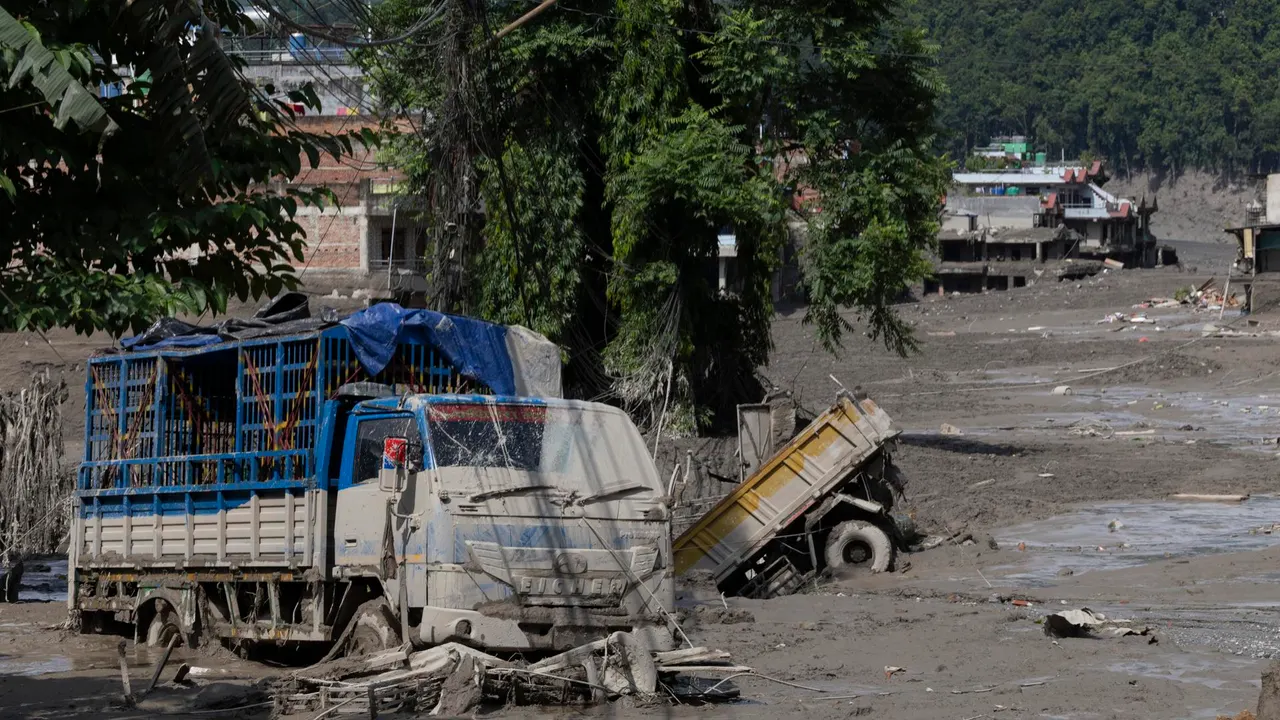
An immense flood hit northern Nepal this Wednesday, especially the Rasuwa district, next to the border with Tibet, leaving at least 160 dead and hundreds missing between Nepal and China. The violence of the current has devastated homes, roads, bridges and other infrastructure.
The exact cause is still being investigated, but one of the hypotheses that is gaining strength points to a phenomenon related to the melting of the Himalayan glaciers: the formation of a temporary lake after their melting and a sudden rupture could have suddenly released an enormous amount of water.
A possibility that Sebastián Álvaro, a renowned adventurer and journalist who has visited the Himalayan mountains on numerous occasions, knows well. In La Brújula, Álvaro has explained that to understand the dimension of a tragedy like this, we must take into account, first of all, the orography of the region itself.
“A terrifying wave of mud, rocks and water”
Northern Nepal and the border with Tibet form one of the steepest areas on the planet. There, Álvaro explained, the enormous slopes and the narrowness of the valleys mean that any phenomenon of these characteristics can quickly multiply its effects. In this scenario, a landslide can block a channel and create a temporary lake. If this barrier ends up giving way, all the accumulated water is suddenly released and descends the slopes dragging mud, rocks and everything in its path.
In this sense, one of the first hypotheses about the origin of the tragedy is the possibility that a glacial lake overflowed or was suddenly released after the detachment of a large mass of ice and rock. Satellite images point to a collapse in a glacial area located at about 5,200 meters above sea level.
But Nepalese authorities have also put on the table the possibility that an earthquake in Tibet triggered the phenomenon. Nepal’s Foreign Minister has indicated that the earthquake could have caused the landslide, although he has called for a more in-depth investigation to determine what exactly happened.
“Probably some glacial lake,” Álvaro pointed out when referring to the possible explanation for the flood. The first investigations also point to a landslide of ice and rocks that would have temporarily blocked the river before causing the enormous flood. The hypothesis also fits with another piece of information: the Nepalese authorities have indicated that there were no intense rains in the area immediately before the flood, which reinforces the need to look for the origin in other phenomena.
A tragedy difficult to measure
Álvaro has highlighted in La Brújula that the complicated terrain of the Himalayas also makes rescue efforts extremely difficult. There are areas with slopes of thousands of meters and very narrow valleys through which an avalanche of water and mud can move at high speed. Furthermore, an important part of the missing are tourists and mountaineers. In the Rasuwa district, contact had been lost with hundreds of people, including many foreigners who were in the area to carry out mountain routes or pilgrimages to Tibet.
For Álvaro, these types of tragedies also show the consequences of the retreat of the Himalayan glaciers. “We are losing glaciers, which are one of the natural treasures we have on Earth, with disastrous effects for the population and for everyone who loves the beauty of nature,” he noted.
We are losing glaciers, which are one of the natural treasures we have on Earth,
The adventurer is currently in Istanbul and plans to travel to Islamabad to undertake a new expedition through the Karakoram, where he will cover some 250 kilometers of glaciers. Meanwhile, emergency teams continue to search for survivors in Nepal. The destruction of roads and bridges and difficult weather are complicating rescue operations.
