
The Swedish election night has left an unusual image for a country accustomed to political stability: a parliamentary majority that fits in a single deputy. The center-left opposition has managed to place itself ahead of the conservative bloc, but the distance is so narrow that the result still does not clear who will have the reins of the country.
The count points to a change of cycle. The Social Democratic Party is once again the most voted force and its leader, Magdalena Andersson, could return to the position of prime minister. However, the progress of his bloc does not automatically translate into an easy Government to build. Alliances and post-election agreements will be as important as the result of the polls.
The opposition prevails by the minimum
The Swedish Social Democratic Party (S) has led the legislative elections held this Sunday, with around 28% of the votes. The center-left bloc led by Andersson reaches 175 seats, compared to the 174 seats added by the forces that support the outgoing conservative prime minister, Ulf Kristersson, according to preliminary results released during the election night.
The figure is especially relevant because the Swedish Parliament has 349 deputies and the absolute majority is 175. In other words, the opposition is just one seat away from the border that allows control of the Chamber.
The data collected by El País with approximately 94% of the districts counted places the Social Democrats at around 28% of the votes and confirms the minimal advantage of the center-left. La Vanguardia also reports a projection of 175 seats for the opposition bloc compared to 174 for the government.
The Swedish Electoral Authority must complete the recount before the final distribution can be closed. The difference is so small that the pending vote could be decisive in confirming the majority.
The return of Magdalena Andersson, conditioned by her allies
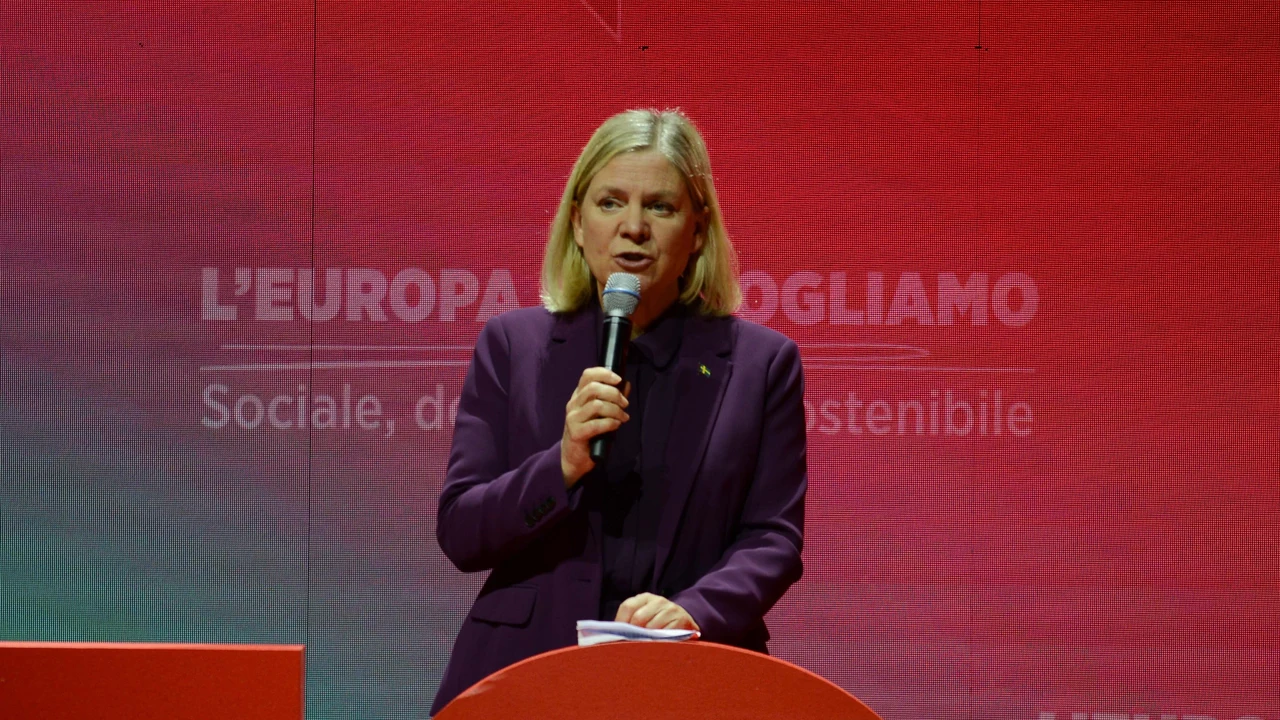
Andersson, who already led the Swedish Executive between 2021 and 2022, now has the opportunity to return to power. His party maintains its historic electoral leadership, but will need to secure the support of other parties to govern.
The composition of the opposition bloc explains why the result cannot be interpreted as a social democratic victory alone. The Left Party, the Center Party and the Green Party are essential pieces of the advance of the center-left.
The Social Democratic Party obtains 99 seats and remains the most voted force, although it loses eight deputies compared to the previous elections. The Left reaches 29 representatives with 8.2% of the votes, while the Center adds 25 seats after obtaining 7.1% of the ballots. The Greens, for their part, obtained 22 deputies with 6.1% of the support.
The Left and the Greens are the formations that are growing the most within the opposition, while the Social Democrats are declining compared to the previous elections. This combination gives Andersson a privileged position to negotiate, but also forces her to manage the ideological differences of her own bloc.
The extreme right loses strength after years of growth
One of the big headlines of the day is the result of the Sweden Democrats (SD). The far-right party has left behind the upward trend it has been experiencing in recent years and is losing parliamentary representation.
The party obtains around 17.6% of the votes and is left with 62 seats, eleven less than in the previous call, according to the distribution shown on the ticker. The fall causes him to lose weight within the conservative bloc and represents a setback for a force that had established itself as a decisive actor in national politics.
The preliminary results coincide in pointing out the decline of the Sweden Democrats, which is no longer the second political force in Parliament in favor of the Moderate Party.
The Moderate Party maintains the leadership of the right
The party of the outgoing prime minister, the Moderate Party (M), improves its results slightly and obtains around 19.9% of the votes, with 71 seats in the provisional distribution of the ticker.
The other two partners of the Executive, the Christian Democrats and the Liberals, also managed to advance in the number of deputies. The former receive 6.2% of the votes and reach 22 seats, while the Liberals have 19 representatives with 5.4% of the votes.
The Liberals had faced a complicated campaign due to the risk of not exceeding the electoral threshold. Its permanence in Parliament allows the conservative bloc to maintain a relevant parliamentary base, although insufficient to overcome the opposition in the current projection.
The right-wing bloc is thus on the verge of retaining power, but its future will depend on whether it manages to regain a sufficient majority or if the recount ends up giving a clearer advantage to the opposition.
What does the victory of the left mean for Sweden?
The result could have important consequences on the country’s domestic politics and European direction. It is not just a matter of a replacement of prime minister: at stake is Sweden’s orientation on issues such as the welfare state, immigration, security and the relationship between traditional parties and the extreme right.
