
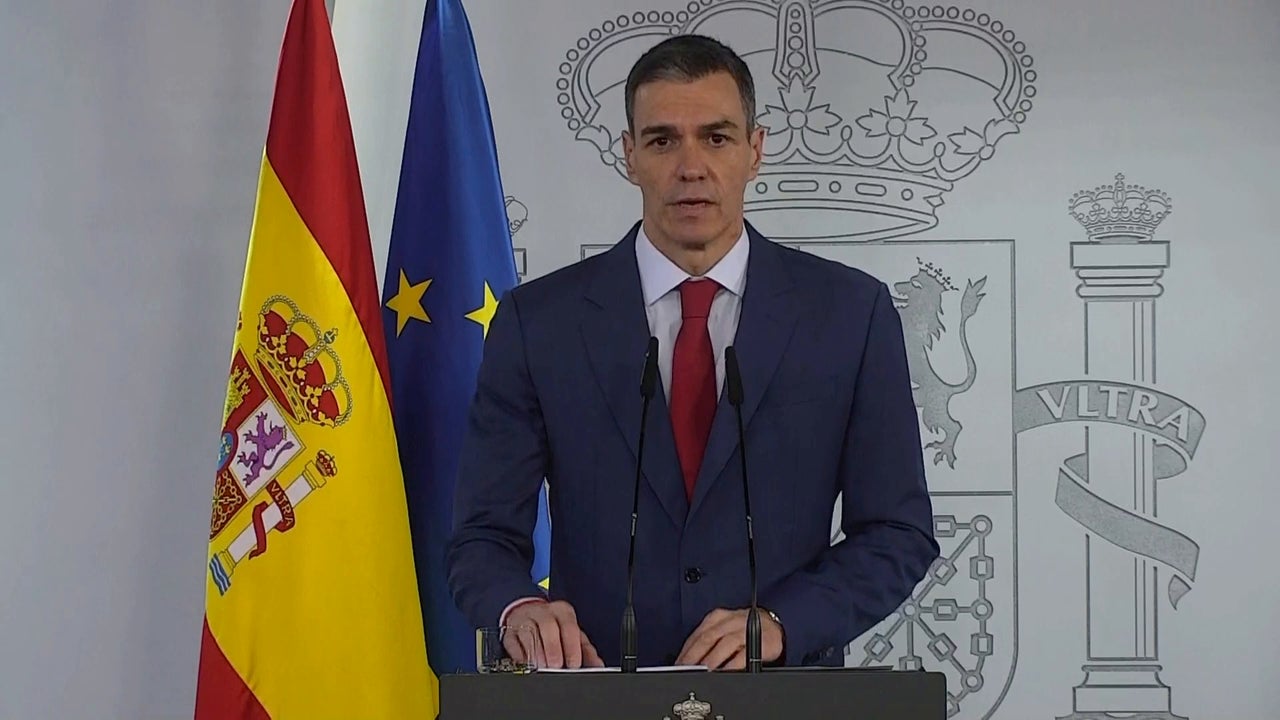
Pedro Sánchez has made an institutional statement from Moncloa to reaffirm the position of the Government of Spain with the war in Iran, which began with the joint attack by the United States and Israel. “No one knows with certainty what will happen now, nor is the objective of those who launched the first attack clear,” began a serious Sánchez, who also pointed out that we should be “prepared” for “a long war with serious consequences in economic terms.”
“The Government’s position is summarized in four words: ‘no to war’,” said Sánchez, who recalled the war in Iraq 23 years ago, when he assured that another US administration “dragged” Spain into another war in the Middle East. “It was done to guarantee global security, but seen in perspective, it unleashed the greatest wave of insecurity that our continent suffered. The war in Iraq generated an increase in jihadist terrorism and also in prices, in the cost of living. That was the gift of the Azores Trio.”
Although it is early to “glimpse” the effects of the conflict, the leader of the Executive believes that the war “will not result in a fairer international order, nor higher salaries, nor a healthier environment.” “What we see is more economic uncertainty, rising oil and gas prices,” he commented, to which he added that Spain is “against this disaster”: “Governments are here to improve people’s lives and not to make them worse.”
“The question is not whether we are for the ayatollahs, the question is whether we are on the side of peace.”
Furthermore, Sánchez has announced that the Government is already studying possible measures to stop the economic consequences derived from the war in Iran. “The coalition government is going to do the same as in other conflicts. We are assisting the Spaniards who are in the Middle East, we are going to protect them and bring them back, and the Government is studying scenarios and possible measures to help households, companies, the self-employed, to mitigate the impacts of this conflict,” said Sánchez, who underlines that, “thanks to the responsibility” of the Executive, Spain has “the necessary resources to face” the crisis as a result of the conflict.
Sánchez “demands” the cessation of hostilities and reaffirms Spain’s position
Regarding the Government’s position on the war, Sánchez has insisted that they must “demand” the “cessation of hostilities” and a “diplomatic resolution.” “The appropriate word is demand, because Spain is a full member of the EU, of NATO, and this also affects us Europeans and Spaniards. We have to demand all the resolution from the US, Iran and Israel so that they stop before it is too late,” Sánchez stressed.
The president maintains that “one illegality cannot be responded to with another”, since “this is how the great disasters of humanity begin” and considers that the question is not whether Spain “is in favor of the ayatollahs”: “The question is not whether we are in favor of the ayatollahs, no one is. The question is whether we are on the side of legality and therefore of peace”, commented Sánchez, who has once again asked other countries to “act coherently” to “defend the same values as when talking about Ukraine or Venezuela.”
In this sense, Sánchez recalled that Spanish citizens “always repudiated Saddam Hussein’s dictatorship, but never supported the war”, and maintains that the Executive’s position “is not naive”, but rather “coherent”: “We are not going to be complicit in something that is bad for the world simply because of the fear of reprisals.”
We have confidence in the economic strength of our country and in times like this we feel more proud than ever to be Spanish,” said Sánchez, who concluded his institutional statement by saying that the Government “is not alone”: “We are not alone, the Government is with whoever it wants to be with, with the values that our grandparents set in the Constitution, it is with the United Nations charter and with peace. With many other governments that think like us and with those who ask for more peace and more prosperity. This benefits us all.”
