
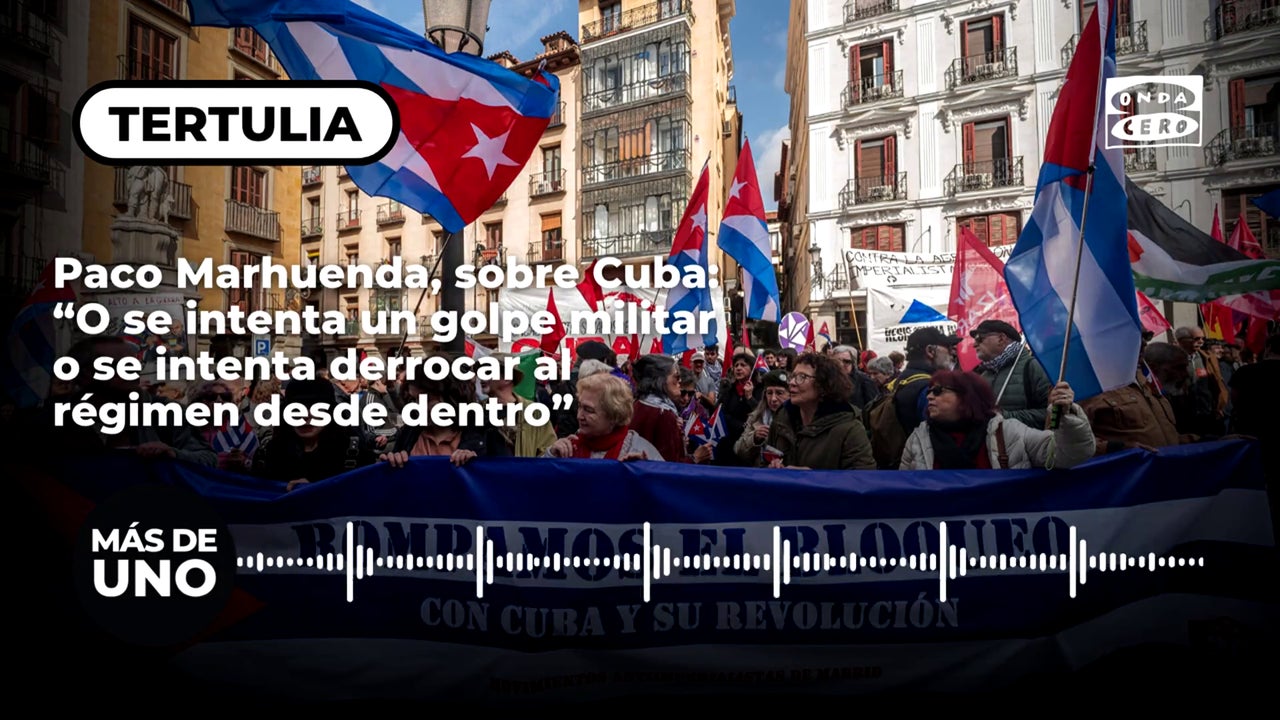
During today’s discussion at more than one The political and economic situation in Cuba has been debated, as well as the possible strategies of the United States to influence a change of regime on the island. Yesterday, Monday, March 16, Donald Trump declared that he will have “the honor” of “taking or liberating Cuba.”
Carlos Alsina raised the hypothesis that Donald Trump’s Administration may be exploring alternative formulas to direct military intervention, betting on an internal transformation of the Cuban system. This strategy would involve identifying figures within the Cuban Government itself who maintain a good relationship with Washington and who can lead a controlled transition, thus opening up a “casting” to play Delcy Rodríguez in Venezuela, that is, “not a transition towards democracy but a prolongation of the dictatorial regime for a time, but supervised by the Government of the United States.”
For his part, Paco Marhuenda has commented that, faced with options such as a military invasion or a coup d’état, Marhuenda defended that an indirect route, inspired by precedents such as the Venezuelan case, could be more viable. “It is very good that Cuba is moving towards a democracy and that the corrupt and criminal regime that currently governs ends, as in Venezuela,” to which Pilar Velasco cuts him off by asking “where is democracy in Venezuela?”
“What Trump is going to do seems very right to me”
“It is a transition. Here there are two options: either a military coup d’état is attempted, with the cost it entails, or an attempt is made to overthrow the regime from within,” explains Marhuenda, adding that, “in that scenario, what Trump is going to do seems very correct to me.”
He has also maintained that, due to life circumstances, he knows people who are in Cuba or “who come and go”, so he knows the situation from within and “it is very precarious.” “Society lives as it does in a corrupt regime, with parallel economies and a subsistence economy,” he explains.
Likewise, the leadership of the current Cuban president, Miguel Díaz-Canel, was questioned, who was described as a figure subordinate to the influence of Raúl Castro. In this context, Marhuenda defends that a change driven from within could open the door to future democratization of the country.
However, the debate revealed the division of opinion on the role that the United States should play. While some consider it legitimate to favor political change on the island, others warn of the lack of guarantees on the part of the US government that such strategies lead to full democracy.
