
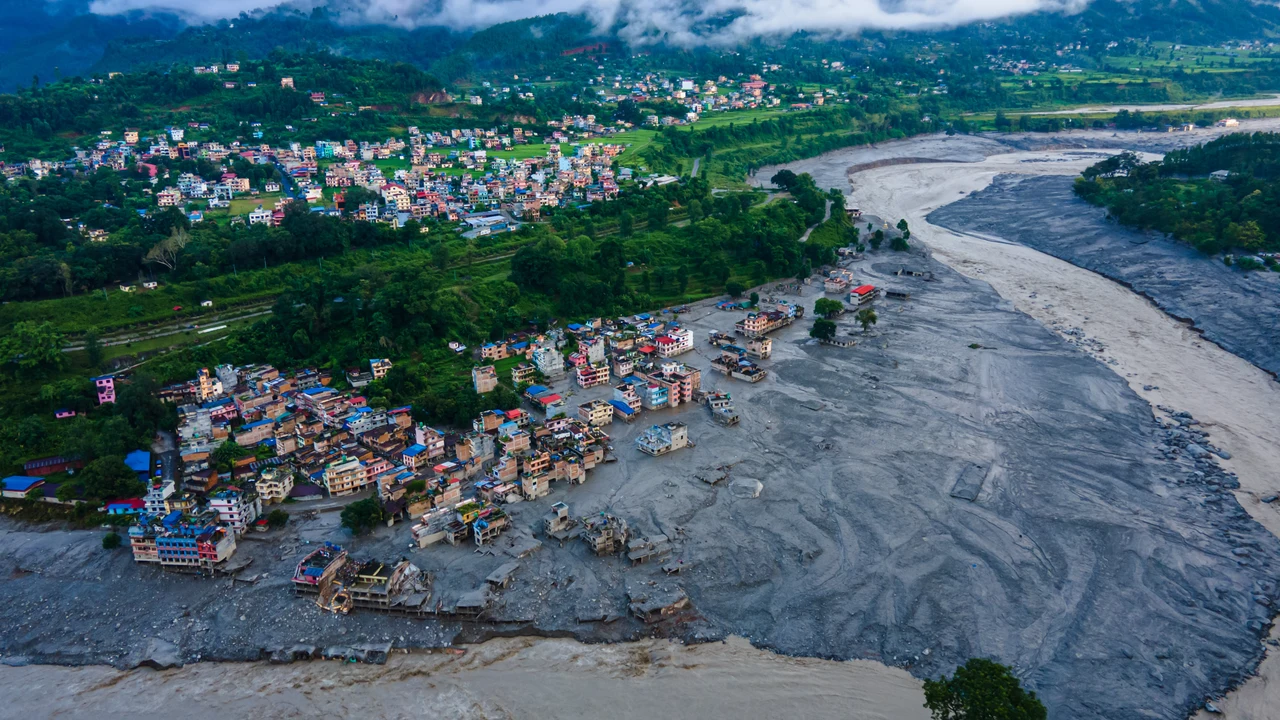
The Government of Nepal has already located the last of the three Spaniards who were missing after the devastating flood last Wednesday, August 26, in the municipality of Rasuwa, on the border with Tibet.
The Nepalese Tourism Board, in its latest update on Sunday, August 30, includes the three Spaniards on the list of “located and in contact”, along with a Belgian citizen and another American.
Missing
For their part, the Chinese authorities published this Sunday for the first time information about the missing foreigners. Specifically, they have reported 261 missing people from 23 countries, including one person from Spain.
The country with the most missing people in Tibet is Nepal, with 104, followed by India, with 49; Latvia, with 33; United States with 18; United Kingdom, with 15; Australia, with six; South Africa, with four; Malaysia, Germany and Russia, with three each; Ireland, Estonia, France, the Netherlands and New Zealand, with two each; and Kazakhstan, Finland, Lithuania, Portugal, Spain and Hungary, with one each, as reported by the Government of the autonomous region of Xizang (Tibet) in a press conference.
The Chinese authorities have notified the respective embassies and consulates of the countries of the missing people, as indicated by the Tibetan regional government.
At the moment, a total of 592 foreigners remain unaccounted for, among the almost 4,200 missing due to the tragedy, which so far leaves a total of approximately 900 dead, in addition to enormous material damage, as stated this Monday, August 31, by the Nepalese authorities.
Origin of the disaster
An expert from China’s Ministry of Natural Resources stressed that the disaster was a chain of events that began with a high-altitude ice avalanche and evolved into a high-speed debris flow before hitting border facilities in Gyirong, ruling out the possibility of a glacial lake outburst.
For his part, Benjamin Mirus, a researcher at the Geological Hazard Science Center (GHSC), said in statements to Europa Press that these conclusions “are similar” to those obtained by the United States Geological Survey (USGS), which has determined that the “glacial collapse” took place in Langtang National Park, in Nepal, near the common border.
