
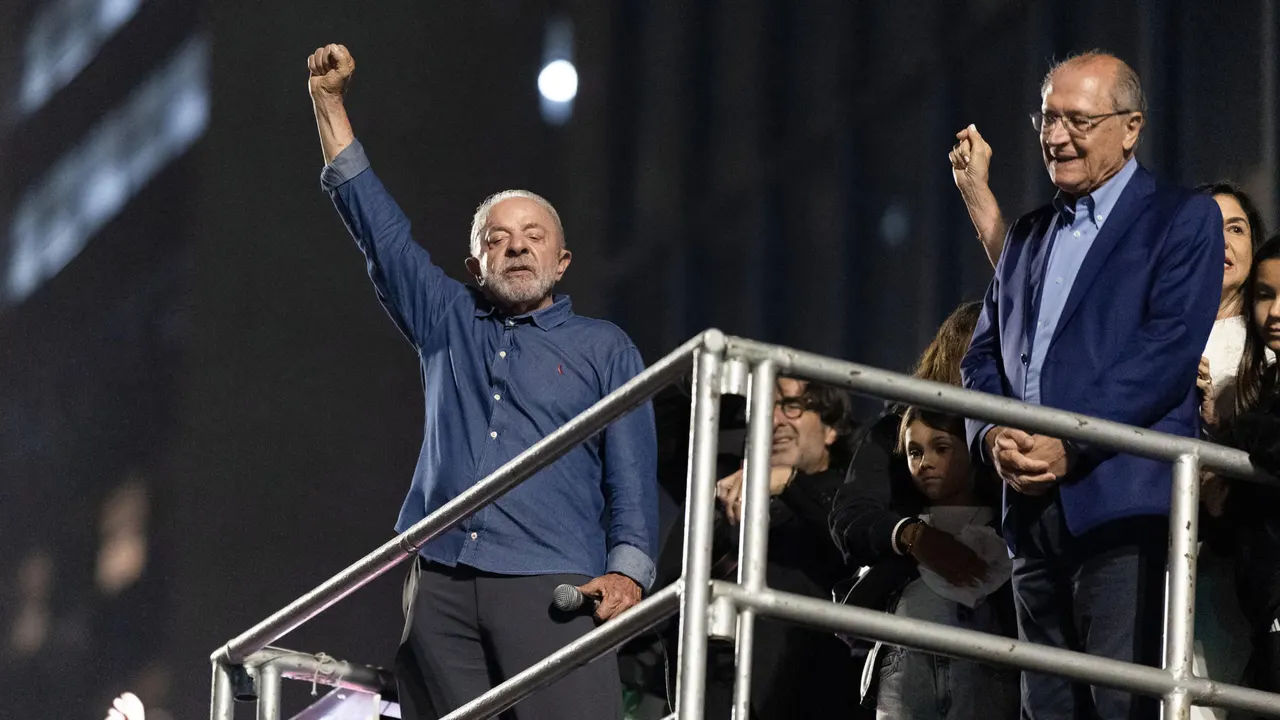
Marta García Aller spoke with Lincoln Macario Maia, researcher at the Ibero-American Institute of the University of Salamanca and political journalist in Brazil for 25 years, about Lula da Silva’s victory in the Brazilian elections and the keys to his comeback in the second round.
Lula has won with 51.79% of the votes, compared to 48.21% for Flávio Bolsonaro, a difference of more than four million supports. Between the two rounds, the candidate of the Workers’ Party (PT) added more than ten million votes, while his rival obtained around 3.7 million more.
For Maia, one of the factors that explain this result has been the fear of a victory for the extreme right, but also the mobilization of militants and activists during the last two weeks of the campaign. As he explained, there was a particularly intense effort by the PT bases and other political sectors, including right-wing groups opposed to Bolsonaro, to mobilize the vote in favor of Lula.
The journalist also recalled that Lula maintains a relatively good relationship with the center-right, with whom he has already governed and negotiated in previous stages. This ability to reach agreements is especially important for the Brazilian left, which in recent years has had limited representation in Parliament: 140 deputies out of a total of 513 at its best.
Social networks, decisive in the comeback
Maia has highlighted the “fundamental” role of social networks during the campaign. In his opinion, the PT and the parties that supported Lula did not pay enough attention to this area during the first round, but they corrected that strategy in the final stretch of the campaign.
One of the examples was the initiative promoted by André Janones, a PT deputy, who led a WhatsApp group called ‘Lula’s Army’ to coordinate the dissemination of messages favorable to the candidate on social networks.
Participants took on daily communication tasks and dedicated several hours a day to sharing content and mobilizing support. “In Brazil, people became bots,” Maia summarized, referring to a militancy that worked in an organized and constant way to amplify campaign messages. In this way, Lula’s supporters reproduced a diffusion dynamic, “doing the work that bots do for far-right campaigns.”
Doing the work that bots do for far-right campaigns
The challenges of the next mandate
After the electoral victory, Lula will have to face several challenges. Maia has pointed out, among them, geopolitical politics and the relationship with the United States, with special attention to the interest that Donald Trump has shown in the Brazilian elections and in the country’s critical minerals.
At the national level, another of the main challenges will be governing with a Parliament in which the right and the extreme right have significant weight. The president-elect will have to negotiate with other forces to carry out his initiatives, in addition to managing the internal differences of the PT, which also respond to territorial interests. Finally, the researcher has pointed to the regulation of social networks as another of the issues that Lula must address. This is an issue that, as he recalled, the candidate has already placed among the priorities of his campaign.
