
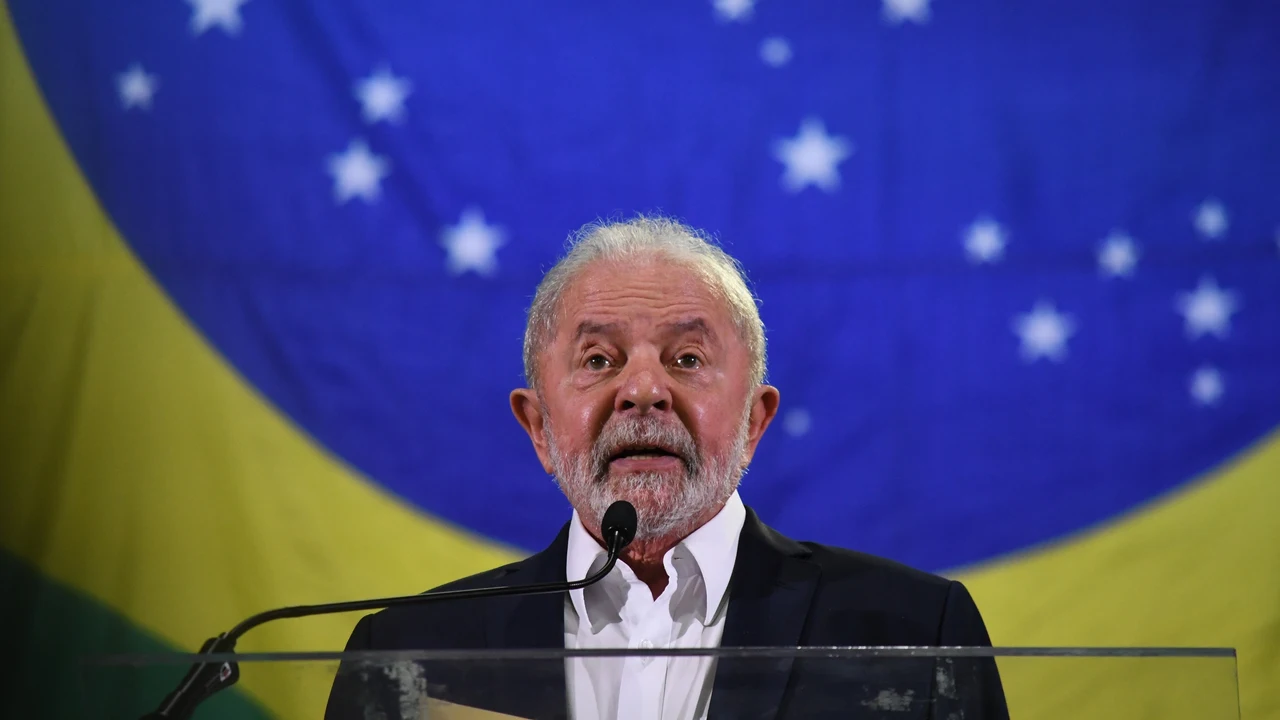
The president of Brazil, Luiz Inácio Lula da Silva, has achieved a historic victory in the presidential elections held this Sunday, by winning the second round over Senator Flávio Bolsonaro, candidate of the right and first-born of former president Jair Bolsonaro. The result, confirmed by the Brazilian electoral authority, grants Lula a fourth non-consecutive presidential term and marks a precedent in the country’s recent democratic history: it is the first time since the end of the military dictatorship, in 1985, that the candidate who finishes second in the first round later achieves definitive victory.
With 100% of the votes counted, Lula has obtained approximately 51.8% of the votes, compared to 48.2% for Flávio Bolsonaro. The difference is around 4.4 million votes, according to data collected by the US agency Associated Press (AP). The victory consolidates the leadership of the veteran leftist leader, who will turn 81 on October 27, and extends his political career at the head of the largest economy in Latin America.
The comeback takes on special relevance due to the result of the first round, held on October 4. Then, Flávio Bolsonaro was in first position, with 47.03% of the valid votes – 56,103,033 votes -, while Lula obtained 45.16%, equivalent to 53,870,724 votes. The conservative candidate led the current president by more than two million ballots, but did not reach the absolute majority necessary to avoid a second round.
Lula’s final victory reverses that result and turns the 2026 Brazilian election into an unprecedented case since the recovery of democracy in the country, according to reports published by Reuters and AP.
Lula claims national sovereignty and promises to govern for everyone
After the results were confirmed, Lula celebrated the victory with his collaborators and thousands of supporters gathered in different Brazilian cities. In his speech, the president thanked the support received and defended the need to preserve national sovereignty in the face of foreign pressures.
“This country will not accept being anyone’s backyard,” he said, according to the transcript of his statements collected by AP. The president also claimed the result as a rejection of misinformation and falsehoods during the electoral campaign.
“This was a defeat of denialism and lies,” Lula said to his followers, according to the same agency.
The president’s message combines two political objectives: presenting the victory as a defense of democratic institutions and reaffirming Brazil’s autonomy on the international stage. During the campaign, Lula had warned that a victory for Flávio Bolsonaro could bring the country closer to the positions of US President Donald Trump, a political ally of the Bolsonaro family.
The re-election also represents a new turn in Lula’s career. A former union leader and one of the founders of the Workers’ Party (PT), he governed Brazil between 2003 and 2010 and returned to the Presidency in 2023, after defeating Jair Bolsonaro in the 2022 elections.
His fourth term, however, will not be without difficulties. The new composition of Congress, characterized by a strong conservative presence, threatens to limit its ability to promote reforms and carry out its main legislative initiatives.
Flávio Bolsonaro rejects the defeat and announces that he will request an annulment
The reaction of the defeated candidate has introduced an element of political uncertainty after the results were announced. Flávio Bolsonaro has refused to recognize Lula’s victory and has announced that he will request the annulment of the second round, alleging irregularities related to an extraordinary extension of voting hours.
The senator has questioned the decision of Supreme Court Judge Cristiano Zanin to extend the opening of the polling stations by two hours. The measure was adopted after both candidates requested an extension due to public transportation problems in some cities and due to the intense rains recorded in the south of the country.
Bolsonaro called the decision “unacceptable” and said he could not recognize the election results under the circumstances, Reuters reported on October 26.
The controversy centers on the time and conditions under which the judicial decision was made. Zanin had been Lula’s lawyer, a circumstance that the conservative candidate has used to question the magistrate’s actions.
However, the existence of a challenge does not imply that the elections will be annulled. AP collects the assessments of electoral law specialists who consider that Bolsonaro would have to demonstrate that the extension of hours effectively affected the free exercise of voting. The president of the electoral authority, Kassio Nunes Marques, pointed out that the extension did not alter the result.
For the moment, the initiative announced by the senator does not modify the proclamation of Lula as the winner. The possibility of reversing the result is considered limited, although the evolution of the challenges must be followed closely.
The refusal to accept defeat is reminiscent of Jair Bolsonaro’s reaction after the 2022 elections, when he also did not fully recognize Lula’s victory. The former president was later convicted of his participation in a coup plot aimed at preventing the transition of power.
A campaign marked by polarization, the economy and security
The electoral outcome reflects the deep political division that Brazil is going through. The campaign confronted two different projects for the country, with the family economy, citizen security, corruption and Brazil’s role in the world among the central issues of the debate.
Flávio Bolsonaro made the fight against crime one of the pillars of his program and promised measures to reduce the cost of food. His candidacy sought to give continuity to his father’s political movement, which maintains an important electoral base among conservative sectors.
Lula, for his part, defended his economic and social management and claimed progress in reducing poverty and inequality. In the final stretch of the campaign, he presented proposals aimed at workers and households with lower incomes, including the reinforcement of social programs.
The contest was also conditioned by suspicions of corruption that have affected leaders and associates of both political spaces. Lula spent 580 days in prison after a corruption conviction that was later annulled by the Brazilian justice system. For its part, Bolsonaro’s entourage has faced investigations and political controversies that have marked the campaign.
In this context, the victory of the incumbent president shows that the advantage obtained by Flávio Bolsonaro in the first round was not enough to ensure majority support in the final confrontation.
A fourth term with a more conservative Congress
Despite the presidential victory, Lula will face a complex legislature. According to the analysis published by Reuters, Bolsonaro’s Liberal Party and its allies could control more than 280 seats in the Chamber of Deputies and up to 50 seats in the Senate, allowing them to exert considerable parliamentary influence.
This balance of forces could make it difficult to approve reforms, budget negotiations and institutional appointments. The Government will also have to manage fiscal concerns arising from high public debt and interest rates.
Lula’s victory guarantees the continuity of his political project in the Executive, but does not imply equivalent parliamentary support. The president will need to build agreements with other parties if he wants to develop his program during the new mandate.
The result also has international implications. Brazil will continue under the leadership of a president who has defended an autonomous foreign policy and who maintains differences with Donald Trump on trade and geopolitical issues. The defeat of Flávio Bolsonaro also represents a setback for the Brazilian right’s strategy of recovering the Presidency through the political continuity of the former president’s family.
The day thus leaves two contrasting images: the celebration of Lula, who achieved a historic electoral comeback, and the rejection of his opponent, who questions the legitimacy of the result and threatens to take the case to the authorities.
In the absence of knowing the evolution of the announced challenges, the central fact is unequivocal: Lula has won the second round and will continue to lead Brazil for a fourth non-consecutive term. The political scope of that victory will now depend on his ability to govern a deeply polarized country and with a Congress in which the conservative opposition will have a position of strength.
