

The TBA21 foundation and the Thysssen-Bornemisza National Museum present in Madrid Listening to the rain all nightthe latest work by artist John Akomfrah.
«Listen to everything until it fits and you are part of it. Listen to all the things, all the diversity, the multiplicity of the cosmos, until everything fits and you are part of it. These words from the American composer, performer and researcher Pauline Oliveros, promoter of sonic meditation and creator of the concept deep listening –deep listening– could be the best advice for anyone who wants to delve into the latest work by the British artist of Ghanaian origin John Akomfrah, which can be visited from November 4 to February 8 at the Thyssen-Bornemisza National Museum, in Madrid. With Listening to the rain all nighthis most experimental work, the artist continues to explore memory, postcolonialism, ecology, emigration and aesthetics using the moving image and, especially, sound as language.
The work asks the visitor for time and calm. It is a tour through four interconnected rooms of the museum, plus a part located in the entrance garden. In each of these spaces the visitor finds a set of large-format video screens in which archival audiovisual material and film sequences—beautiful—recorded by Akomfrah are shown intertwined. An audiovisual collage in which scenes from the colonial past appear, from the struggles for independence in Africa and Asia, from the daily life of the African diaspora today or from the fight for civil rights in the United States, combined with spectacular Scottish mountain landscapes, with recordings of the seabed, rivers, forests… The images are synchronized with a very rich sound montage that intersperses ambient music with the sound of rain or the sea, with fragments of speeches from Martin Luther King or Malcom Water, in the form of fog, rain and sea, is a common thread throughout the work, as a symbol of the passage of time and the travels of migrant communities. «When we are in one of the rooms of this fantastic exhibition and we sit for a while, at first we do not necessarily understand the connection, many associations are awakened in us. But if we let ourselves go, we flow with the water, with the memory, with that kind of internal monologue,” says Solana.
Each of these video installations, which the artist calls Songslasts approximately half an hour and is stylistically and thematically connected to the others. The rooms have seats where the visitor can sit, open their eyes and ears and let themselves go. “I invite you to listen,” Akomfrah said during the press conference. «To receive the work you do not have to be predisposed to anything. The mere interest in nonlinearity, in polyphony, in the entire range of possible reactions that you can have, that multiplicity is deeply democratic. I don’t want to tell anyone what the work has to mean. “I don’t want to tell anyone what to take or what to think.”
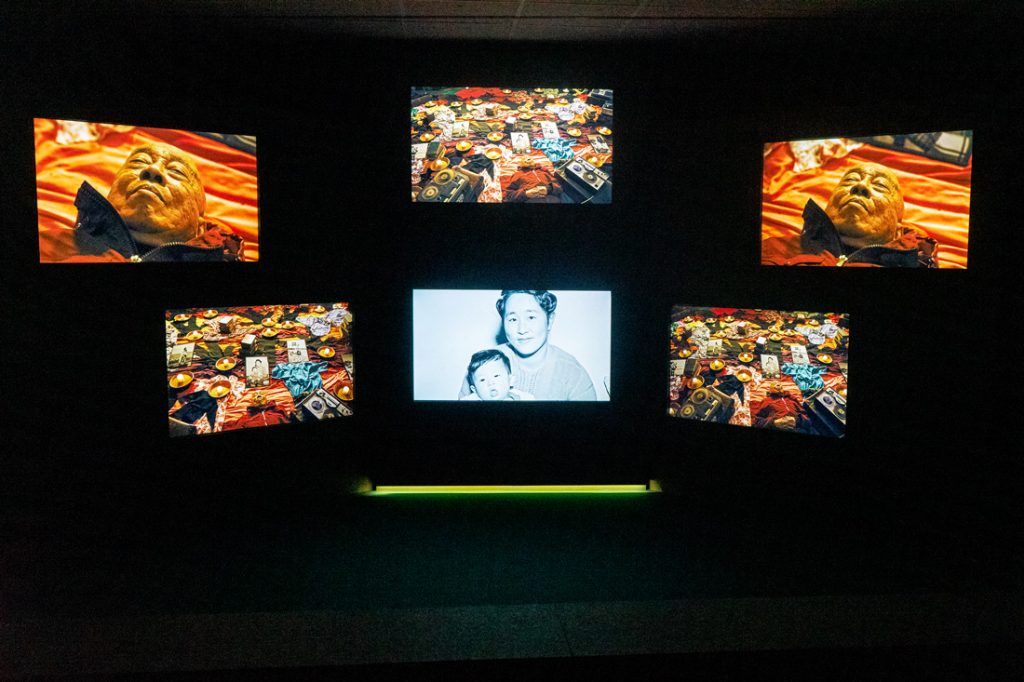
Listening to the rain all nightwhich takes its title from an 11th-century poem by Chinese writer Su Dongpo, was a work originally commissioned by the British Council for the British Pavilion at the 60th International Art Exhibition-La Biennale di Venezia in 2024. For its premiere in Madrid, five of the eight have been chosen Songs originals and have been adapted to the morphology of the museum, accompanying the immersive multichannel cinema and sound installations with works from the Thyssen-Bornemisza collections, including pieces by Joan Miró, Lucio Fontana and Romare Bearden, with which the dialogue created between the video and the soundscape is expanded.
Both the original project and the exhibition at the Thyssen are curated by Tarini Malik, curator of modern and contemporary art at the Royal Academy of Arts in London. “The exhibition addresses issues related to ecological devastation and the decolonial era in such sensitive, but at the same time so experimental, ways that I have loved working on this process that is not something finished, but something living that can continue to evolve,” Malik said during the presentation. “John’s work is about dialogue, about that space between image and sound, the past and imagining what the future could be like.”
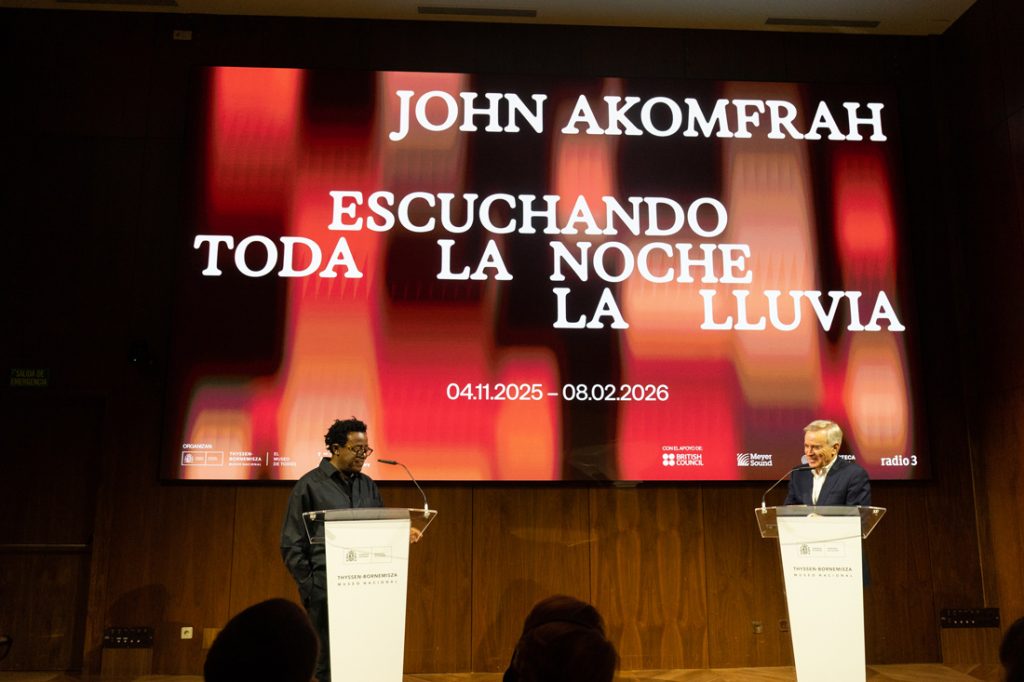
John Akomfrah is an artist recognized internationally for his art films and video installations that deal with topics such as racial injustice, colonial legacies, identity, migration and climate change. He was the founder, in the early 1980s, of the Black Audio Film Collective. In 2017 he received the Artes Mundi Award for his film in diptych form Auto Da Fé and represented Ghana with its first national pavilion at the Venice Biennale in 2019 with Four Nocturnes. This latest project is not the artist’s first collaboration with the TBA21 Foundation (Thyssen-Bornemisza Art Contemporary), created by Francesca Thyssen-Bornemisza and co-directed by Rosa Ferré and Markus Reymann. In 2017 TBA21 presented Purplean immersive video installation with six large screens in which the filmmaker addresses climate change, rising sea levels and extreme weather events.
Listening to the rain all night, His most experimental work to date, it has received numerous praise from critics, including that of The Guardian newspaper, which described it as “a magnificent and terrible journey (…) more than immersive, destabilizing, painful and absolutely captivating.” Without a doubt, staying for two hours—or more—among the images and sounds proposed by Akomfrah “until everything falls into place” is an experience that is difficult to forget.
