
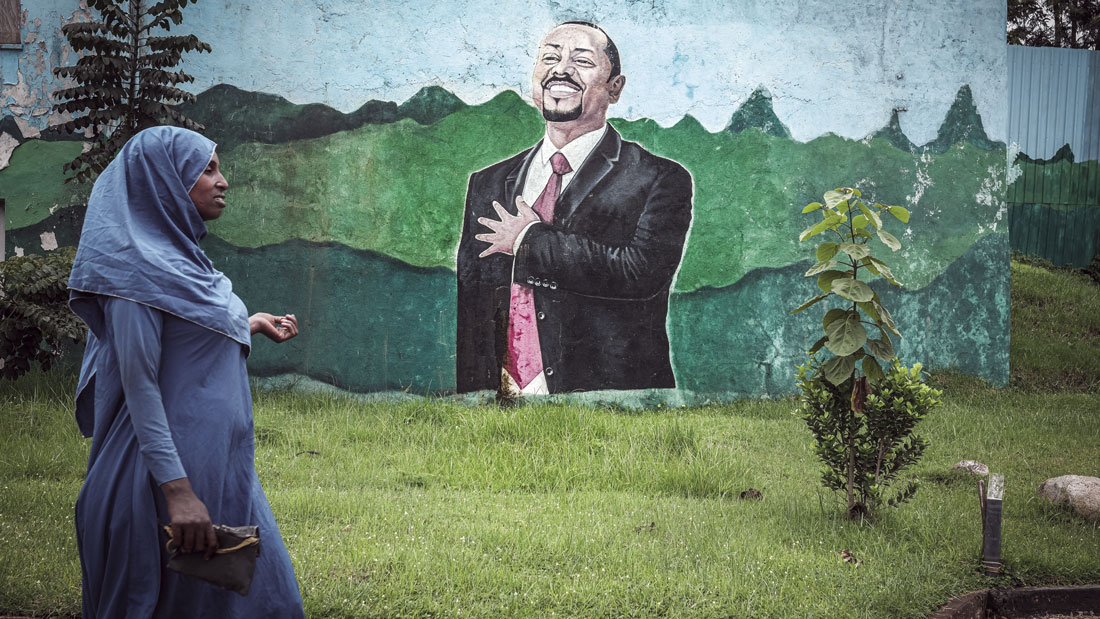
Abiy Ahmed secures another victory in the June 1 elections and a second term as prime minister.
June started in Ethiopia with an election day. According to official data, more than 50 million citizens registered to vote and estimates indicate that almost 40 million exercised their right to do so. The results, announced 20 days after the elections, certified a new victory for the Prosperity Party (PP), which obtained 438 of the 501 seats up for grabs, thus controlling 90% of Parliament. From 1991 to 2019, the People’s Revolutionary Democratic Front of Ethiopia (FDRPE) led the Government. At that time it was dissolved and renamed PP, already under the leadership of Ahmed. This formation, under either of its two names, has had no rival in the last three electoral calls. In 2010, the FDRPE secured 99.6% of the seats in Parliament, five years later it monopolized all the seats and in 2021, the first elections in which the PP participated, they accounted for 97%. This year, the seventh since the transition process from the authoritarian to the parliamentary regime was completed, has not been an exception to the rule.
Not everyone votes
The Tigray region, in northern Ethiopia, has been in conflict with the federal government for more than a decade. After the 2015 elections, those scheduled for 2020 had to be postponed due to COVID-19. However, the Tigrin regional government, in a challenge to the federal Executive, decided to organize regional elections in September 2020, which, in the end, became a trigger for the war that pitted both sides against each other for two years and left around 600,000 dead. The 2021 general elections excluded Tigré, a scenario that has been repeated this year, which means that the inhabitants of the northern region have not exercised their right to vote for more than a decade and there will be two legislatures without federal parliamentary representation.
In addition to Tigray, which was excluded in its entirety, parts of the regions of Oromia and Amhara, two of the most populated, also saw their right to vote limited. Between these two regions, at least 140 electoral districts suspended voting, mostly citing security risks. This means that, of 547 total seats, only 501 have been elected. Added to the exclusion of all these areas is the fact that in another 65, the only party that presented a candidate was the PP, which has assured them those seats in Parliament without the need to count the votes.
A fragmented opposition
Several dozen parties participated in the Ethiopian elections. Some of them, of a regional nature, are very close to the PP, while those who make the opposition visible are very fragmented. Ennatu Domingo Soler, a Catalan political scientist of Ethiopian origin, and John White, a journalist specialized in the Horn of Africa, in conversation via WhatsApp with MUNDO NEGRO, agree in pointing out the lack of opposition as one of the most problematic elements of the elections. Both agree that the opposition is very weak, it is not united and its campaign has been disorganized and limited, which is why it has had little impact. Added to this is the aforementioned exclusion of hundreds of electoral districts in the three regions, as well as the “climate of intimidation present in several localities,” according to White. Along with the lack of opposition, there is also the low participation of women in the process. According to journalist Maya Misikir in Sifter, its digital newsletter, less than 25% of the candidates were women. In addition, it denounces cases of violence and intimidation against women in the electoral context, which caused some to give up running as candidates.
Given the doubt as to whether Ahmed, the 2019 Nobel Peace Prize winner, is the ideal person to lead Ethiopia at a time of strong internal and regional tensions, with the threat of a new war in Tigray and clashes with neighboring countries, such as Eritrea, Domingo Soler maintains that “he is the only political figure who has the support of regional (IGAD), continental (AU) and international organizations.” “In addition,” adds the expert, “he has presented himself as a more moderate and centralizing politician than the alternatives that existed before.” Along with this, and as White highlights, the prime minister “wants to turn Ethiopia into the third economic power in Africa.” However, the prolongation of internal conflicts, as well as the suspicions that it is beginning to raise due to its approach to the United Arab Emirates and the Sudanese Rapid Support Forces, may further erode its figure.
The cost of the skyscraper
«There are already hundreds of new gigantic buildings and authentic skyscrapers of up to 30 or 40 floors spread throughout the capital, creating an authentic skyline similar to that of many cities in the Gulf countries,” details John White. This statement hides two realities. On the one hand, the vast majority of reforms and developments are limited to the capital area, while rural and peripheral regions proceed at a very different speed. On the other hand, this modernization involves a very high cost.
One of the star projects of the Ahmed Executive is the Corridor Development Project (CDP), an urban development plan that is intended to be implemented in up to 58 cities in the country and that is already very advanced in Addis Ababa. Regarding this initiative, denounced by organizations such as Amnesty International, John White relates that he has witnessed “the devastation that, both in Addis Ababa and in the cities that I have visited, it has already caused thousands of families displaced from their homes and expelled to the peripheries of the cities, often without any type of compensation, leaving them, in addition, without access to small informal stores, where they could buy food and basic necessities. “I have seen some people cry when recounting the injustice suffered.” As Domingo Soler summarizes, “his urban reforms have been perceived as a superficial change to the social and economic needs of the Ethiopian population.” The political scientist also highlights the complexity of this scenario and states that “Abiy Ahmed will have to find a middle point to be able to reconcile the interests of the regions and his desire to centralize political power and also economic development,” but warns that “without an opposition alternative and without guaranteeing competition between different ideologies and political groups, it will be very difficult to decentralize access to power and also economic development in the country.” White closes with two images taken from his close circle, which describe the feelings of millions of fellow Ethiopians: “Abiy Ahmed has transformed from a bee into a leopard” and “He seems determined to eliminate poverty by eliminating the poor!”
